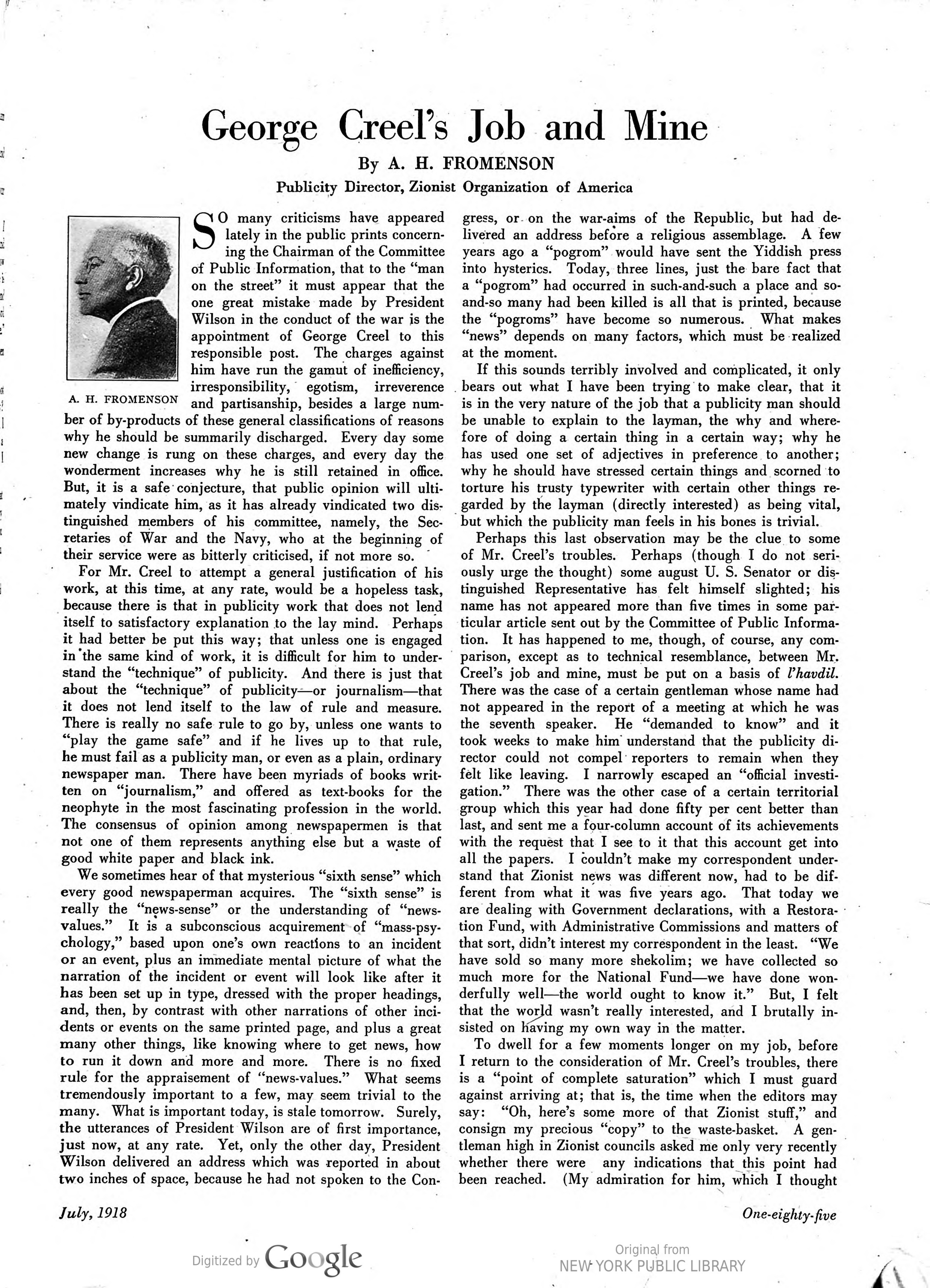
SO many criticisms have appeared lately in the public prints concerning the Chairman of the Committee of Public Information, that to the "man on the street" it must appear that the one great mistake made by President Wilson in the conduct of the war is the appointment of George Creel to this responsible post. The charges against him have run the gamut of inefficiency, irresponsibility, egotism, irreverence A. H. FROMENSON and partisanship, besides a large number of by-products of these general classifications of reasons why he should be summarily discharged. Every day some new change is rung on these charges, and every day the wonderment increases why he is still retained in office. But, it is a safe conjecture, that public opinion will ultimately vindicate him, as it has already vindicated two distinguished members of his committee, namely, the Secretaries of War and the Navy, who at the beginning of their service were as bitterly criticised, if not more so.
For Mr. Creel to attempt a general justification of his work, at this time, at any rate, would be a hopeless task, because there is that in publicity work that does not lend itself to satisfactory explanation to the lay mind. Perhaps it had better be put this way; that unless one is engaged inthe same kind of work, it is difficult for him to understand the “technique” of publicity. And there is just that about the “technique” of publicity—or journalism—that it does not lend itself to the law of rule and measure. There is really no safe rule to go by, unless one wants to “play the game safe” and if he lives up to that rule, he must fail as a publicity man, or even as a plain, ordinary newspaper man. There have been myriads of books written on “journalism,” and offered as text-books for the neophyte in the most fascinating profession in the world. The consensus of opinion among newspapermen is that not one of them represents anything else but a waste of good white paper and black ink.
We sometimes hear of that mysterious “sixth sense” which every good newspaperman acquires. The “sixth sense” is really the “news-sense” or the understanding of “news- values.” It is a subconscious acquirement of “mass-psychology,” based upon one’s own reactions to an incident or an event, plus an immediate mental picture of what the narration of the incident or event will look like after it has been set up in type, dressed with the proper headings, and, then, by contrast with other narrations of other incidents or events on the same printed page, and plus a great many other things, like knowing where to get news, how to run it down and more and more. There is no fixed rule for the appraisement of ‘“‘news-values.” What seems tremendously important to a few, may seem trivial to the many. What is important today, is stale tomorrow. Surely, the utterances of President Wilson are of first importance, just now, at any rate. Yet, only the other day, President Wilson delivered an address which was reported in about two inches of space, because he had not spoken to the Con-
Publicity Director, Zionist Organization of America
gress, or on the war-aims of the Republic, but had delivered an address before a religious assemblage. A few years ago a "pogrom" would have sent the Yiddish press into hysterics. Today, three lines, just the bare fact that a "pogrom" had occurred in such-and-such a place and so-and-so many had been killed is all that is printed, because the "pogroms" have become so numerous. What makes "news" depends on many factors, which must be realized at the moment.
If this sounds terribly involved and complicated, it only bears out what I have been trying to make clear, that it is in the very nature of the job that a publicity man should be unable to explain to the layman, the why and wherefore of doing a certain thing in a certain way; why he has used one set of adjectives in preference to another; why he should have stressed certain things and scorned to torture his trusty typewriter with certain other things regarded by the layman (directly interested) as being vital, but which the publicity man feels in his bones is trivial.
Perhaps this last observation may be the clue to some of Mr. Creel’s troubles. Perhaps (though I do not seriously urge the thought) some august U. S. Senator or distinguished Representative has felt himself slighted; his name has not appeared more than five times in some particular article sent out by the Committee of Public Information. It has happened to me, though, of course, any comparison, except as to technical resemblance, between Mr. Creel’s job and mine, must be put on a basis 0] 1. There was the case of a certain gentleman whose name had not appeared in the report of a meeting at which he was the seventh speaker. He “demanded to know” and it took weeks to make him understand that the publicity director could not compel’ reporters to remain when they felt like leaving. I narrowly escaped an “official investigation.” There was the other case of a certain territorial group which this year had done fifty per cent better than last, and sent me a four-column account of its achievements with the request that I see to it that this account get into all the papers. I couldn’t make my correspondent understand that Zionist news was different now, had to be different from what it was five years ago. That today we are dealing with Government declarations, with a Restora- - tion Fund, with Administrative Commissions and matters of that sort, didn’t interest my corréspondent in the least. “We have sold so many more shekolim; we have collected so much more for the National Fund—we have done wonderfully well—the world ought to know it.” But, I felt that the world wasn’t really interested, and I brutally insisted on Having my own way in the matter.