The Maccabaean
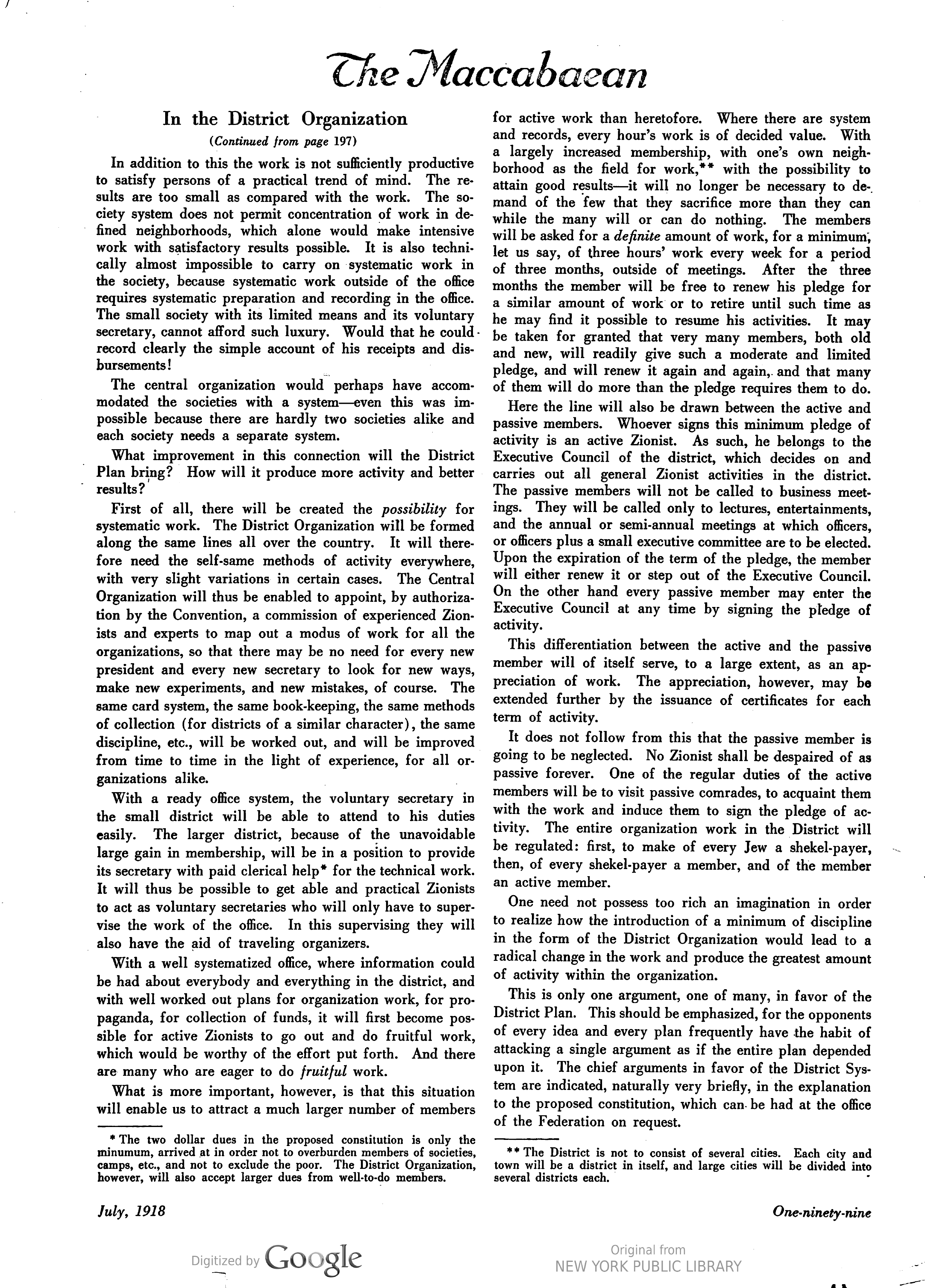
In the District Organization
(Continued from page 197)
In addition to this the work is not sufficiently productive to satisfy persons of a practical trend of mind. The results are too small as compared with the work. The society system does not permit concentration of work in defined neighborhoods, which alone would make intensive work with satisfactory results possible. It is also technically almost impossible to carry on systematic work in the society, because systematic work outside of the office requires systematic preparation and recording in the office. The small society with its limited means and its voluntary secretary, cannot afford such luxury. Would that he could record clearly the simple account of his receipts and disbursements!
The central organization would perhaps have accommodated the societies with a system—even this was impossible because there are hardly two societies alike and each society needs a separate system.
What improvement in this connection will the District Plan bring? How will it produce more activity and better results?
First of all, there will be created the possibility for systematic work. The District Organization will be formed along the same lines all over the country. It will therefore need the self-same methods of activity everywhere, with very slight variations in certain cases. The Central Organization will thus be enabled to appoint, by authorization by the Convention, a commission of experienced Zionists and experts to map out a modus of work for all the organizations, so that there may be no need for every new president and every new secretary to look for new ways, make new experiments, and new mistakes, of course. The same card system, the same bookkeeping, the same methods of collection (for districts of a similar character), the same discipline, etc., will be worked out, and will be improved from time to time in the light of experience, for all organizations alike.
With a ready office system, the voluntary secretary in the small district will be able to attend to his duties easily. The larger district, because of the unavoidable large gain in membership, will be in a position to provide its secretary with paid clerical help* for the technical work. It will thus be possible to get able and practical Zionists to act as voluntary secretaries who will only have to supervise the work of the office. In this supervising they will also have the aid of traveling organizers.
With a well systematized office, where information could be had about everybody and everything in the district, and with well worked out plans for organization work, for propaganda, for collection of funds, it will first become possible for active Zionists to go out and do fruitful work, which would be worthy of the effort put forth. And there are many who are eager to do fruitful work.
What is more important, however, is that this situation will enable us to attract a much larger number of members
for active work than heretofore. Where there are system and records, every hour’s work is of decided value. With a largely increased membership, with one’s own neighborhood as the field for work,** with the possibility to attain good results—it will no longer be necessary to 6- mand of the few that they sacrifice more than they can while the many will or can do nothing. The members will be asked for a definite amount of work, for a minimum, let us say, of three hours’ work every week for a period of three months, outside of meetings. After the three months the member will be free to renew his pledge for a similar amount of work or to retire until such time as he may find it possible to resume his activities. It may be taken for granted that very many members, both old and new, will readily give such a moderate and limited pledge, and will renew it again and again,. and that many of them will do more than the nledse reaniree them ta da
Here the line will also be drawn between the active and passive members. Whoever signs this minimum pledge of activity is an active Zionist. As such, he belongs to the Executive Council of the district, which decides on and carries out all general Zionist activities in the district. The passive members will not be called to business meetings. They will be called only to lectures, entertainments, and the annual or semi-annual meetings at which officers, or officers plus a small executive committee are to be elected. Upon the expiration of the term of the pledge, the member will either renew it or step out of the Executive Council. On the other hand every passive member may enter the Executive Council at any time by signing the pledge of activity.
This differentiation between the active and the passive member will of itself serve, to a large extent, as an appreciation of work. The appreciation, however, may be extended further by the issuance of certificates for each term of activity.
It does not follow from this that the passive member is going to be neglected. No Zionist shall be despaired of as passive forever. One of the regular duties of the active members will be to visit passive comrades, to acquaint them with the work and induce them to sign the pledge of activity. The entire organization work in the District will be regulated: first, to make of every Jew a shekel-payer, then, of every shekel-payer a member, and of the member an active member.
One need not possess too rich an imagination in order to realize how the introduction of a minimum of discipline in the form of the District Organization would lead to a radical change in the work and produce the greatest amount of activity within the organization.
This is only one argument, one of many, in favor of the District Plan. This should be emphasized, for the opponents of every idea and every plan frequently have the habit of attacking a single argument as if the entire plan depended upon it. The chief arguments in favor of the District System are indicated, naturally very briefly, in the explanation to the proposed constitution, which can. 26 had at the office of the Federation on request.
** The District is not to consist of several cities. Each city and town will be a district in itself, and large cities will be divided into several districts each. .