The Pittsburgh Program
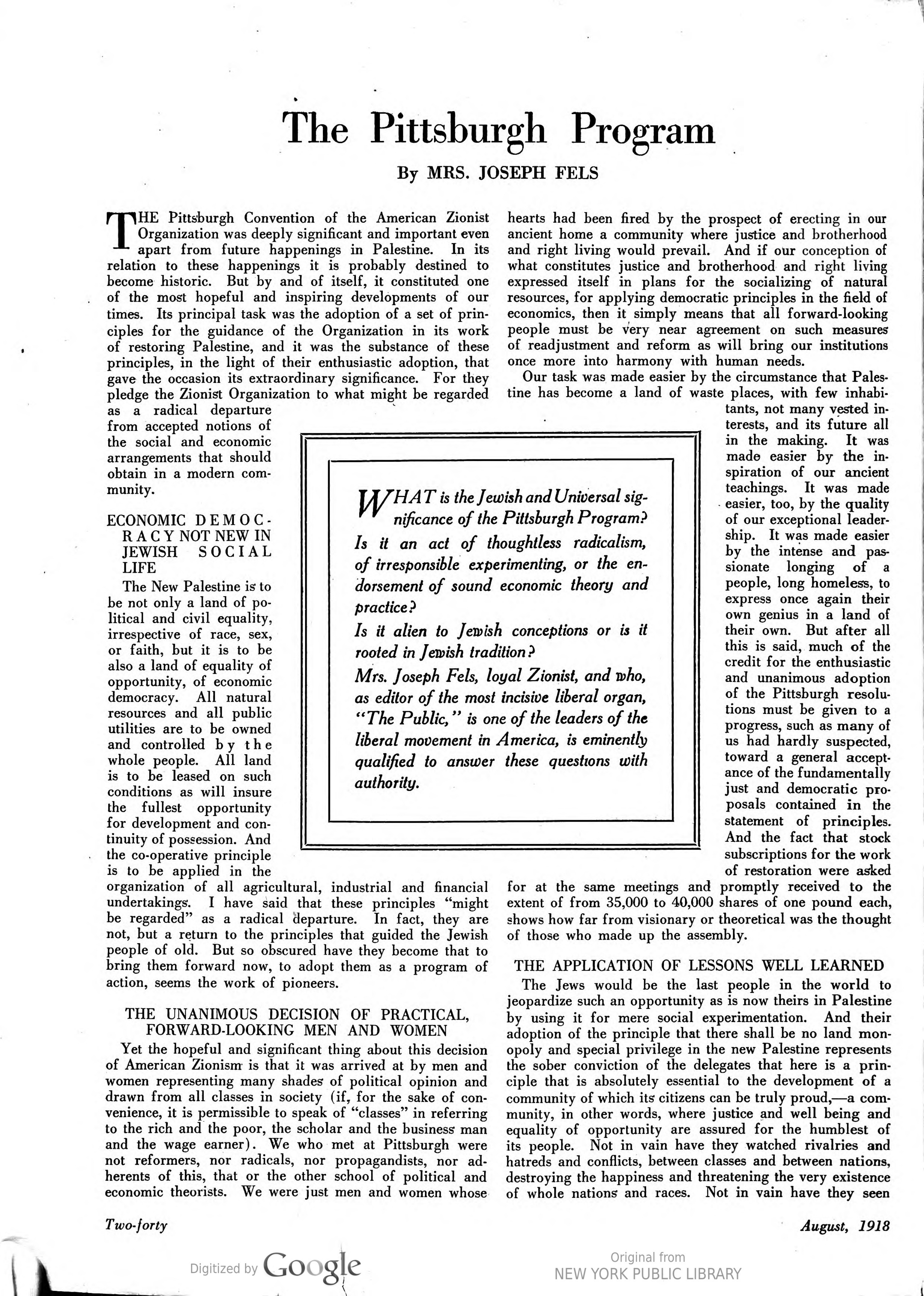
THE Pittsburgh Convention of the American Zionist Organization was deeply significant and important even apart from future happenings in Palestine. In its relation to these happenings it is probably destined to become historic. But by and of itself, it constituted one of the most hopeful and inspiring developments of our times. Its principal task was the adoption of a set of principles for the guidance of the Organization in its work of restoring Palestine, and it was the substance of these principles, in the light of their enthusiastic adoption, that gave the occasion its extraordinary significance. For they pledge the Zionist Organization to what might be regarded as a radical departure from accepted notions of the social and economic arrangements that should obtain in a modern community.
ECONOMIC DEMOCRACY NOT NEW IN JEWISH SOCIAL LIFE
The New Palestine is to be not only a land of political and civil equality, irrespective of race, sex, or faith, but it is to be also a land of equality of opportunity, of economic democracy. All natural resources and all public utilities are to be owned and controlled by the whole people. All land is to be leased on such conditions as will insure the fullest opportunity for development and continuity of possession. And the co-operative principle is to be applied in the organization of all agricultural, industrial and financial undertakings. I have said that these principles "might be regarded" as a radical departure. In fact, they are not, but a return to the principles that guided the Jewish people of old. But so obscured have they become that to bring them forward now, to adopt them as a program of action, seems the work of pioneers.
THE UNANIMOUS DECISION OF PRACTICAL, FORWARD-LOOKING MEN AND WOMEN
Yet the hopeful and significant thing about this decision of American Zionism is that it was arrived at by men and women representing many shades of political opinion and drawn from all classes in society (if, for the sake of convenience, it is permissible to speak of "classes" in referring to the rich and the poor, the scholar and the business man and the wage earner). We who met at Pittsburgh were not reformers, nor radicals, nor propagandists, nor adherents of this, that or the other school of political and economic theorists. We were just men and women whose
hearts had been fired by the prospect of erecting in our ancient home a community where justice and brotherhood and right living would prevail. And if our conception of what constitutes justice and brotherhood and right living expressed itself in plans for the socializing of natural resources, for applying democratic principles in the field of economics, then it simply means that all forward-looking people must be very near agreement on such measures of readjustment and reform as will bring our institutions once more into harmony with human needs.
Our task was made easier by the circumstance that Palestine has become a land of waste places, with few inhabitants, not many vested interests, and its future all in the making. It was made easier by the inspiration of our ancient teachings. It was made easier, too, by the quality of our exceptional leadership. It was made easier by the intense and passionate longing of a people, long homeless, to express once again their own genius in a land of their own. But after all this is said, much of the credit for the enthusiastic and unanimous adoption of the Pittsburgh resolutions must be given to a progress, such as many of us had hardly suspected, toward a general acceptance of the fundamentally just and democratic proposals contained in the statement of principles. And the fact that stock subscriptions for the work of restoration were asked
for at the same meetings and promptly received to the extent of from 35,000 to 40,000 shares of one pound each, shows how far from visionary or theoretical was the thought of those who made up the assembly.
THE APPLICATION OF LESSONS WELL LEARNED
The Jews would be the last people in the world to jeopardize such an opportunity as is now theirs in Palestine by using it for mere social experimentation. And their adoption of the principle that there shall be no land monopoly and special privilege in the new Palestine represents the sober conviction of the delegates that here is a principle that is absolutely essential to the development of a community of which its citizens can be truly proud,—a community, in other words, where justice and well being and equality of opportunity are assured for the humblest of its people. Not in vain have they watched rivalries and hatreds and conflicts, between classes and between nations, destroying the happiness and threatening the very existence of whole nations and races. Not in vain have they seen