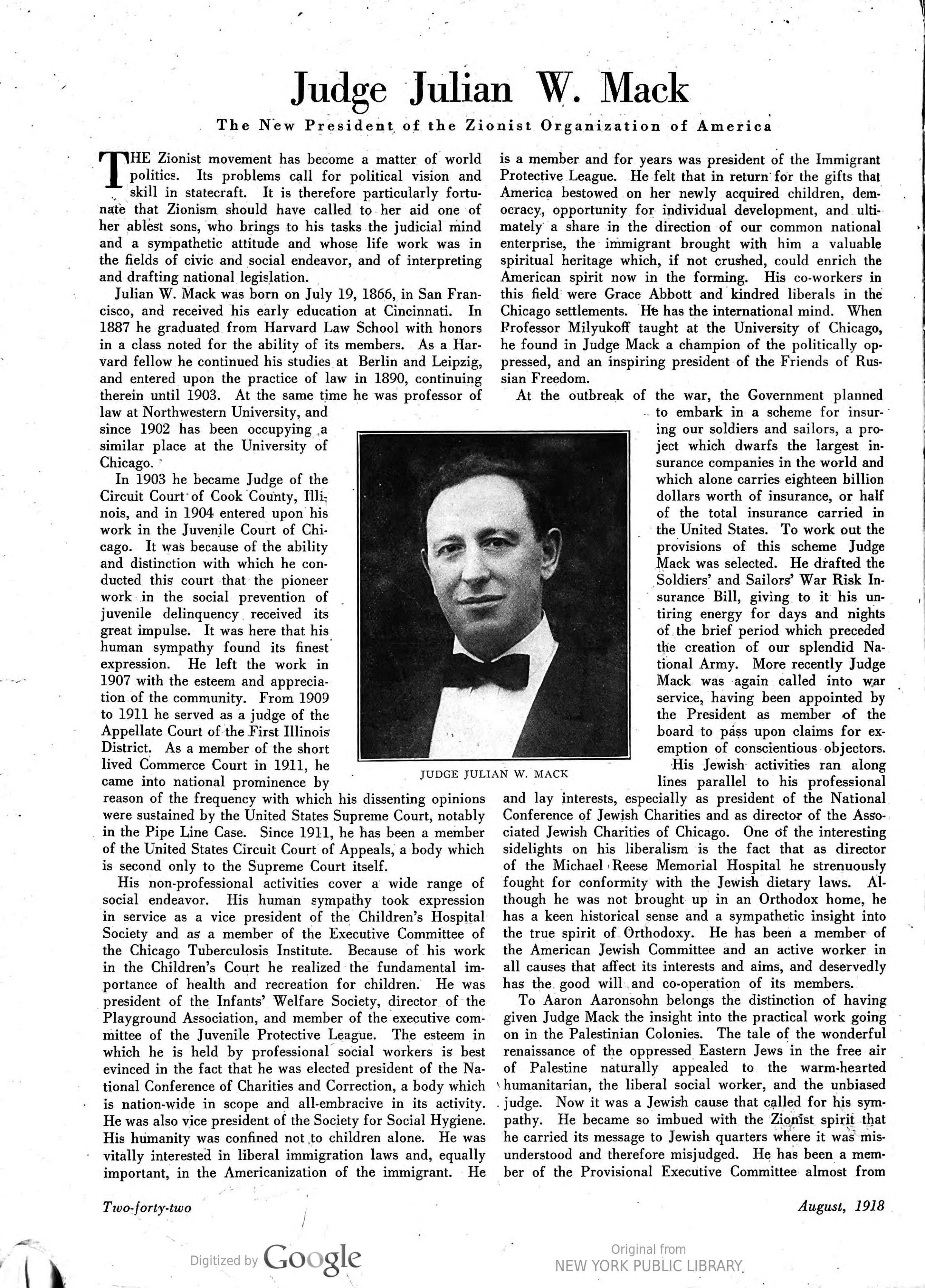
Judge Julian W. Mack
The New President of the Zionist Organization of America
THE Zionist movement has become a matter of world politics. Its problems call for political vision and skill in statecraft. It is therefore particularly fortunate that Zionism should have called to her aid one of her ablest sons, who brings to his tasks the judicial mind and a sympathetic attitude and whose life work was in the fields of civic and social endeavor, and of interpreting and drafting national legislation.
Julian W. Mack was born on July 19, 1866, in San Francisco, and received his early education at Cincinnati. In 1887 he graduated from Harvard Law School with honors in a class noted for the ability of its members. As a Harvard fellow he continued his studies at Berlin and Leipzig, and entered upon the practice of law in 1890, continuing therein until 1903. At the same time he was professor of law at Northwestern University, and since 1902 has been occupying a similar place at the University of Chicago.
In 1903 he became Judge of the Circuit Court of Cook County, Illi- nois, and in 1904 entered upon his work in the Juvenile Court of Chicago. It was because of the ability and distinction with which he conducted this court that the pioneer work in the social prevention of juvenile delinquency received its great impulse. It was here that his human sympathy found its finest expression. He left the work in 1907 with the esteem and appreciation of the community. From 1909 to 1911 he served as a judge of the Appellate Court of the First Illinois District. As a member of the short lived Commerce Court in 1911, he came into national prominence by reason of the frequency with which his dissenting opinions were sustained by the United States Supreme Court, notably in the Pipe Line Case. Since 1911, he has been a member of the United States Circuit Court of Appeals, a body which is second only to the Supreme Court itself.
His non-professional activities cover a wide range of social endeavor. His human sympathy took expression in service as a vice president of the Children’s Hospital Society and as a member of the Executive Committee of the Chicago Tuberculosis Institute. Because of his work in the Children’s Court he realized the fundamental importance of health and recreation for children. He was president of the Infants’ Welfare Society, director of the Playground Association, and member of the executive committee of the Juvenile Protective League. The esteem in which he is held by professional social workers is best evinced in the fact that he was elected president of the National Conference of Charities and Correction, a body which is nation-wide in scope and all-embracive in its activity. He was also vice president of the Society for Social Hygiene. His humanity was confined not 10 children alone. He was vitally interested in liberal immigration laws and, equally important, in the Americanization of the immigrant. He
is a member and for years was president of the Immigrant Protective League. He felt that in return for the gifts that America bestowed on her newly acquired children, democracy, opportunity for individual development, and _ultimately a share in the direction of our common national enterprise, the immigrant brought with him a valuable spiritual heritage which, if not crushed, could enrich the American spirit now in the forming. His co-workers in this field’ were Grace Abbott and kindred liberals in the Chicago settlements. 116 has the international mind. When Professor Milyukoff taught at the University of Chicago, he found in Judge Mack a champion of the politically oppressed, and an inspiring president of the Friends of Russian Freedom.
At the outbreak of the war, the Government planned to embark in a scheme for insuring our soldiers and sailors, a project which dwarfs the largest insurance companies in the world and which alone carries eighteen billion dollars worth of insurance, or half of the total insurance carried in the United States. To work out the provisions of this scheme Judge Mack was selected. He drafted the Soldiers’ and Sailors’ War Risk Insurance Bill, giving to it his untiring energy for days and nights of the brief period which preceded the creation of our splendid National Army. More recently Judge Mack was again called into war service, having been appointed by the President as member of the board to pass upon claims for exemption of conscientious objectors.
Stet His Jewish activities ran along AN W. MACK / : . lines parallel to his professional and lay interests, especially as president of the National Conference of Jewish Charities and as director of the Associated Jewish Charities of Chicago. One of the interesting sidelights on his liberalism is the fact that as director of the Michael: Reese Memorial Hospital he strenuously fought for conformity with the Jewish dietary laws. 1 though he was not brought up in an Orthodox home, he has a keen historical sense and a sympathetic insight into the true spirit of Orthodoxy. He has been a member of the American Jewish Committee and an active worker in all causes that affect its interests and aims, and deservedly has the. good will:.and co-operation of its members.
To Aaron Aaronsohn belongs the distinction of having given Judge Mack the insight into the practical work going on in the Palestinian Colonies. The tale of the wonderful renaissance of the oppressed Eastern Jews in the free air of Palestine naturally appealed to the warm-hearted ‘humanitarian, the liberal social worker, and the unbiased . judge. Now it was a Jewish cause that called for his sympathy. He became so imbued with the Zionist spirit that he carried its message to Jewish quarters where it was misunderstood and therefore misjudged. He has been a member of the Provisional Executive Committee almost from