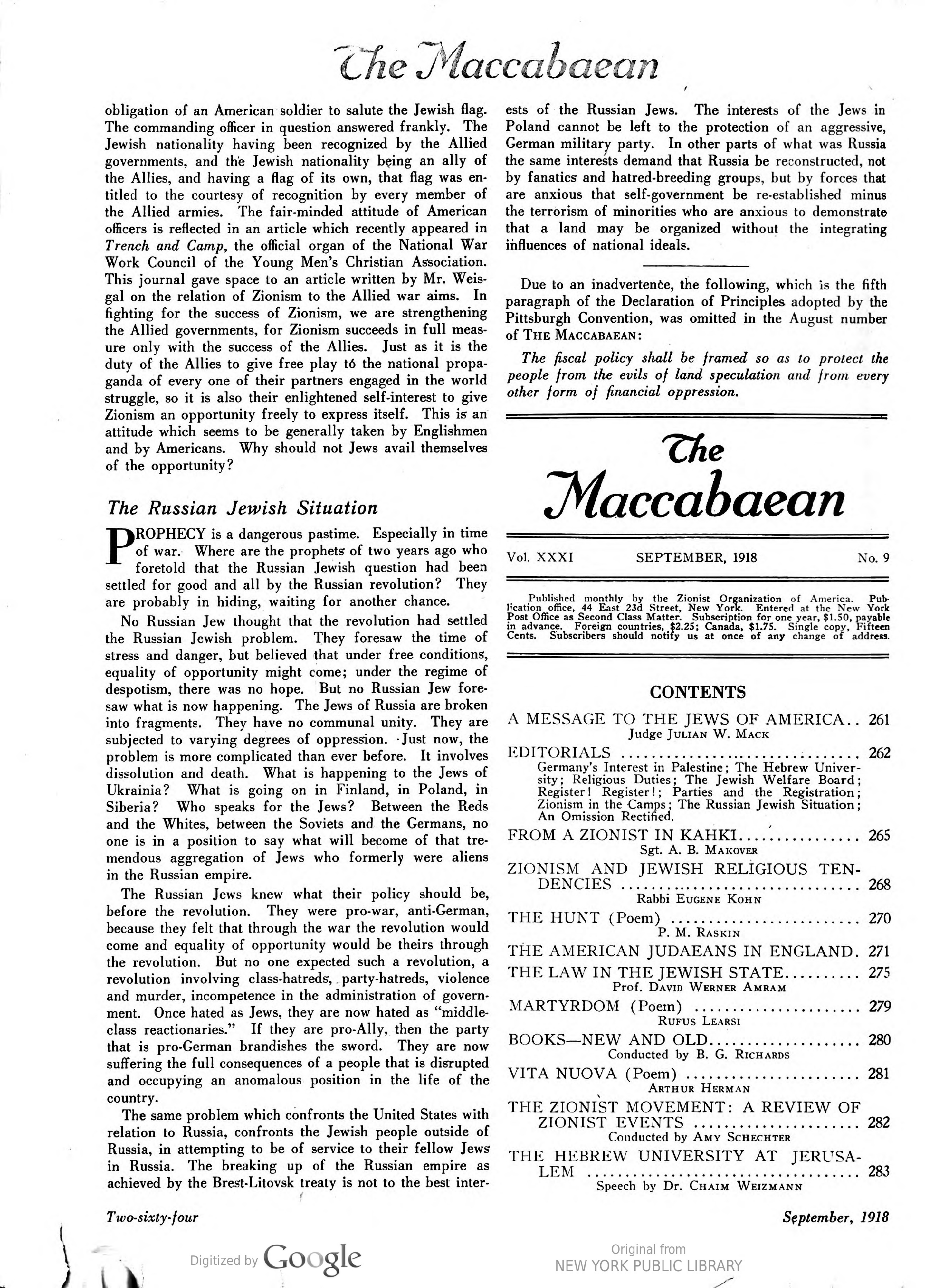
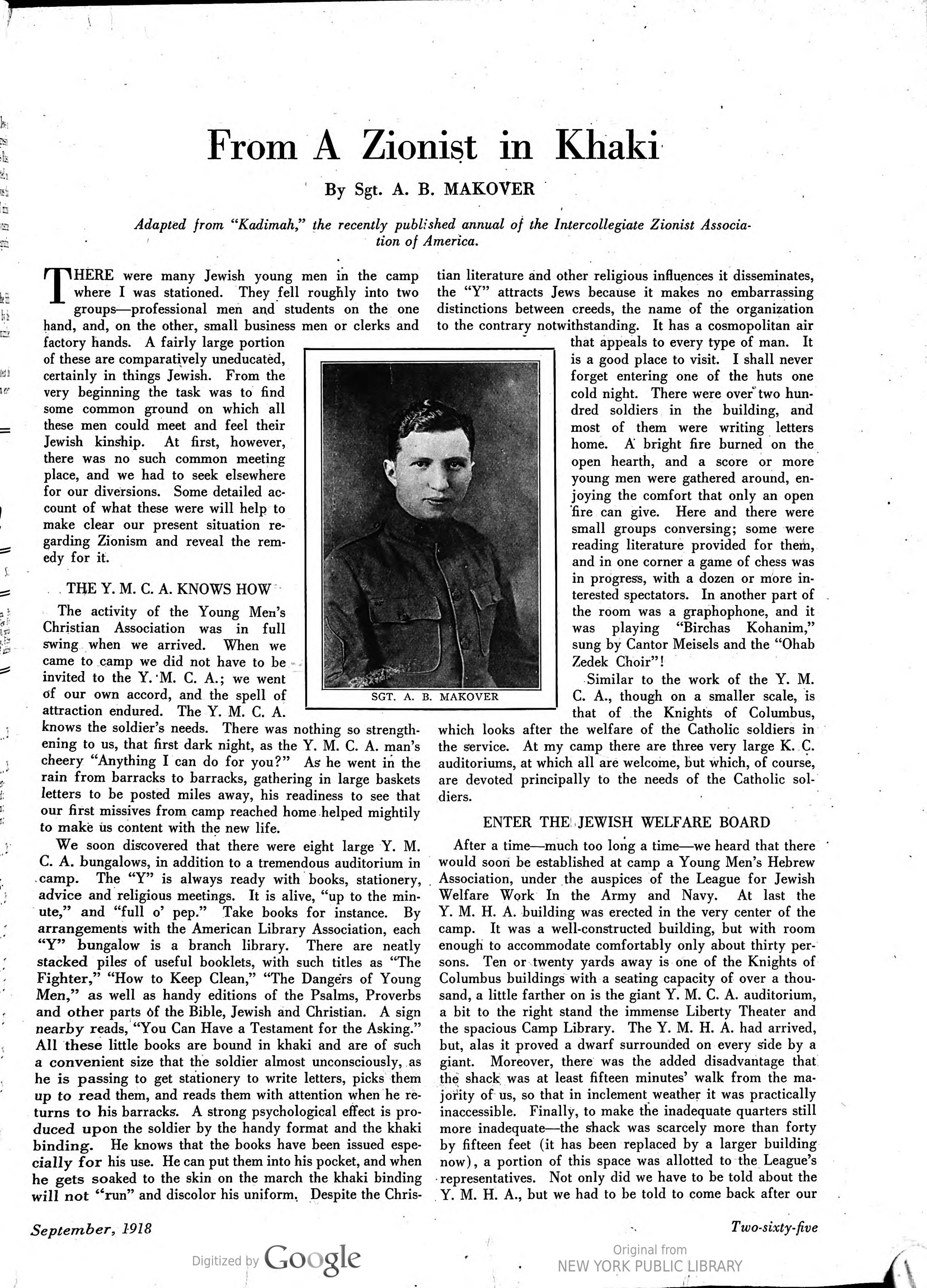
From A Zionist in Khaki
Adapted from "Kadimah," the recently published annual of the Intercollegiate Zionist Association of America.
THERE were many Jewish young men in the camp where I was stationed. They fell roughly into two groups —professional men and students on the one hand, and, on the other, small business men or clerks and factory hands. A fairly large portion of these are comparatively uneducated, certainly in things Jewish. From the very beginning the task was to find some common ground on which all these men could meet and feel their Jewish kinship. At first, however, there was no such common meeting place, and we had to seek elsewhere for our diversions. Some detailed account of what these were will help to make clear our present situation regarding Zionism and reveal the remedy for it.
THE Y. M. C. A. KNOWS HOW
The activity of the Young Men’s Christian Association was in full swing when we arrived. When we came to camp we did not have to be invited to the Y. M. C. A.; we went of our own accord, and the spell of attraction endured. The Y. M. C. A. knows the soldier’s needs. There was nothing so strengthening to us, that first dark night, as the Y. M. C. A. man’s cheery “Anything I can do for you?” As he went in the rain from barracks to barracks, gathering in large baskets letters to be posted miles away, his readiness to see that our first missives from camp reached home helped mightily to make us content with the new life.
We soon discovered that there were eight large Y. M. C. A. bungalows, in addition to a tremendous auditorium in -camp. The “Y” is always ready with books, stationery, advice and religious meetings. It is alive, “up to the minute,” and “full 0' pep.” Take books for instance. By arrangements with the American Library Association, each “Y” bungalow is a branch library. There are neatly stacked piles of useful booklets, with such titles as “The Fighter,” “How to Keep Clean,” “The Dangers of Young Men,” as well as handy editions of the Psalms, Proverbs and other parts of the Bible, Jewish and Christian. A sign nearby reads, “You Can Have a Testament for the Asking.” All these little books are bound in khaki and are of such a convenient size that the soldier almost unconsciously, .as he is passing to get stationery to write letters, picks them up to read them, and reads them with attention when he returns to his barracks. A strong psychological effect is produced upon the soldier by the handy format and the khaki binding. He knows that the books have been issued especially for his use. He can put them into his pocket, and when he gets soaked to the skin on the march the khaki binding will not “‘run” and discolor his uniform, Despite the Chris-
tian literature and other religious influences it disseminates, the “Y” attracts Jews because it makes no embarrassing distinctions between creeds, the name of the organization to the contrary notwithstanding. It has a cosmopolitan air that appeals to every type of man. It is a good place to visit. I shall never forget entering one of the huts one cold night. There were over two hundred soldiers in the building, and most of them were writing letters home. A bright fire burned on the open hearth, and a score or more young men were gathered around, enjoying the comfort that only an open fire can give. Here and there were small groups conversing; some were reading literature provided for them, and in one corner a game of chess was in progress, with a dozen or more interested spectators. In another part of the room was a graphophone, and it was playing “Birchas Kohanim,” sung by Cantor Meisels and the “Ohab Zedek Choir”!
Similar to the work of the Y. M. C. A., though on a smaller scale, is that of the Knights of Columbus, which looks after the welfare of the Catholic soldiers in the service. At my camp there are three very large K. C. auditoriums, at which all are welcome, but which, of course, are devoted principally to the needs of the Catholic soldiers.
ENTER THE JEWISH WELFARE BOARD
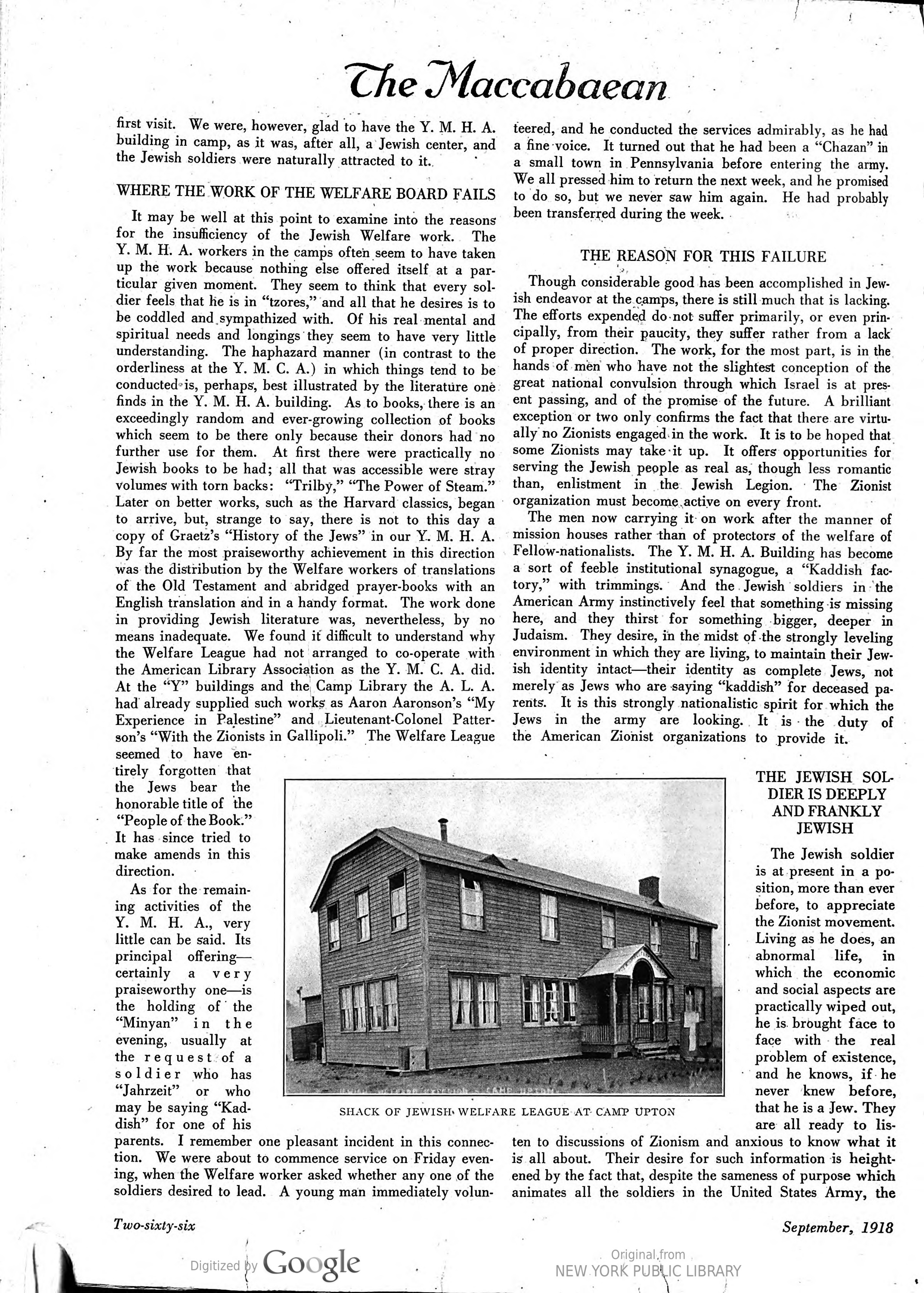
After a time—much too long a time—we heard that there would soon be established at camp a Young Men’s Hebrew Association, under the auspices of the League for Jewish Welfare Work In the Army and Navy. At last the Y. M. H. A. building was erected in the very center of the camp. It was a well-constructed building, but with room enough to accommodate comfortably only about thirty persons. Ten or.twenty yards away is one of the Knights of Columbus buildings with a seating capacity of over a thousand, a little farther on is the giant Y. M. C. A. auditorium, a bit to the right stand the immense Liberty Theater and the spacious Camp Library. The Y. M. H. A. had arrived, but, alas it proved a dwarf surrounded on every side by a giant. Moreover, there was the added disadvantage that the shack was at least fifteen minutes’ walk from the majority of us, so that in inclement weather it was practically inaccessible. Finally, to make the inadequate quarters still more inadequate—the shack was scarcely more than forty by fifteen feet (it has been replaced by a larger building now), a portion of this space was allotted to the League’s -representatives. Not only did we have to be told about the -Y. M. H. A., but we had to be told to come back after our