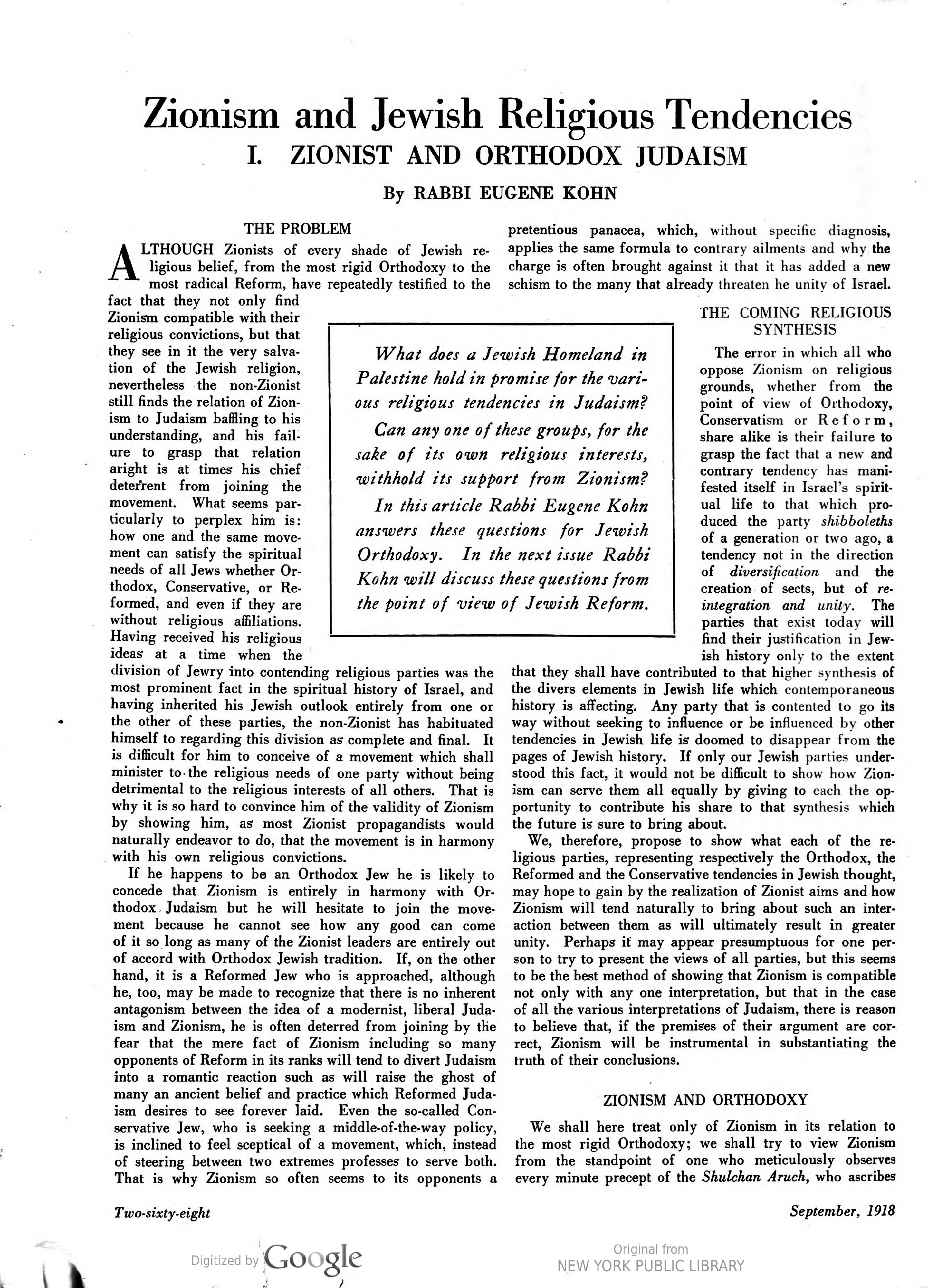
I. ZIONIST AND ORTHODOX JUDAISM
THE PROBLEM
ALTHOUGH Zionists of every shade of Jewish religious belief, from the most rigid Orthodoxy to the most radical Reform, have repeatedly testified to the fact that they not only find Zionism compatible with their religious convictions, but that they see in it the very salvation of the Jewish religion, nevertheless the non-Zionist still finds the relation of Zionism to Judaism baffling to his understanding, and his failure to grasp that relation aright is at times his chief deterrent from joining the movement. What seems particularly to perplex him is: how one and the same movement can satisfy the spiritual needs of all Jews whether Orthodox, Conservative, or Reformed, and even if they are without religious affiliations. Having received his religious ideas at a time when the division of Jewry into contending religious parties was the most prominent fact in the spiritual history of Israel, and having inherited his Jewish outlook entirely from one or the other of these parties, the non-Zionist has habituated himself to regarding this division as complete and final. It is difficult for him to conceive of a movement which shall minister to the religious needs of one party without being detrimental to the religious interests of all others. That is why it is so hard to convince him of the validity of Zionism by showing him, as most Zionist propagandists would naturally endeavor to do, that the movement is in harmony with his own religious convictions.
pretentious panacea, which, without specific diagnosis, applies the same formula to contrary ailments and why the charge is often brought against it that it has added a new schism to the many that already threaten he unity of Israel.
THE COMING RELIGIOUS SYNTHESIS
The error in which all who oppose Zionism on religious grounds, whether from the point of view of Orthodoxy, Conservatism or Reform, share alike is their failure to grasp the fact that a new and contrary tendency has manifested itself in Israel's spiritual life to that which produced the party shibboleths of a generation or two ago, a tendency not in the direction of diversification and the creation of sects, but of reintegration and unity. The parties that exist today will find their justification in Jewish history only to the extent
that they shall have contributed to that higher synthesis of the divers elements in Jewish life which contemporaneous history is affecting. Any party that is contented to go its way without seeking to influence or be influenced by other tendencies in Jewish life is doomed to disappear from the pages of Jewish history. If only our Jewish parties understood this fact, it would not be difficult to show how Zionism can serve them all equally by giving to each the opportunity to contribute his share to that synthesis which the future is sure to bring about.
We, therefore, propose to show what each of the religious parties, representing respectively the Orthodox, the Reformed and the Conservative tendencies in Jewish thought, may hope to gain by the realization of Zionist aims and how Zionism will tend naturally to bring about such an interaction between them as will ultimately result in greater unity. Perhaps it may appear presumptuous for one person to try to present the views of all parties, but this seems to be the best method of showing that Zionism is compatible not only with any one interpretation, but that in the case of all the various interpretations of Judaism, there is reason to believe that, if the premises of their argument are correct, Zionism will be instrumental in substantiating the truth of their conclusions.
ZIONISM AND ORTHODOXY
We shall here treat only of Zionism in its relation to the most rigid Orthodoxy; we shall try to view Zionism from the standpoint of one who meticulously observes every minute precept of the Shulchan Aruch, who ascribes