"We Have Found Water"
מצאנו מים
(Genesis XVI, 32)
An Incident in the Life of the First Pioneers in Rishon-le-Zion
T
THE last days of the month of Ab.
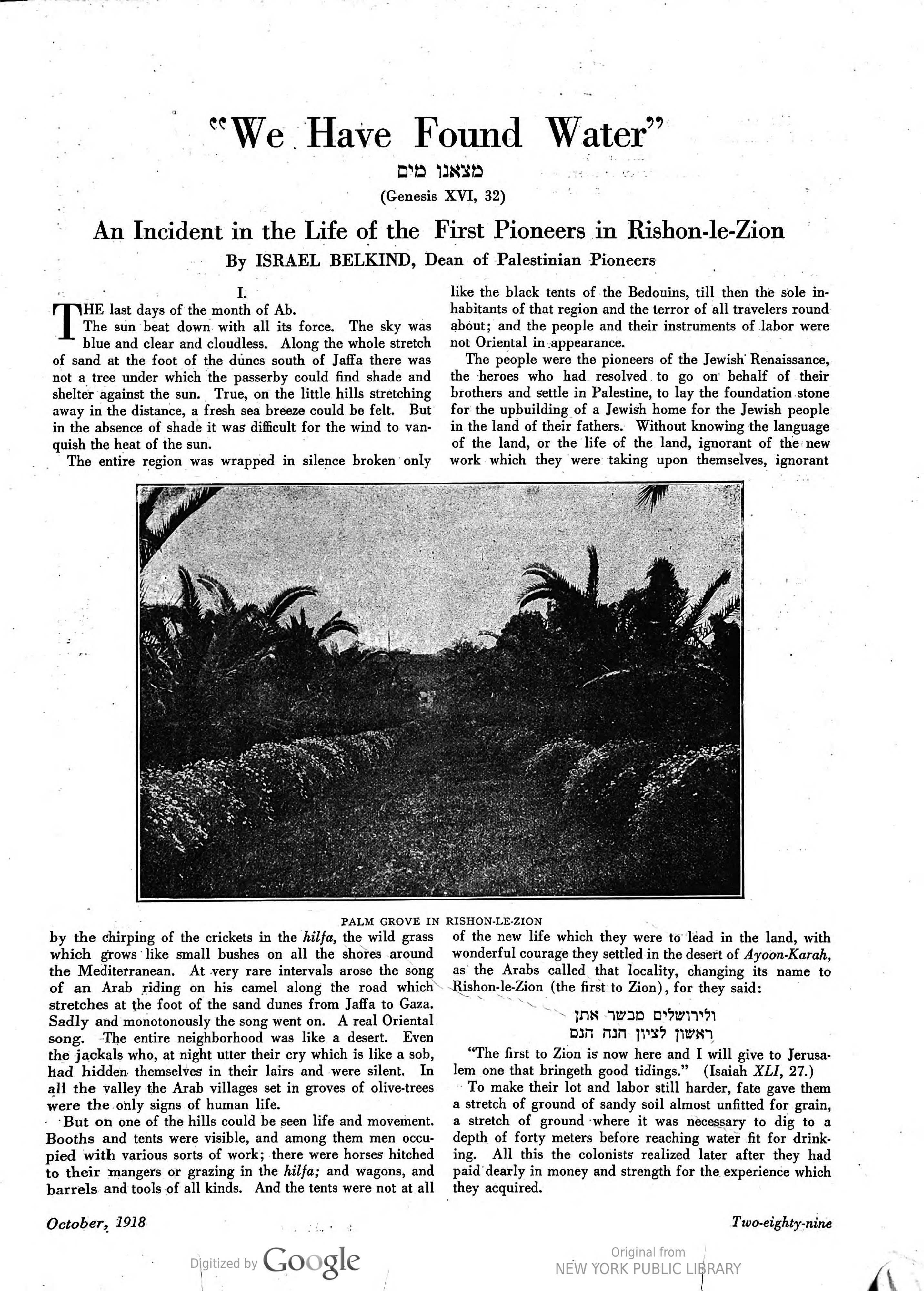
The sun beat down with all its force. The sky was blue and clear and cloudless. Along the whole stretch of sand at the foot of the dunes south of Jaffa there was not a tree under which the passerby could find shade and shelter against the sun. True, on the little hills stretching away in the distance, a fresh sea breeze could be felt. But in the absence of shade it was difficult for the wind to van- quish the heat of the sun.
by the chirping of the crickets in the hilfa, the wild grass which grows like small bushes on all the shores around the Mediterranean. At very rare intervals arose the song of an Arab riding on his camel along the road which stretches at the foot of the sand dunes from Jaffa to Gaza. Sadly and monotonously the song went on. A real Oriental song. -The entire neighborhood was like a desert. Even the jackals who, at night utter their cry which is like a sob, had hidden themselves in their lairs and were silent. In all the valley the Arab villages set in groves of olive-trees were the only signs of human life.
- -But on one of the hills could be seen life and movement. Booths and tents were visible, and among them men occupied with various sorts of work; there were horses hitched to their mangers or grazing in the hilfa; and wagons, and barrels. and tools of all kinds. And the tents were not at all
like the black tents of the Bedouins, till then the sole inhabitants of that region and the terror of all travelers round about; and the people and their instruments of labor were not Oriental in appearance.
The people were the pioneers of the Jewish Renaissance, the heroes who had resolved to go on behalf of their brothers and settle in Palestine, to lay the foundation stone for the upbuilding of a Jewish home for the Jewish people in the land of their fathers. Without knowing the language of the land, or the life of the land, ignorant of the new work which they were taking upon themselves, ignorant
of the new life which they were to lead in the land, with wonderful courage they settled in the desert of Ayoon-Karah, as the Arabs called that locality, changing its name to Rishon-le-Zion (the first to Zion), for they said:
ולירושלים מכשר אתןראשון לציון הנה הנם
“The first to Zion is now here and I will give to Jerusalem one that bringeth good tidings.” (Isaiah XLI, 27.)
- To make their lot and labor still harder, fate gave them a stretch of ground of sandy soil almost unfitted for grain, a stretch of ground ‘where it was necessary to dig to a depth of forty meters before reaching water fit for drinking. All this the colonists realized later after they had paid dearly in money and strength for the experience which they acquired.