The Maccabaean
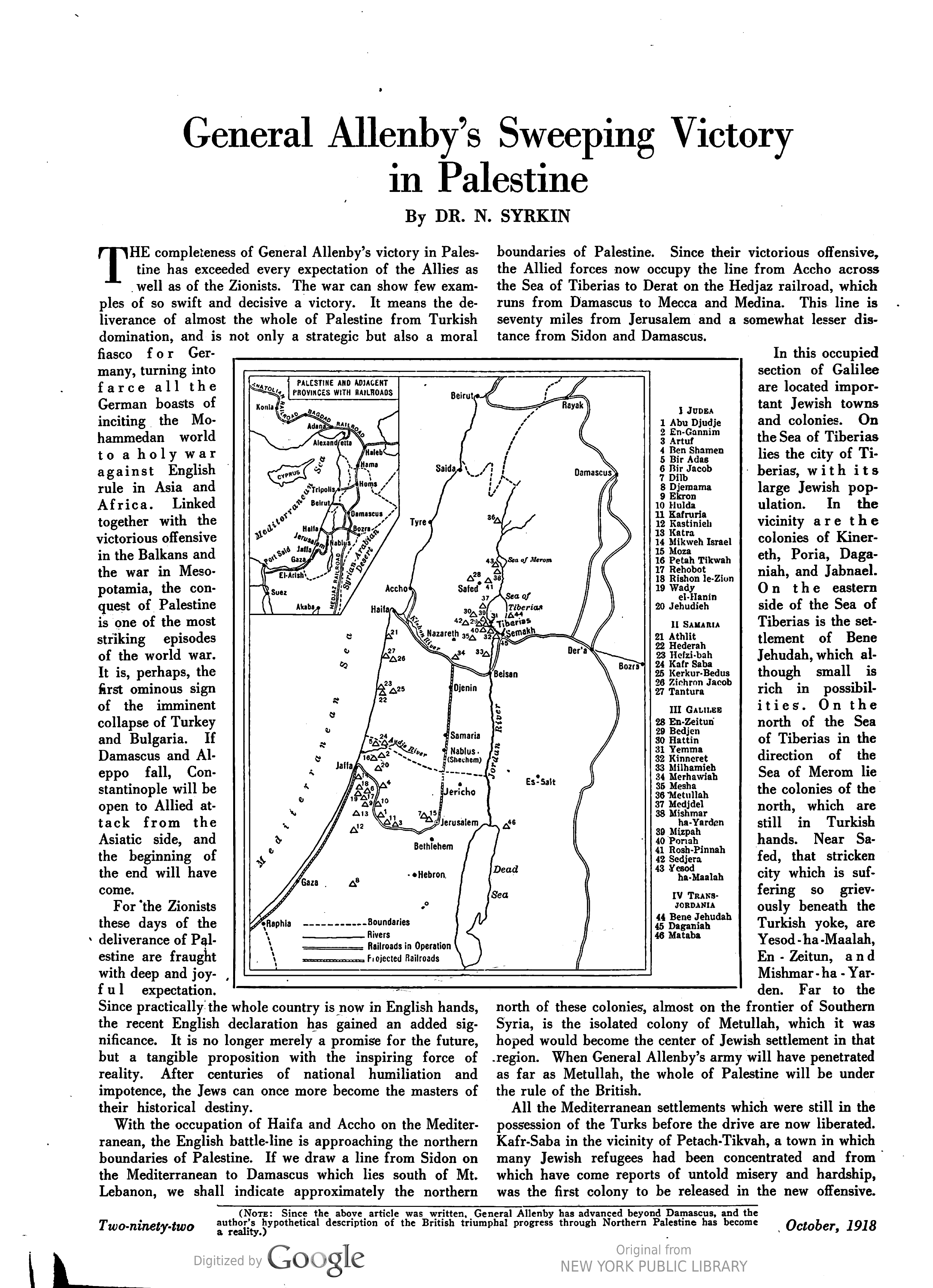
Further up the coast, Hederah, which has always been considered as a future Palestinian port, has been freed, and also the large and important settlement of Zichron-Yaakob, together with the smaller colonies of Hefzi-bah, Kerkur- Bedus, and Tantura; and further still toward Haifa, the colony Atlit. The last points on the Mediterranean to be captured were Haifa and Accho. Haifa is not only a point of great strategic importance and the largest German stronghold in Palestine, around which lie the German colonies of Karmel, Bethlehem, and Umalemuk, but also a center of Jewish culture and enterprise in Palestine. In Haifa is located the Hebrew Polytechnicum about which raged the German-Hebrew language-controversy. At the junction of the Jaffa-Haifa railroad, on the railroad running from Haifa to Beisan, is located the beautiful colony of Merchavia. which is organized on a co-operative basis.
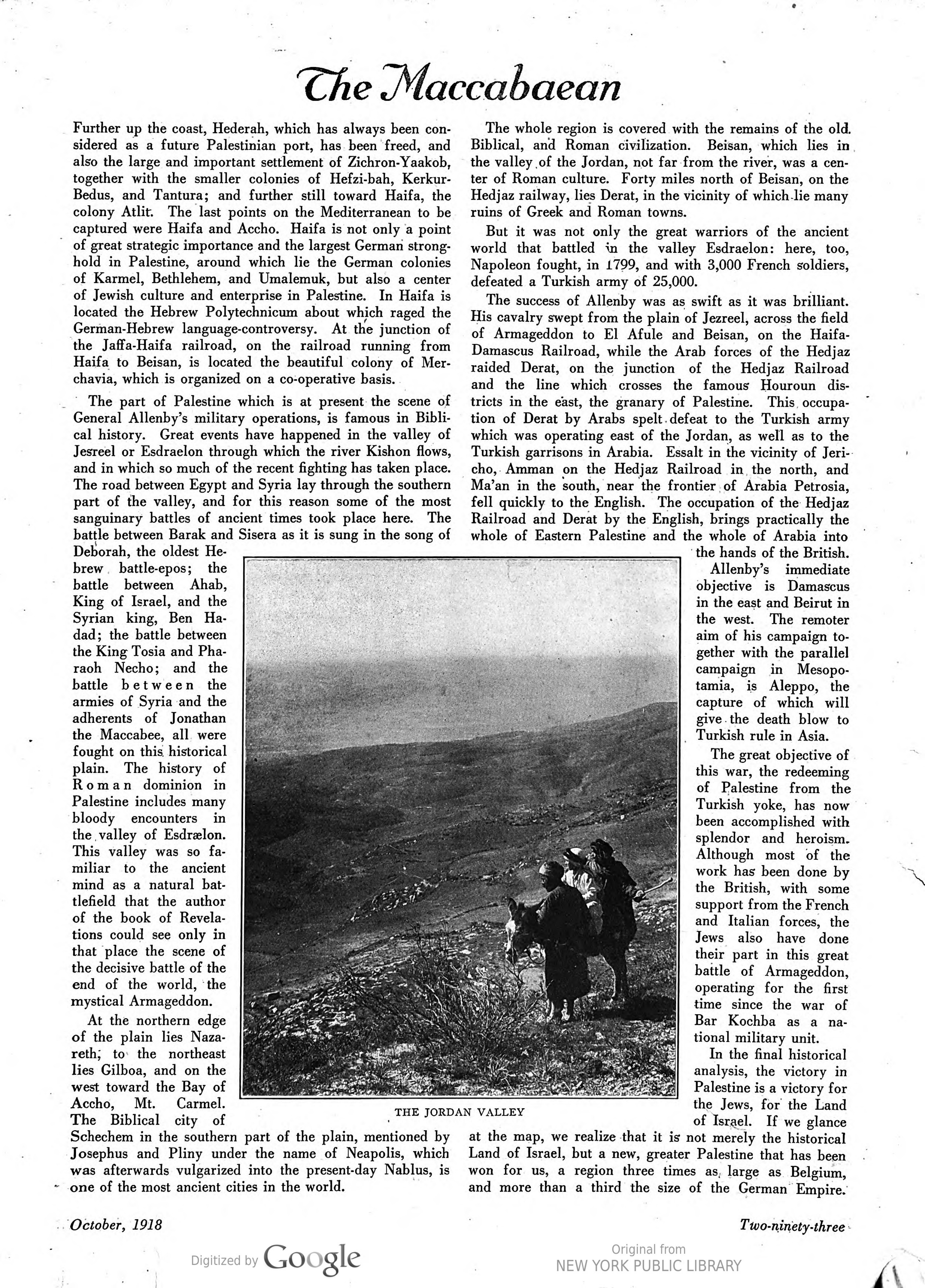
The part of Palestine which is at present the scene of General Allenby's military operations, is famous in Biblical history. Great events have happened in the valley of Jesreel or Esdraelon through which the river Kishon flows, and in which so much of the recent fighting has taken place. The road between Egypt and Syria lay through the southern part of the valley, and for this reason some of the most sanguinary battles of ancient times took place here. The battle between Barak and Sisera as it is sung in the song of Deborah, the oldest Hebrew battle-epos; the battle between Ahab, King of Israel, and the Syrian king, Ben Hadad; the battle between the King Tosia and Pharaoh Necho; and the armies of Syria and the adherents of Jonathan the Maccabee, all were fought on this historical plain. The history of Roman dominion in Palestine includes many bloody encounters in the valley of Esdraelon. This valley was so familiar to the ancient mind as a natural battlefield that the author of the book of Revelations could see only in that place the scene of the decisive battle of the end of the world, the mystical Armageddon.
At the northern edge of the plain lies Nazareth; to the northeast lies Gilboa, and on the west toward the Bay of Accho, Mt. Carmel. The Biblical city of Schechem in the southern part of the plain, mentioned by Josephus and Pliny under the name of Neapolis, which was afterwards vulgarized into the present-day Nablus, is one of the most ancient cities in the world.
The whole region is covered with the remains of the old. Biblical, and Roman civilization. Beisan, which lies in the valley of the Jordan, not far from the river, was a center of Roman culture. Forty miles north of Beisan, on the Hedjaz railway, lies Derat, in the vicinity of which lie many ruins of Greek and Roman towns.
But it was not only the great warriors of the ancient world that battled in the valley Esdraelon: here, too, Napoleon fought, in 1799, and with 3,000 French soldiers, defeated a Turkish army of 25,000.
The success of Allenby was as swift as it was brilliant. His cavalry swept from the plain of Jezreel, across the field of Armageddon to El Afule and Beisan, on the Haifa-Damascus Railroad, while the Arab forces of the Hedjaz raided Derat, on the junction of the Hedjaz Railroad and the line which crosses the famous Houroun districts in the east, the granary of Palestine. This occupation of Derat by Arabs spelt defeat to the Turkish army which was operating east of the Jordan, as well as to the Turkish garrisons in Arabia. Essalt in the vicinity of Jericho, Amman on the Hedjaz Railroad in the north, and Ma'an in the south, near the frontier of Arabia Petrosia, fell quickly to the English. The occupation of the Hedjaz Railroad and Derat by the English, brings practically the whole of Eastern Palestine and the whole of Arabia into the hands of the British.
Allenby’s immediate objective is Damascus in the east and Beirut in the west. The remoter aim of his campaign together with the parallel campaign in Mesopotamia, is Aleppo, the capture of which will give.the death blow to Turkish rule in Asia.
The great objective of this war, the redeeming of Palestine from the Turkish yoke, has now been accomplished with splendor and _ heroism. Although most of the work has been done by the British, with some support from the French and Italian forces, the Jews also have done their part in this great battle of Armageddon, operating for the first time since the war of Bar Kochba as a national military unit.
In the final historical analysis, the victory in Palestine is a victory for the Jews, for the Land of Israel. If we glance
Land of Israel, but a new, greater Palestine that has been won for us, a region three times as large as Belgium, and more than a third the size of the German Empire.