The Colonies of Liberated Judaea
Notes on a Trip Made by the Zionist Commission Through Some of the Judaean Colonies
AFEW weeks after the Commission's arrival in Palestine, it was my privilege to accompany Dr. Weizmann on a tour through seven colonies of the liberated territory. Our party consisted of Dr. Weizmann, Prof. Sylvain Levi, Mr. Joseph Cowen, Lieut. Samuel and myself.
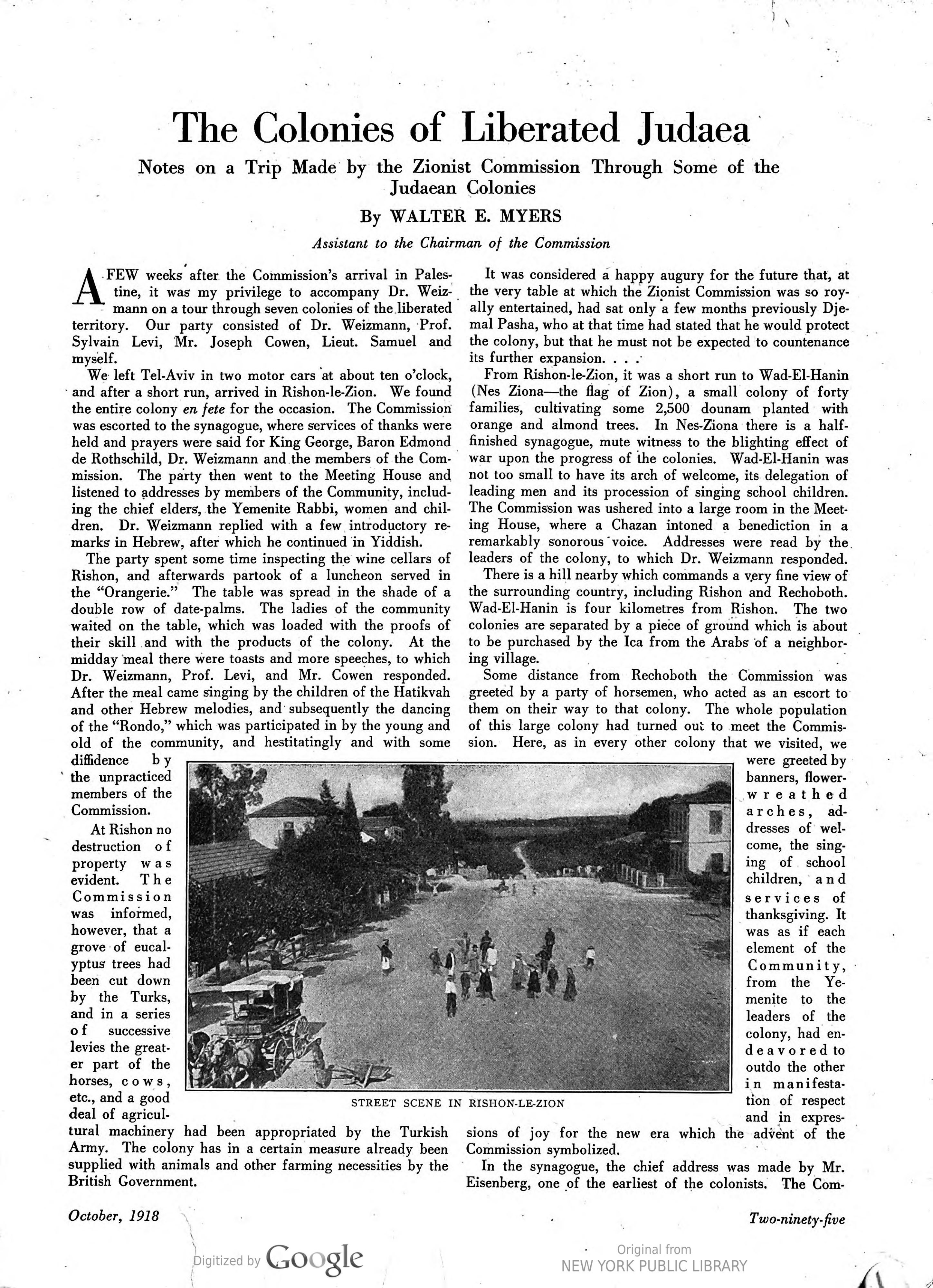
We left Tel-Aviv in two motor cars at about ten o’clock, and after a short run, arrived in Rishon-le-Zion. We found the entire colony en fete for the occasion. The Commission was escorted to the synagogue, where services of thanks were held and prayers were said for King George, Baron Edmond de Rothschild, Dr. Weizmann and the members of the Commission. The party then went to the Meeting House and listened to addresses by members of the Community, including the chief elders, the Yemenite Rabbi, women and children. Dr. Weizmann replied with a few introductory remarks in Hebrew, after which he continued in Yiddish.
The party spent some time inspecting the wine cellars of Rishon, and afterwards partook of a luncheon served in the "Orangerie." The table was spread in the shade of a double row of date-palms. The ladies of the community waited on the table, which was loaded with the proofs of their skill and with the products of the colony. At the midday meal there were toasts and more speeches, to which Dr. Weizmann, Prof. Levi, and Mr. Cowen responded. After the meal came singing by the children of the Hatikvah and other Hebrew melodies, and subsequently the dancing of the "Rondo," which was participated in by the young and old of the community, and hesitatingly and with some diffidence by the unpracticed members of the Commission.
At Rishon no destruction of property was evident. The Commission was informed, however, that a grove of eucalyptus trees had been cut down by the Turks, and in a series of successive levies the greater part of the horses, cows, etc., and a good deal of agricultural machinery Army. The col supplied with a1 British Governn
It was considered a happy augury for the future that, at the very table at which the Zionist Commission was so royally entertained, had sat only a few months previously Djemal Pasha, who at that time had stated that he would protect the colony, but that he must not be expected to countenance its further expansion. . . .
From Rishon-le-Zion, it was a short run to Wad-El-Hanin (Nes Ziona—the flag of Zion), a small colony of forty families, cultivating some 2,500 dounam planted with orange and almond trees. In Nes-Ziona there is a half-finished synagogue, mute witness to the blighting effect of war upon the progress of the colonies. Wad-El-Hanin was not too small to have its arch of welcome, its delegation of leading men and its procession of singing school children. The Commission was ushered into a large room in the Meeting House, where a Chazan intoned a benediction in a remarkably sonorous voice. Addresses were read by the leaders of the colony, to which Dr. Weizmann responded.
There is a hill nearby which commands a very fine view of the surrounding country, including Rishon and Rechoboth. Wad-El-Hanin is four kilometres from Rishon. The two colonies are separated by a piece of ground which is about to be purchased by the Ica from the Arabs of a neighboring village.
Some distance from Rechoboth the Commission was greeted by a party of horsemen, who acted as an escort to them on their way to that colony. The whole population of this large colony had turned out to meet the Commission. Here, as in every other colony that we visited, we
were greeted by banners, flower- wreathed arches, addresses of welcome, the singing of. school children, and services of thanksgiving. It was as if each element of the Community, - from the Yemenite to the leaders of the colony, had endeavored to outdo the other in manifestation of respect and in expres-
sions of joy for the new era which the advent of the Commission symbolized. ; > In the synagogue, the chief address was made by Mr. Eisenberg, one of the earliest of the colonists. The Com-