The Maccabaean
of the entrances to the Harem (temple area) and the surplus flowed into Harem cisterns. The public were allowed to fill their “gas tins” at two wayside brass taps for a nominal charge. It was no improvement of sorts but a mere makeshift. Years before on no less than three occasions offers had come from England to restore—free from all expense —the ancient aqueducts as an act of philanthropy; and at one time, the late Sir Charles (then Captain) Wilson actually made a survey at the expense of the Baroness Burdett-Coutts, for the purpose of carrying out this proposal; but the greed and stupidity of the Turks on each occasion blocked the wav. , \
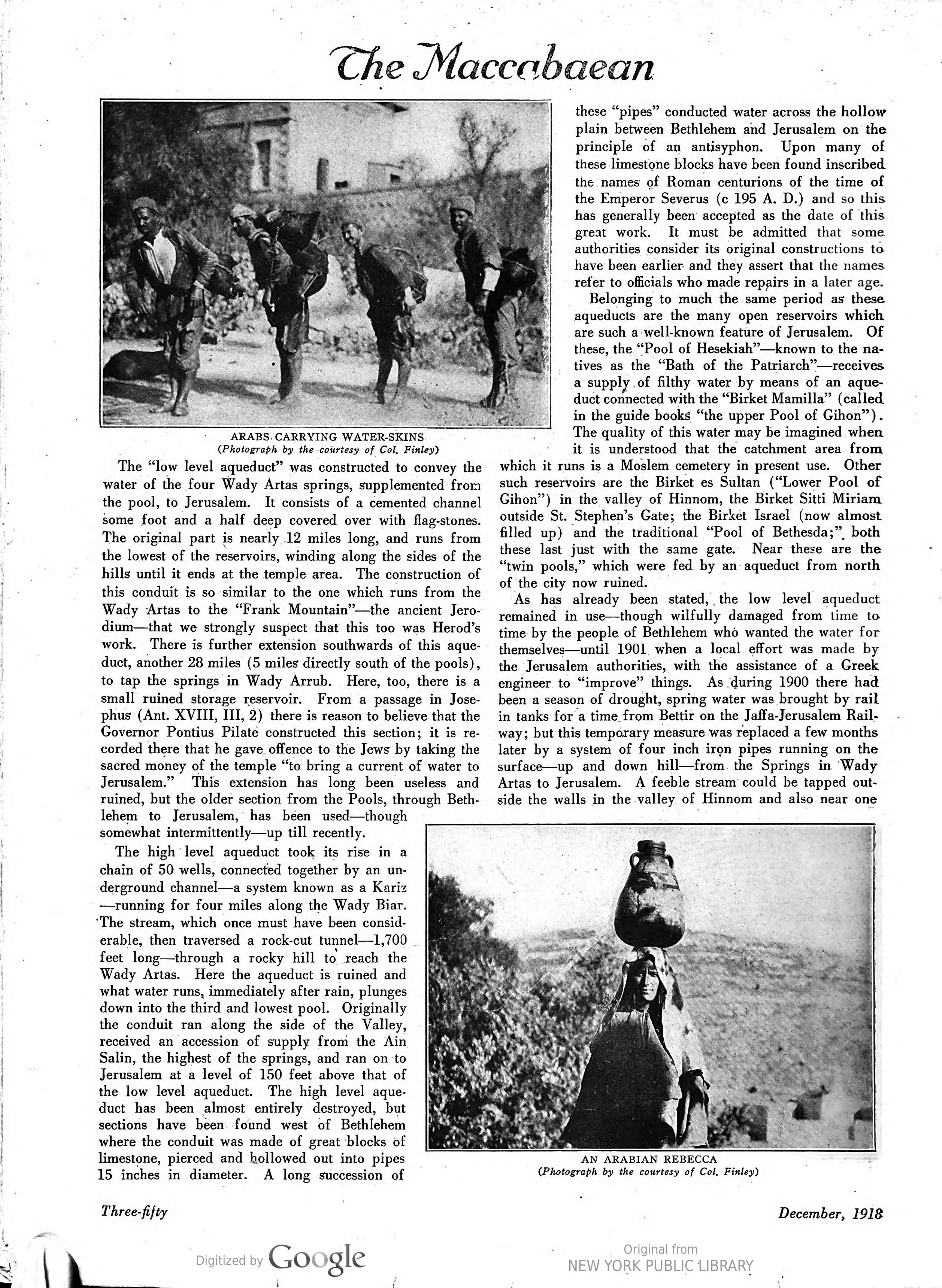
Shortly before the war, the subject again came up; and the local authorities had before them two schemes, one to tap the springs in Wady Arrub and the other to pump up water from the copious fountain “Ain Farah.” At both sources the quality is good, but the Arrub Springs were found to have considerably diminished since the time of Wilson’s survey—due partly to the destruction of timber and shrub over the collecting area, but even more to the constant waste going on through the water running along underground rock-cut channels which had ceased to feed the aqueduct. At that time the present writer saw thousands of gallons of good water running to waste along these ancient constructions. The great advantage of this source lay not only in its excellence and abundance but in the fact that the springs lie over 200 feet above the level of the greater part of Jerusalem, so that a minimum of pumping would have been necessary. The Ain Farah scheme on the other hand would have necessitated pumping the water up over 2,000 feet. However, like so many schemes in Turkey, it ended in talk. The inhabitants of Jerusalem had to continue to depend upon rain-filled cisterns, which in most cases were seldom cleaned and were frequently very foul. The house-cisterns, too, were the greatest cause of the prevalent malaria as they were the breeding places of countless millions of malaria-carrying mosquitoes. Some depended upon the foul sewage contaminated water of Ain ed Daraj or Bir Eyyub, or other water, equally doubtful, carried about in goat skins, and sold in the streets. Some of the more well-to-do actually sent daily for a jar of water from
springs four or five miles off such as Ain Karim for their daily supply for drinking purposes.
gE EEE eee When, therefore, General Allenby’s victorious army entered the Holy City, the question of a water supply was one which was in every way urgent. Through long ages numerous efforts had, as we have shown, been made to supply Jerusalem with the highly-prized gift of fresh and pure water. The chief antiquities around the city bear witness to the great works constructed in the past to give Jerusalem this great gift. The condition of the city, stricken with malaria and dysentery and, at last just before the British entry, with cholera enteric and typhus, all made the claim for pure water for drinking and abundant for cleaning, the most urgent of all sanitary measures. There was no possibility of improved sewers without water to flush them. It is certain that no measure could possibly inaugurate the British military occupation more auspiciously. So what the Turks had failed to do oyer long centuries, officers of our Royal Engineers carried out within two months. They thoroughly investigated the group of springs in the Wady Arrub, used originally by the Romans and found them to yield under proper management no less than 14,000 gallons per hour. Pipes were laid and pumps provided so that the water might reach the highest parts of the new suburbs of the city, and in this short time an abundant supply, ten times that of the previous year, entered the city. The preliminary survey was made in the middle of February, as soon as weather and other conditions permitted and by June 18, the new and abundant supply reached the city. The hospitals and public buildings are supplied direct. Cisterns, when cleane’ to the satisfaction of the sanitary authorities and provided with pumps are filled from tle mains on application to the Governor.
It is the beginning of a new and happier era. Jerusalem in past years has been a hot-bed of disease, for the poor, who make up the great majority of its population. Much remains to be done, but in bringing abundant good water, the foundation of all further sanitary organization has been laid, and unlike many sanitary measures, this health-giving measure cannot but give the highest satisfaction’ to every class of the community and pave the way for popular support for whatever health regulations have yet to be made.
France and the New Palestine
Palestine, the Organ of the British Palestine Committee, comments as follows on the Secret Treaties of 1916-17 and France’s attitude toward the new Palestine.
In the course of an article on General Allenby’s great victory in Palestine, the Temps, whose close connection with the French Foreign Office is well known, writes as follows: “It will then be necessary to give to the populations of Syria and the Lebanon, as also to those of Palestine, the possibility of obtaining their political education. They must be helped and advised and trained to govern themselves. France, who is bound by so many traditions to these countries, will have a part to play in this work of an entirely new character. As early as 1916, on the initiative of London, France and Great Britain came to an understanding on this matter.” The Temps goes on to refer to the secret Treaties of 1916-17 which are now published for the first time in France, and adds: “We are happy to
know that the British Government. fuithfu!l as always to the word it has given, is resolved to apply these engagements to which French opinion attaches so high a value.”
* Let us recall what those engagements are so far as they relate to Palestine. First, Great Britain reserved to herself the ports of Haifa and Acre; secondly, “with a view to guaranteeing the religious interests of the Allied Powers, Palestine and the Holy Places are excluded from Turkish territory, and will be subjected to a special regime in accordance with agreements made between Russia, France, and England.” It will be observed that these secret agreements contemplated the partition of Palestine and took no account sn shaping the destinies of Palestine of Jewish national claims. Since these agreements were made, two vital changes have occurred. Russia, one of the parties to them, has dropped out, and the Allied Governments have formally recognised Jewish claims to Palestine
and made them part of their war aims. It follows that the provisions relating to Palestine are null and void, and we think France would do well to admit the fact forthwith and to limit her concern in the old agreement to Syria. We may add in general that after President Wilson’s formal insistence that the peace settlement must rest on principles and not on bargains, French diplomacy would make a radical blunder in endeavoring to build upon so unhealthy a foundation as the secret treaties. We are all the more confident that that is the real intention of France, because the Temps recognises and insists upon the right of the people of Palestine to become self-governing, and the duty of the Allies to aid them to their utmost in their pilgrimage along the road of self-government. It is plain that the secret agreement neither contemplated such a thing nor is consistent with such a thing, and under no circumstances will the Jewish people submit to a partition of its land.