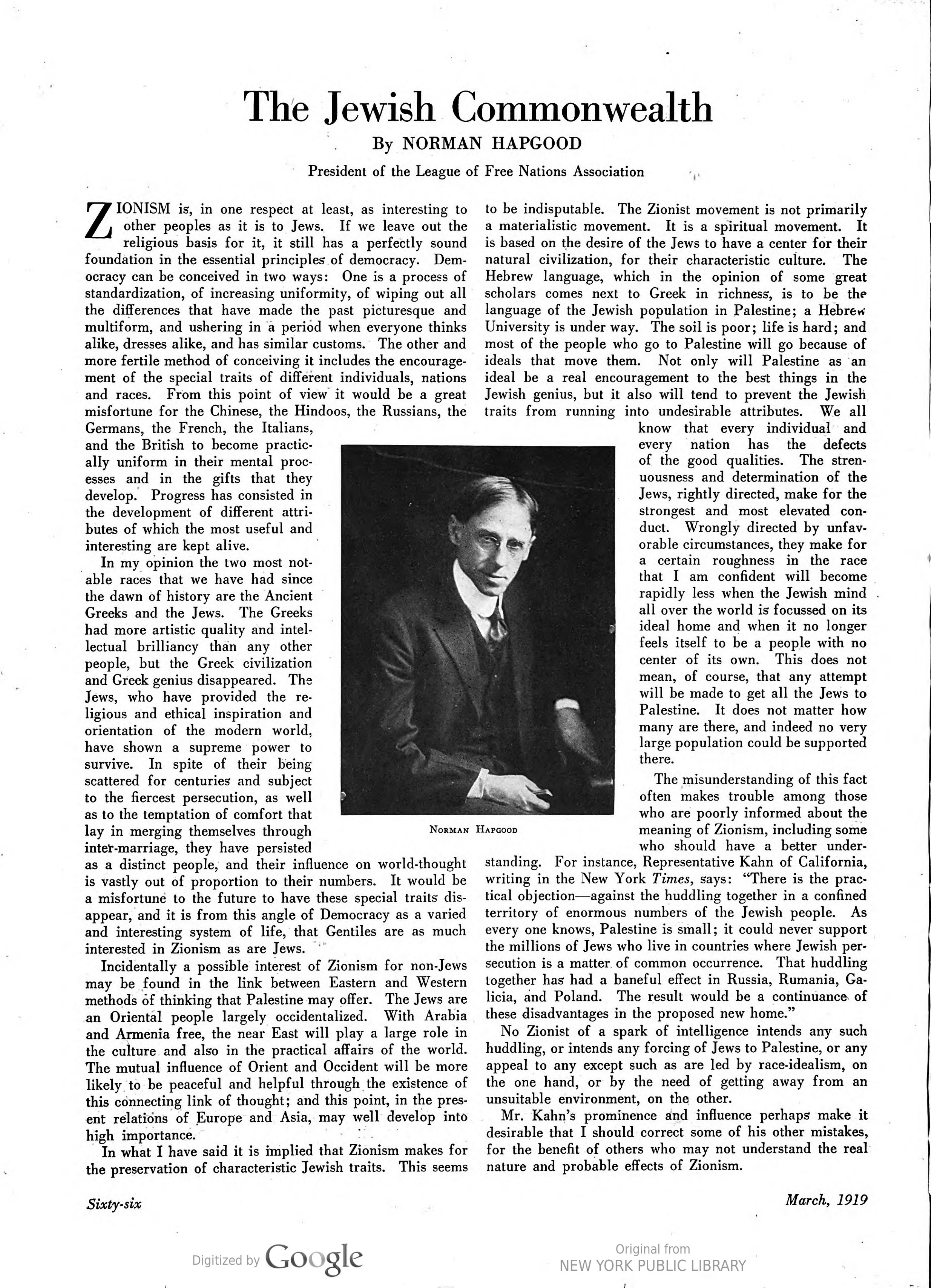
The Jewish Commonwealth
President of the League of Free Nations Association
ZIONISM is, in one respect at least, as interesting to other peoples as it is to Jews. If we leave out the religious basis for it, it still has a perfectly sound foundation in the essential principles of democracy. Democracy can be conceived in two ways: One is a process of standardization, of increasing uniformity, of wiping out all the differences that have made the past picturesque and multiform, and ushering in a period when everyone thinks alike, dresses alike, and has similar customs. The other and more fertile method of conceiving it includes the encouragement of the special traits of different individuals, nations and races. From this point of view it would be a great misfortune for the Chinese, the Hindoos, the Russians, the Germans, the French, the Italians, and the British to become practically uniform in their mental processes and in the gifts that they develop. Progress has consisted in the development of different attributes of which the most useful and interesting are kept alive.
In my opinion the two most notable races that we have had since the dawn of history are the Ancient Greeks and the Jews. The Greeks had more artistic quality and intellectual brilliancy than any other people, but the Greek civilization and Greek genius disappeared. The Jews, who have provided the religious and ethical inspiration and orientation of the modern world, have shown a supreme power to survive. In spite of their being scattered for centuries and subject to the fiercest persecution, as well as to the temptation of comfort that lay in merging themselves through intermarriage, they have persisted as a distinct people, and their influence on world-thought is vastly out of proportion to their numbers. It would be a misfortune to the future to have these special traits disappear, and it is from this angle of Democracy as a varied and interesting system of life, that Gentiles are as much interested in Zionism as are Jews.
Incidentally a possible interest of Zionism for non-Jews may be found in the link between Eastern and Western methods of thinking that Palestine may offer. The Jews are an Oriental people largely occidentalized. With Arabia and Armenia free, the near East will play a large role in the culture and also in the practical affairs of the world. The mutual influence of Orient and Occident will be more likely to be peaceful and helpful through the existence of this connecting link of thought; and this point, in the present relations of Europe and Asia, may well develop into high importance.
In what I have said it is implied that Zionism makes for the preservation of characteristic Jewish traits. This seems
to be indisputable. The Zionist movement is not primarily a materialistic movement. It is a spiritual movement. It is based on the desire of the Jews to have a center for their natural civilization, for their characteristic culture. The Hebrew language, which in the opinion of some great scholars comes next to Greek in richness, is to be the language of the Jewish population in Palestine; a Hebrew University is under way. The soil is poor; life is hard; and most of the people who go to Palestine will go because of ideals that move them. Not only will Palestine as an ideal be a real encouragement to the best things in the Jewish genius, but it also will tend to prevent the Jewish traits from running into undesirable attributes. We all
know that every individual and every nation has the defects of the good qualities. The strenuousness and determination of the Jews, rightly directed, make for the strongest and most elevated conduct. Wrongly directed by unfavorable circumstances, they make for a certain roughness in the race that I am confident will become rapidly less when the Jewish mind all over the world is focussed on its ideal home and when it no longer feels itself to be a people with no center of its own. This does not mean, of course, that any attempt will be made to get all the Jews to Palestine. It does not matter how many are there, and indeed no very large population could be supported there.
The misunderstanding of this fact often makes trouble among those who are poorly informed about the meaning of Zionism, including some who should have a better under- , Representative Kahn of California, rk Times, says: "There is the prac- the huddling together in a confined
standing. For instance, Representative Kahn of California, writing in the New York Times, says: "There is the practical objection—against the huddling together in a confined territory of enormous numbers of the Jewish people. As every one knows, Palestine is small; it could never support the millions of Jews who live in countries where Jewish persecution is a matter of common occurrence. That huddling together has had a baneful effect in Russia, Rumania, Galicia, and Poland. The result would be a continuance of these disadvantages in the proposed new home."
No Zionist of a spark of intelligence intends any such huddling, or intends any forcing of Jews to Palestine, or any appeal to any except such as are led by race-idealism, on the one hand, or by the need of getting away from an unsuitable environment, on the other.
Mr. Kahn's prominence and influence perhaps make it desirable that I should correct some of his other mistakes, for the benefit of others who may not understand the real nature and probable effects of Zionism.