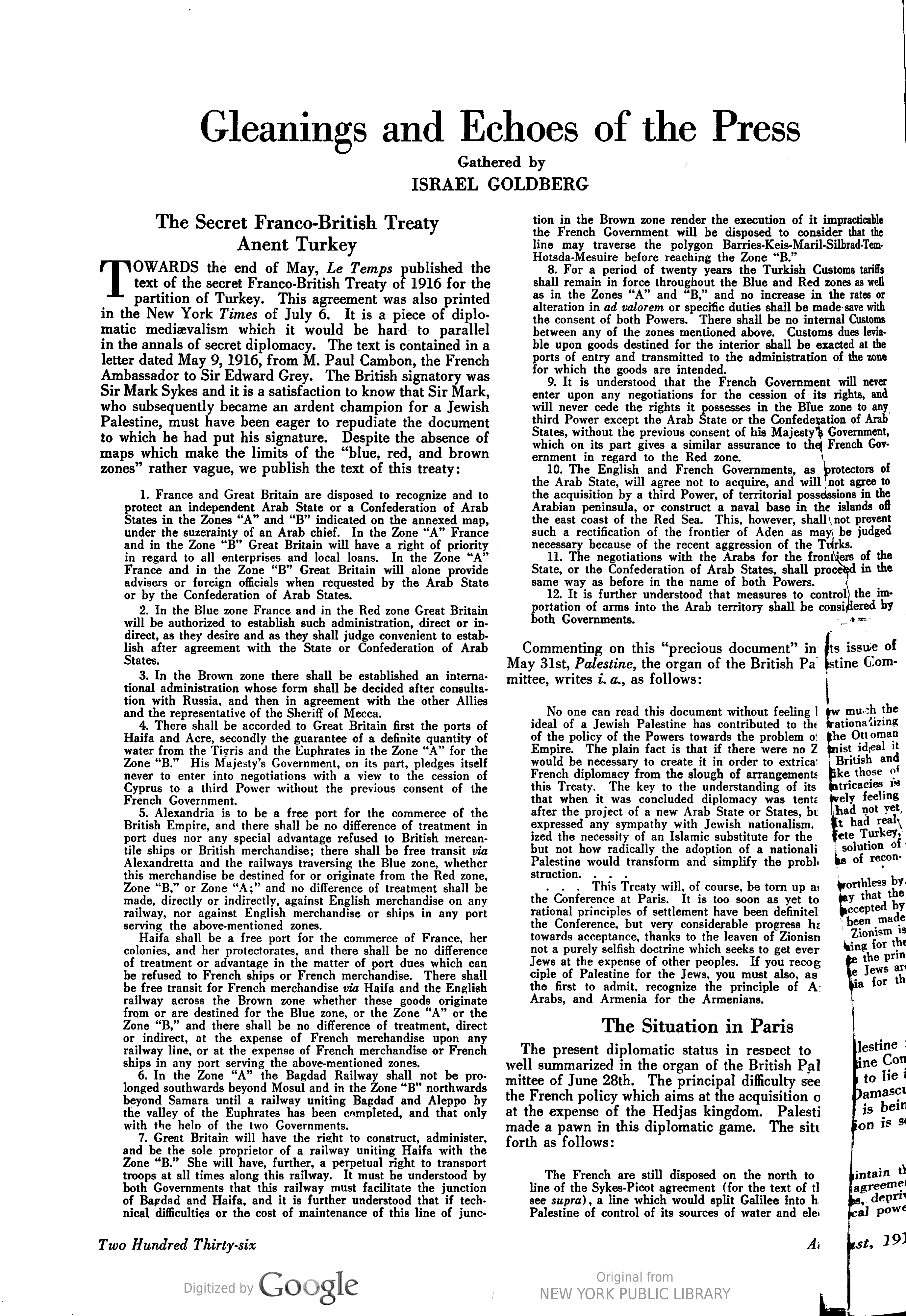
Gleanings and Echoes of the Press
The Secret Franco-British Treaty Anent Turkey
TOWARDS the end of May, Le Temps published the text of the secret Franco-British Treaty of 1916 for the partition of Turkey. This agreement was also printed in the New York Times of July 6. It is a piece of diplomatic mediævalism which it would be hard to parallel in the annals of secret diplomacy. The text is contained in a letter dated May 9, 1916, from M. Paul Cambon, the French Ambassador to Sir Edward Grey. The British signatory was Sir Mark Sykes and it is a satisfaction to know that Sir Mark, who subsequently became an ardent champion for a Jewish Palestine, must have been eager to repudiate the document to which he had put his signature. Despite the absence of maps which make the limits of the "blue, red, and brown zones" rather vague, we publish the text of this treaty:
1. France and Great Britain are disposed to recognize and to protect an independent Arab State or a Confederation of Arab States in the Zones "A" and "B" indicated on the annexed map, under the suzerainty of an Arab chief. In the Zone "A" France and in the Zone "B" Great Britain will have a right of priority in regard to all enterprises and local loans. In the Zone "A" France and in the Zone "B" Great Britain will alone provide advisers or foreign officials when requested by the Arab State or by the confederation of Arab States.
2. In the Blue zone France and in the Red zone Great Britain will be authorized to establish such administration, direct or indirect, as they desire and as they shall judge convenient to establish after agreement with the State or Confederation of Arab States.
3. In the Brown zone there shall be established an international administration whose form shall be decided after consultation with Russia, and then in agreement with the other Alliesand the representative of the Sheriff of Mecca.
and the representative of the Sherif of Mecca. 4. There shall be accorded to Great Britain first the ports of Haifa and Acre, secondly the guarantee of a definite quantity of water from the Tigris and the Euphrates in the Zone “A” for the Zone “B.” His Majesty’s Government, on its part, pledges itself never to enter into negotiations with a view to the cession of Cyprus to a third Power without the previous consent of the French Government.
5. Alexandria is to be a free port for the commerce of the British Empire, and there shall be no difference of treatment in port dues nor any special advantage refused to British mercantile ships or British merchandise; there shall be free transit via Alexandretta and the railways traversing the Blue zone, whether this merchandise be destined for or originate from the Red zone, Zone "B," or Zone "A;" and no difference of treatment shall be made, directly or indirectly, against English merchandise on any railway, nor against English merchandise or ships in any port serving the above-mentioned zones.
ws Köuk =} REN EABFAF TU BEIULERLEANFEINDNGE OA DUELGIS Haifa shall be a free port for the commerce of France, her colonies, and her protectorates, and there shall be no difference of treatment or advantage in the matter of port dues which can be refused to French ships or French merchandise. There shall be free transit for French merchandise via Haifa and the English railway across the Brown zone whether these goods originate fram or are destined for the Blue zone, or ihe Zone “A” or the Zone “B,” and there shall be no difference of treatment, direct or indirect, at the expense of French merchandise upon any railway line, or at the expense of French merchandise or French shivs in anv nort servinz the above-mentioned zones.
6. In the Zone "A" the Bagdad Railway shall not be prolonged southwards beyond Mosul and in the Zone "B" northwards beyond Samara until a railway uniting Bagdad and Aleppo by the valley of the Euphrates has been completed, and that only with the help of the two Governments.
7. Great Britain will have the right to construct, administer, and be the sole proprietor of a railway uniting Haifa with the Zone "B". She will have, further, a perpetual right to transport troops at all times along this railway. It must be understood by both Governments that this railway must facilitate the junction of Bagdad and Haifa, and it is further understood that if technical difficulties or the cost of maintenance of this line of junc-
Gathered byISRAEL GOLDBERG
tion in the Brown zone render the execution of it impracticable the French Government will be disposed to consider that the line may traverse the polygon Barries-Keis-Maril-Silbrad-Tem-Hotsda-Mesuire before reaching the Zone "B."
8. For a period of twenty years the Turkish Customs tariffs shall remain in force throughout the Blue and Red zones as well as in the Zones "A" and "B", and no increase in the rates or alteration in ad valorem or specific duties shall be made-save with the consent of both Powers. There shall be no internal Customs between any of the zones mentioned above. Customs dues leviable upon goods destined for the interior shall be exacted at the ports of entry and transmitted to the administration of the zone for which the goods are intended.
9. It is understood that the French Government will never enter upon any negotiations for the cession of its rights, and will never cede the rights it possesses in the Blue zone to any third Power except the Arab State or the Confederation of Arab States, without the previous consent of his Majesty's Government, which on its part gives a similar assurance to the French Government in regard to the Red zone.
10. The English and French Governments, as protectors of the Arab State, will agree not to acquire, and will not agree to the acquisition by a third Power, of territorial possessions in the Arabian peninsula, or construct a naval base in the islands off the east coast of the Red Sea. This, however, shall not prevent such a rectification of the frontier of Aden as may be judged necessary because of the recent aggression of the Turks.
11. The negotiations with the Arabs for the frontiers of the State, or the Confederation of Arab States, shall proceed in the same way as before in the name of both Powers.
12. It is further understood that measures to control the importation of arms into the Arab territory shall be considered by both Governments.
Commenting on this "precious document" in its issue of May 31st, Palestine, the organ of the British Palestine Committee, writes i.a., as follows:
No one can read this document without feeling how much the ideal of a Jewish Palestine has contributed to the rationalizing of the policy of the Powers towards the problem of the Ottoman Empire. The plain fact is that if there were no Zionist ideal would be necessary to create it in order to extricate British and French diplomacy from the slough of arrangements like those of this Treaty. The key to the understanding of its intricacies is that when it was concluded diplomacy was tentatively feeling after the project of a new Arab State or States, but had not yet expressed any sympathy with Jewish nationalism. It had recognized the necessity of an Islamic substitute for the effete Turkish but not how radically the adoption of a nationalistic solution in Palestine would transform and simplify the problems of reconstruction.
. . . This Treaty will, of course, be torn up a: fworthless the Conference at Paris. It is too soon as yet to y that rational principles of settlement have been definitel ccept the Conference, but very considerable progress hk ‘been M towards acceptance, thanks to the leaven of Zionisn Zionist not a purely selfish doctrine which seeks to get ever king for Jews at the expense of other peoples. If you recog the ı ciple of Palestine for the Jews, you must also, as e Jews the first to admit, recognize the principle of A: ia for Arahbs. and Armenia for the Armenians.
The Situation in Paris
The present diplomatic status in respect to well summarized in the organ of the British Pal mittee of June 28th. The principal difficulty see the French policy which aims at the acquisition o at the expense of the Hedjas kingdom. Palesti made a pawn in this diplomatic game. The situ forth as follows:
The French are still disposed on the north to line of the Sykes-Picot agreement (for the text of this see supra), a line which would split Galilee into the Palestine of control of its sources of wate