The Maccabaean
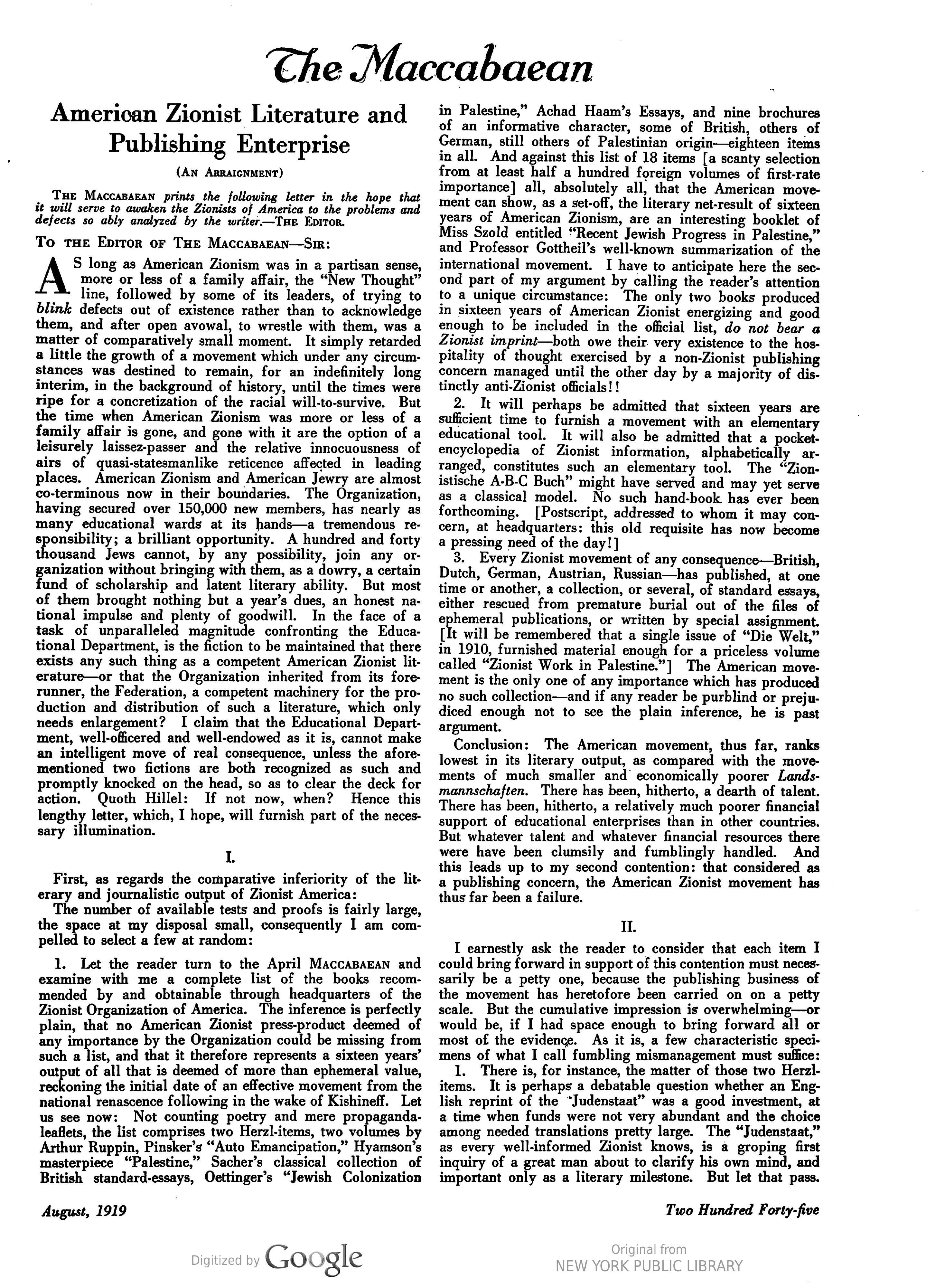
American Zionist Literature and Publishing Enterprise
(AN ARRAIGNMENT)
The MACCABAEAN prints the following letter in the hope that it will serve to awaken the Zionists of America to the problems and defects so ably analyzed by the writer.—THE EDITOR.
TO THE EDITOR OF THE MACCABAEAN—SIR:
S long as American Zionism was in a partisan sense, more or less of a family affair, the “New Thought” line, followed by some of its leaders, of trying to blink defects out of existence rather than to acknowledge them, and after open avowal, to wrestle with them, was a matter of comparatively small moment. It simply retarded a little the growth of a movement which under any circumstances was destined to remain, for an indefinitely long interim, in the background of history, until the times were ripe for a concretization of the racial will-to-survive. But the time when American Zionism was more or less of a family affair is gone, and gone with it are the option of a leisurely laissez-passer and the relative innocuousness of airs of quasi-statesmanlike reticence affected in leading places. American Zionism and American Jewry are almost co-terminous now in their boundaries.. The Organization, having secured over 150,000 new members, has nearly as many educational wards at its hands—a tremendous responsibility; a brilliant opportunity. A hundred and forty thousand Jews cannot, by any possibility, join any organization without bringing with them, as a dowry, a certain und of scholarship and latent literary ability. But most of them brought nothing but a year’s dues, an honest national impulse and plenty of goodwill. In the face of a task of unparalleled magnitude confronting the Educational Department, is the fiction to be maintained that there exists any such thing as a competent American Zionist literature—or that the Organization inherited from its forerunner, the Federation, a competent machinery for the production and distribution of such a literature, which only needs enlargement? I claim that the Educational Department, well-oflicered and well-endowed as it is, cannot make an intelligent move of real consequence, unless the aforementioned two fictions are both recognized as such and promptly knocked on the head, so as to clear the deck for action. Quoth Hillel: If not now, when? Hence this lengthy letter, which, I hope, will furnish part of the necessary illumination.
I.
First, as regards the comparative inferiority of the literary and journalistic output of Zionist America:
The number of available tests and proofs is fairly large, the space at my disposal small, consequently I am compelled to select a few at random:
1. Let the reader turn to the April MAccABAEAN and examine with me a complete list of the books recommended by and obtainable through headquarters of the Zionist Organization of America. The inference is perfectly plain, that no American Zionist press-product deemed of any importance by the Organization could be missing from such a list, and that it therefore represents a sixteen years’ output of all that is deemed of more than ephemeral value, reckoning ihe initial date of an effective movement from the national renascence following in the wake of Kishineff. Let us see now: Not counting poetry and mere propaganda- leaflets, the list comprises two Herzl-items, two volumes by Arthur Ruppin, Pinsker’s “Auto Emancipation,” Hyamson’s masterpiece “Palestine,” Sacher’s classical collection of British standard-essays, Oettinger’s “Jewish Colonization
in Palestine,” Achad Haam’s Essays, and nine brochures of an informative character, some of British, others of German, still others of Palestinian origin—eighteen items in all. And against this list of 18 items [a scanty selection from at least half a hundred foreign volumes of first-rate importance] all, absolutely all, that the American movement can show, as a set-off, the literary net-result of sixteen years of American Zionism, are an interesting booklet of Miss Szold entitled “Recent Jewish Progress in Palestine,” and Professor Gottheil’s well-known summarization of the international movement. I have to anticipate here the second part of my argument by calling the reader’s attention to a unique circumstance: The only two books produced in sixteen years of American Zionist energizing and good enough to be included in the official list, do not bear a Zionist imprint—both owe their. very existence to the hospitality of thought exercised by a non-Zionist publishing concern managed until the other day by a majority of dis- tinctlv anti-Zionist afhriale 1
2. It will perhaps be admitted that sixteen years are suficient time to furnish a movement with an elementary educational tool. It will also be admitted that a pocket- encyclopedia of Zionist information, alphabetically arranged, constitutes such an elementary tool. The “Zionistische A-B-C Buch” might have served and may yet serve as a classical model. No such handbook has ever been forthcoming. [Postscript, addressed to whom it may concern, at headquarters: this old requisite has now become a pressine need of the day!]
3. Every Zionist movement of any consequence—British, Dutch, German, Austrian, Russian—has published, at one time or another, a collection, or several, of standard essays, either rescued from premature burial out of the files of ephemeral publications, or written by special assignment. [It will be remembered that a single issue of “Die Welt,” in 1910, furnished material enough for a priceless volume called “Zionist Work in Palestine.”] The American movement is the only one of any importance which has produced no such collection—and if any reader be purblind or prejudiced enough not to see the plain inference, he is past argument.
Conclusion: The American movement, thus far, ranks lowest in its literary output, as compared with the movements of much smaller and’ economically poorer Landsmannschaften. There has been, hitherto, a dearth of talent. There has been, hitherto, a relatively much poorer financial support of educational enterprises than in other countries. But whatever talent and whatever financial resources there were have been clumsily and fumblingly handled. And this leads up to my second contention: that considered as a publishing concern, the American Zionist movement has thus far been a failure.
II.
I earnestly ask the reader to consider that each item I could bring forward in support of this contention must necessarily be a petty one, because the publishing business of the movement has heretofore been carried on on a petty scale. But the cumulative impression is overwhelming—or would be, if I had space enough to bring forward all or most of the evidence. As it is, a few characteristic specimens of what I call fumbling mismanagement must suflice:
1. There is, for instance, the matter of those two Herzl- items. It is perhaps a debatable question whether an English reprint of the "Judenstaat” was a good investment, at a time when funds were not very abundant and the choice among needed translations pretty large. The “Judenstaat,” as every well-informed Zionist knows, is a groping first inquiry of a great man about to clarify his own mind, and important only as a literary milestone. But let that pass.