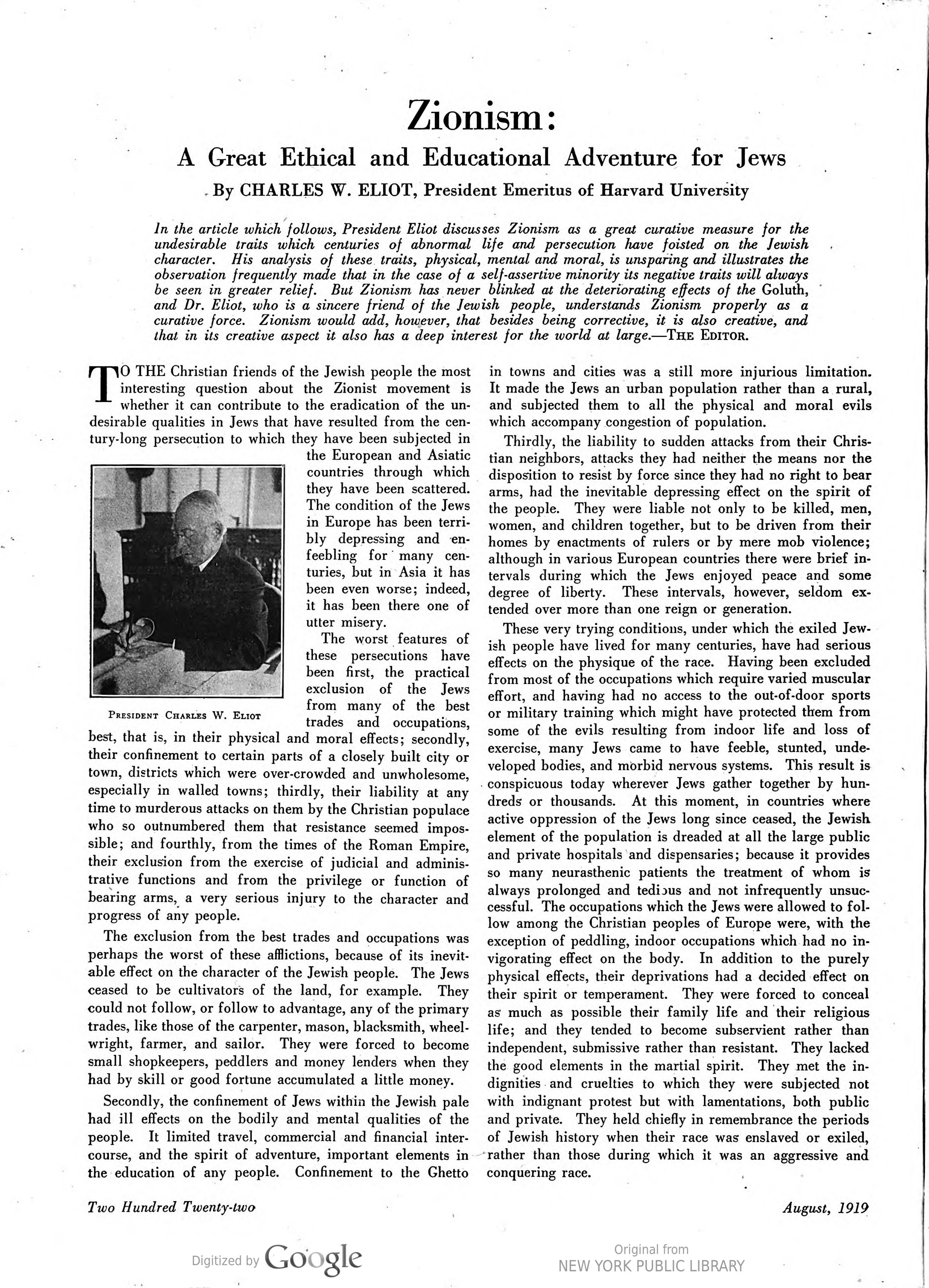
Zionism:
A Great Ethical and Educational Adventure for Jews
By CHARLES W. ELIOT, President Emeritus of Harvard University
In the article which follows, President Eliot discusses Zionism as a great curative measure for the undesirable traits which centuries of abnormal life and persecution have foisted on the Jewish character. His analysis of these traits, physical, mental and moral, is unsparing and illustrates the observation frequently made that in the case of a self-assertive minority its negative traits will always be seen in greater relief. But Zionism has never blinked at the deteriorating effects of the Goluth, and Dr. Eliot, who is a sincere friend of the Jewish people, undersiands Zionism properly as a curative force. Zionism would add, however, that besides being corrective, it is also creative, and that in its creative asvect it also has a deen interest for the world at larce—-THE EDITOR.
TO THE Christian friends of the Jewish people the most interesting question about the Zionist movement is whether it can contribute to the eradication of the undesirable qualities in Jews that have resulted from the century-long persecution to which they have been subjected in
the European and Asiatic countries through which they have been scattered. The condition of the Jews in Europe has been terribly depressing and enfeebling for many centuries, but in Asia it has been even worse; indeed, it has been there one of utter misery.
The worst features of these persecutions have been first, the practical exclusion of the Jews from many of the best trades and occupations.
trades and occupations, best, that is, in their physical and moral effects; secondly, their confinement to certain parts of a closely built city or town, districts which were overcrowded and unwholesome, especially in walled towns; thirdly, their liability at any time to murderous attacks on them by the Christian populace who so outnumbered them that resistance seemed impossible; and fourthly, from the times of the Roman Empire, their exclusion from the exercise of judicial and administrative functions and from the privilege or function of bearing arms, a very serious injury to the character and progress of any people.
The exclusion from the best trades and occupations was perhaps the worst of these afflictions, because of its inevitable effect on the character of the Jewish people. The Jews ceased to be cultivators of the land, for example. They could not follow, or follow to advantage, any of the primary trades, like those of the carpenter, mason, blacksmith, wheelwright, farmer, and sailor. They were forced to become small shopkeepers, peddlers and money lenders when they had by skill or good fortune accumulated a little money.
Secondly, the confinement of Jews within the Jewish pale had ill effects on the bodily and mental qualities of the people. It limited travel, commercial and financial intercourse, and the spirit of adventure, important elements in the education of any people. Confinement to the Ghetto
in towns and cities was a still more injurious limitation. It made the Jews an urban population rather than a rural, and subjected them to all the physical and moral evils which accompany congestion of population.
Thirdly, the liability to sudden attacks from their Christian neighbors, attacks they had neither the means nor the disposition to resist by force since they had no right to bear arms, had the inevitable depressing effect on the spirit of the people. They were liable not only to be killed, men, women, and children together, but to be driven from their homes by enactments of rulers or by mere mob violence; although in various European countries there were brief intervals during which the Jews enjoyed peace and some degree of liberty. These intervals, however, seldom extended over more than one reign or generation.
These very trying conditions, under which the exiled Jewish people have lived for many centuries, have had serious effects on the physique of the race. Having been excluded from most of the occupations which require varied muscular effort, and having had no access to the out-of-door sports or military training which might have protected tem from some of the evils resulting from indoor life and loss of exercise, many Jews came to have feeble, stunted, undeveloped bodies, and morbid nervous systems. This result is conspicuous today wherever Jews gather together by hundreds or thousands. At this moment, in countries where active oppression of the Jews long since ceased, the Jewish element of the population is dreaded at all the large public and private hospitals and dispensaries; because it provides so many neurasthenic patients the treatment of whom is always prolonged and tedi>us and not infrequently unsuccessful. The occupations which the Jews were allowed to follow among the Christian peoples of Europe were, with the exception of peddling, indoor occupations which had no invigorating effect on the body. In addition to the purely physical effects, their deprivations had a decided effect on their spirit or temperament. They were forced to conceal as much as possible their family life and their religious life; and they tended to become subservient rather than independent, submissive rather than resistant. They lacked the good elements in the martial spirit. They met the indignities-and cruelties to which they were subjected not with indignant protest but with lamentations, both public and private. They held chiefly in remembrance the periods of Jewish history when their race was enslaved or exiled, ‘rather than those during which it was an aggressive and conquering race.