The Co-operative Movement
The Meaning of Co-operation
"The co-operative principle should be applied as far as feasible in the organization of all agricultural, industrial, commercial, and financial undertakings."
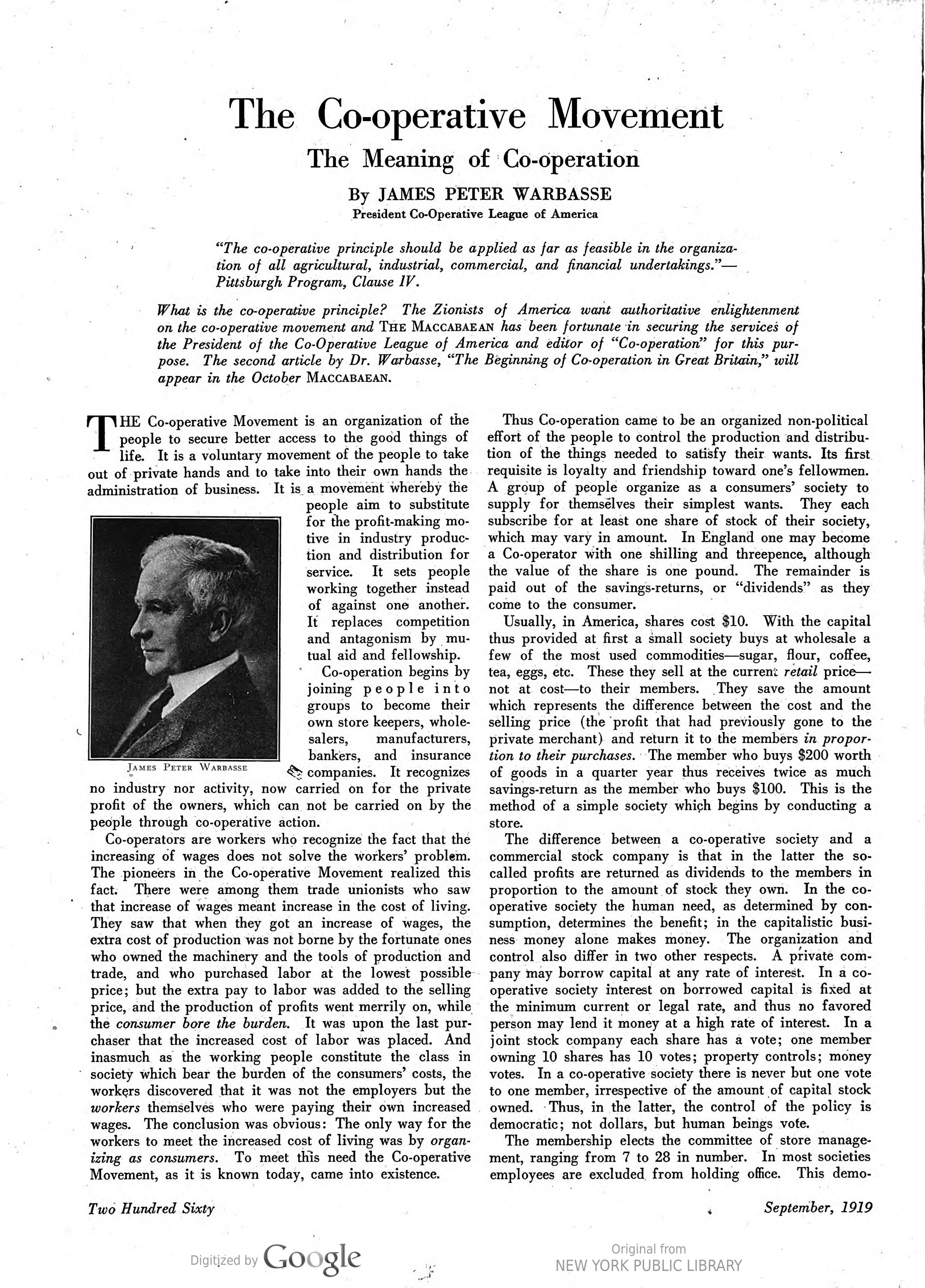
What is the co-operative principle? The Zionists of America want authoritative enlightenment on the co-operative movement and THE MACCABAEAN has been fortunate in securing the services of the President of the Co-Operative League of America and editor of "Co-operation" for this purpose. The second article by Dr. Warbasse, "The Beginning of Co-operation in Great Britain," will appear in the October MACCABAEAN.
THE Co-operative Movement is an organization of the people to secure better access to the good things of life. It is a voluntary movement of the people to take out of private hands and to take into their own hands the administration of business. It is a movement whereby the
people aim to substitute for the profit-making motive in industry production and distribution for service. It sets people working together instead of against one another. It replaces competition and antagonism by mutual aid and fellowship.
* Co-operation begins by joining people into groups to become their own store keepers, wholesalers, manufacturers, bankers, and insurance » companies. It recognizes
no industry nor activity, now carried on for the private profit of the owners, which can not be carried on by the people through co-operative action.
Co-operators are workers who recognize the fact that the increasing of wages does not solve the workers’ problem. The pioneers in the Co-operative Movement realized this fact. There were among them trade unionists who saw that increase of wages meant increase in the cost of living. They saw that when they got an increase of wages, the extra cost of production was not borne by the fortunate ones who owned the machinery and the tools of production and trade, and who purchased labor at the lowest possible price; but the extra pay to labor was added to the selling price, and the production of profits went merrily on, while the consumer bore the burden. It was upon the last purchaser that the increased cost of labor was placed. And inasmuch as the working people constitute the class in “ society which bear the burden of the consumers’ costs, the workers discovered that it was not the employers but the workers themselves who were paying their own increased wages. The conclusion was obvious: The only way for the workers to meet the increased cost of living was by organizing as consumers. To meet this need the Co-operative Movement, as it is known today, came into existence.