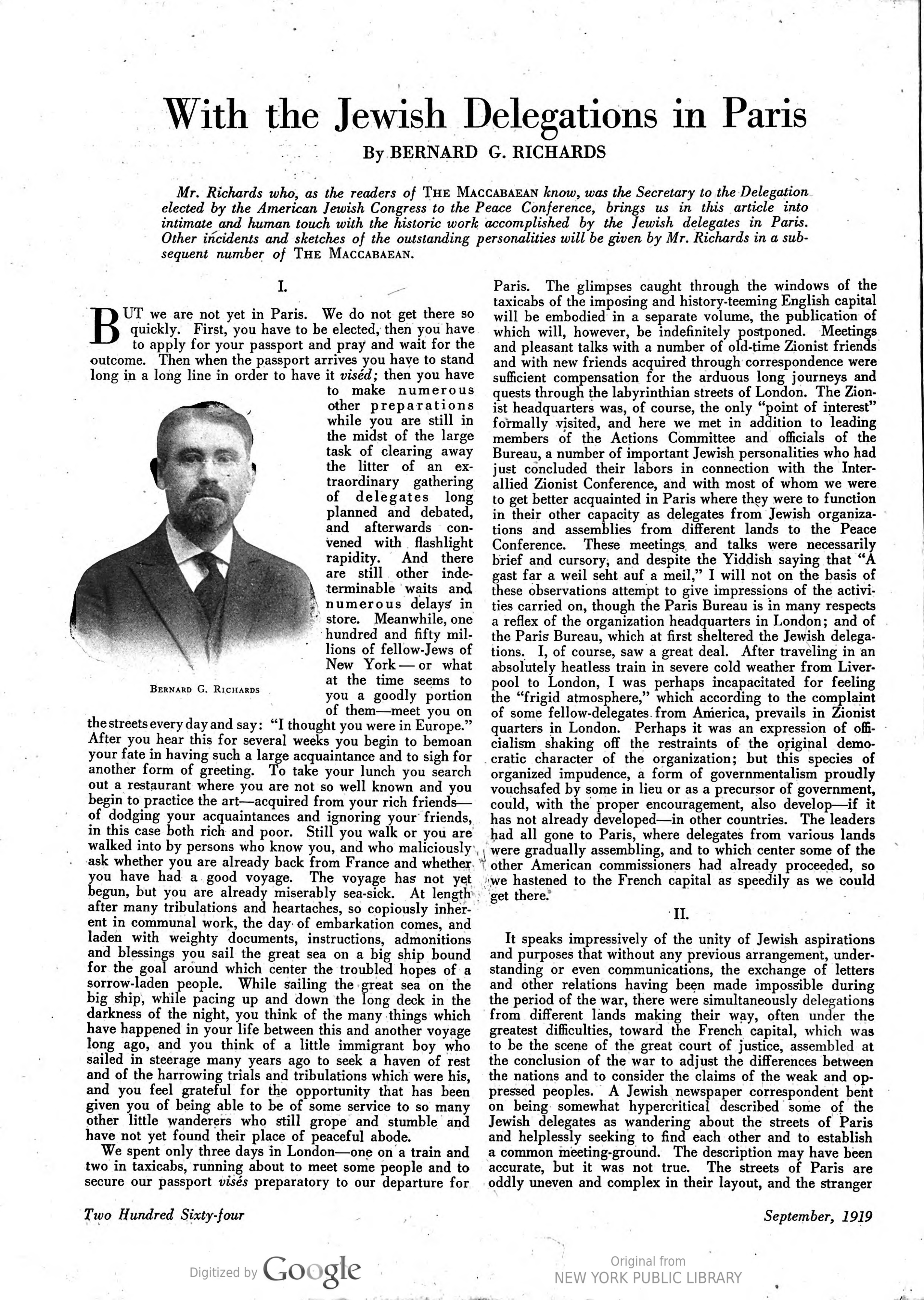
With the Jewish Delegations in Paris
Mr. Richards who, as the readers of THE MACCABAEAN know, was the Secretary to the Delegation elected by the American Jewish Congress to the Peace Conference, brings us in this article into intimate and human touch with the historic work accomplished by the Jewish delegates in Paris. Other incidents and sketches of the outstanding personalities will be given by Mr. Richards in a subsequent number of THE MACCABAEAN.
I.
BUT we are not yet in Paris. We do not get there so quickly. First, you have to be elected, then you have to apply for your passport and pray and wait for the outcome. Then when the passport arrives you have to stand long in a long line in order to have it vised; then you have
to make numerous other preparations while you are still in the midst of the large task of clearing away the litter of an extraordinary gathering of delegates long planned and debated, and afterwards convened with flashlight rapidity. And there are still other indeterminable waits and numerous delays in store. Meanwhile, one hundred and fifty millions of fellow-Jews of New York—or what at the time seems to you a goodly portion of them—meet you on
wi Ailbili LUUL JE vıi thestreetseverydayand say: “I thought you were in Europe.” After you hear this for several weeks you begin to bemoan your fate in having such a large acquaintance and to sigh for another form of greeting. To take your lunch you search out a restaurant where you are not so well known and you begin to practice the ar—acquired from your rich friends— of dodging your acquaintances and ignoring your friends, in this case both rich and poor. Still you walk or you are walked into by persons who know you, and who maliciously‘ ask whether you are already back from France and whether. you have had a.good voyage. The voyage has not yet begun, but you are already miserably sea-sick. At length: after many tribulations and heartaches, so copiously inherent in communal work, the day: of embarkation comes, and laden with weighty documents, instructions, admonitions and blessings you sail the great sea on a big ship bound for the goal around which center the troubled hopes of a sorrow-laden people. While sailing the:great sea on the big ship, while pacing up and down the long deck in the darkness of the night, you think of the many things which have happened in your life between this and another voyage long ago, and you think of a little immigrant boy who sailed in steerage many years ago to seek a haven of rest and of the harrowing trials and tribulations which were his, and you feel grateful for the opportunity that has been given you of being able to be of some service to so many other little wanderers who still grope and stumble and have not yet found their place of peaceful abode.
We spent only three days in London—one on a train and two in taxicabs, running about to meet some people and to secure our passport vises preparatory to our departure for
Paris. The glimpses caught through the windows of the taxicabs of the imposing and history-teeming English capital will be embodied in a separate volume, the publication of which will, however, be indefinitely postponed. Meetings and pleasant talks with a number of old-time Zionist friends and with new friends acquired through correspondence were suficient compensation for the arduous long journeys and quests through the labyrinthian streets of London. The Zionist headquarters was, of course, the only “point of interest” formally visited, and here we met in addition to leading members of the Actions Committee and oflicials of the Bureau, a number of important Jewish personalities who had just concluded their labors in connection with the Inter-allied Zionist Conference, and with most of whom we were to get better acquainted in Paris where they were to function in their other capacity as delegates from Jewish organizations and assemblies from different lands to the Peace Conference. These meetings, and talks were necessarily brief and cursory, and despite the Yiddish saying that “A gast far a weil seht auf a meil,” I will not on the basis of these observations attempt to give impressions of the activities carried on, though the Paris Bureau is in many respects a reflex of the organization headquarters in London; and of the Paris Bureau, which at first sheltered the Jewish delegations. I, of course, saw a great deal. After traveling in an absolutely heatless train in severe cold weather from Liverpool to London, I was perhaps incapacitated for feeling the “frigid atmosphere,” which according to the complaint of some fellow-delegates. from America, prevails in Zionist quarters in London. Perhaps it was an expression of ofh- cialism shaking off the restraints of the original democratic character of the organization; but this species of organized impudence, a form of governmentalism proudly vouchsafed by some in lieu or as a precursor of government, could, with the proper encouragement, also develop—if it has not already developed—in other countries. The leaders had all gone to Paris, where delegates from various lands were gradually assembling, and to which center some of the other American commissioners had already proceeded, so we hastened to the French capital as speedily as we could 'cet there. :
II.
It speaks impressively of the unity of Jewish aspirations and purposes that without any previous arrangement, understanding or even communications, the exchange of letters and other relations having been made impossible during the period of the war, there were simultaneously delegations from different lands making their way, often under the greatest difficulties, toward the French capital, which was to be the scene of the great court of justice, assembled at the conclusion of the war to adjust the differences between the nations and to consider the claims of the weak and oppressed peoples. A Jewish newspaper correspondent bent on being somewhat hypercritical described some of the Jewish delegates as wandering about the streets of Paris and helplessly seeking to find each other and to establish a common meeting-ground. The description may have been accurate, but it was not true. The streets of Paris are oddly uneven and complex in their layout, and the stranger