Michal Halperin: A Jewish Don Quixote
THE eccentric reputation of Michal Halperin, both in his native Russia and in the Holy Land, had reached my ears long before I stood with him face to face. Both Jews and Arabs in Eretz-Yisroel told
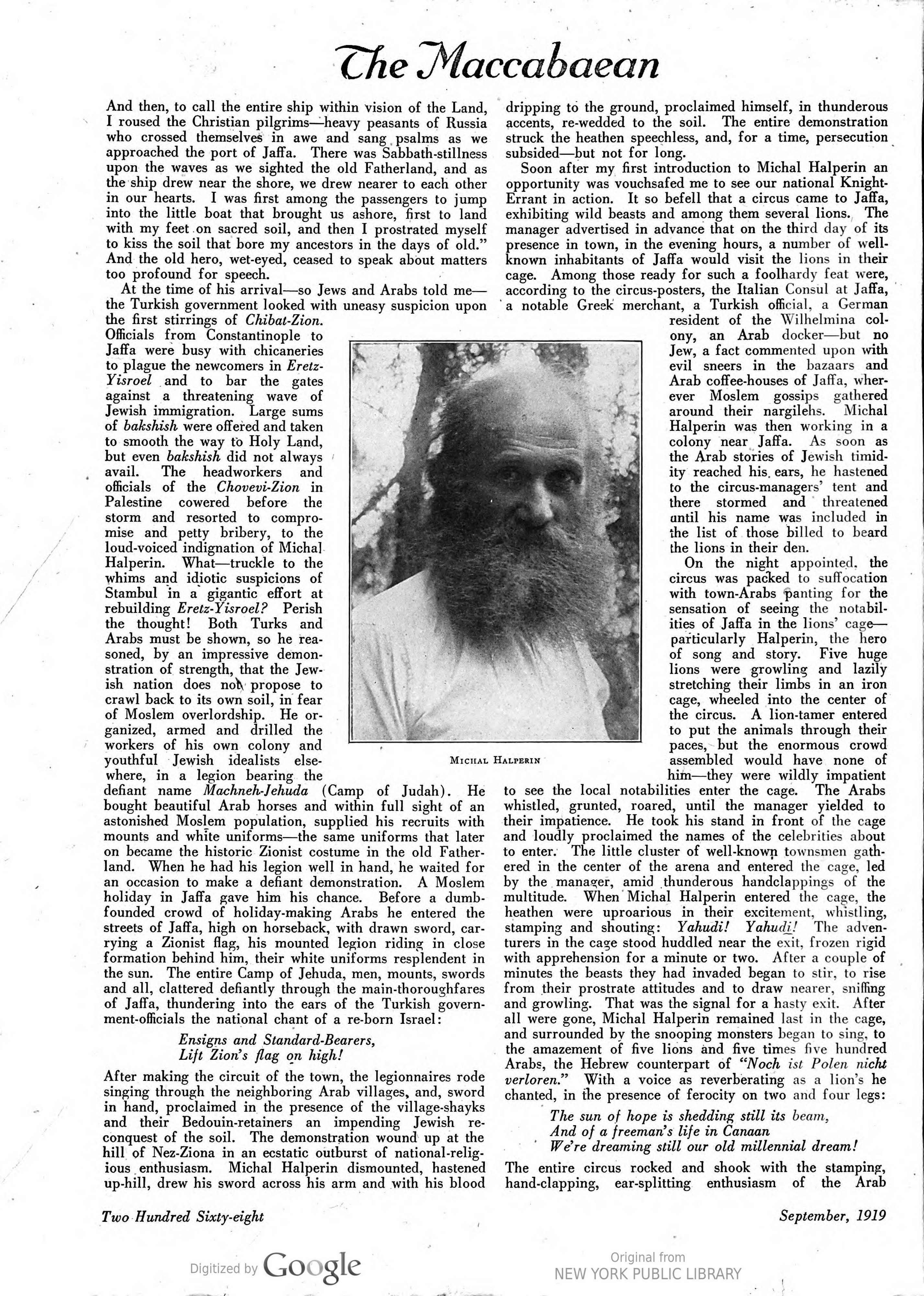
Eretz-Ysroel told stories about him, about his wonderful prowess, his high-flown principles, his fanaticism, stories told with the enthusiastic belief of Orientals in the power and scope of human personality. He was described—correctly, I found, upon meeting him—as the handsomest of mortals—muscular, broad-backed, deep-chested, with an ancient prophet's head upon his shoulders, his features in a frame of long, wavy hair, a youngish-looking patriarch despite his slightly graying hair and beard.
In the traditional accounts of Jews and Arabs alike he appeared as the most interesting type of that romantic, pre-Herzlian period of colony-founding Zionism which is known by the name of Chibath-Zion. The very origin of the man —a native, by the way, of Vilna—is imposing, for he is a grandson of no less a luminary of Hebrew learning than the great Malbim. The father of Michal was a wealthy factory-owner of Vilna, and the first act through which his son attained to fame was successful socialist propaganda among the employees of the paternal workshop and the organization of a strike against his own father. His next step—so the stories run—was the establishment of a work men’s colony in Eretz-Yisroel, called Nez-Ziona, founded upon principles of social justice. This true Jewish Knight Errant, who is often hard put to it now for a night’s shelter or the price of a meal, did cheerfully sink a large fortune in the founding and maintenance of Nez-Ziona. It was he who first organized the Agudath Hapoalim (Workmen’s League) on holy soil. It was his glowing imagination and fertility of resource which first struck the idea of a mounted corps of rural guards (Ha-Shomer). In these latter days he is himself a mounted rural guardsman—a very efficient gensdarme, but an unofficial one, because of a quixotic scruple: his libertarian principles, rigid, severe and pursued to extreme conclusions, do not square with the rigorous discipline of the Ha-Shomer. It is highly characteristic of the man and his simple fervor, that he once sent twenty francs of his pitifully small pay as a guardsman to a London paper read almost exclusively by High Tories and men within the sphere of high-finance, as a fee for the insertion of the following pronouncement:
"I, Michal Halperin, with my past as a guarantee of good faith, and with my head as a forfeit to be publicly severed from my shoulders if I fail in my undertaking, offer to rebuild our ancient Jewish commonwealth in Palestine, to any one putting at my disposal a loan of fifty million dollars." After this specimen of his style of public delivery, you may easily imagine my impatient wish for an encounter with this hero of a simple faith, this true Jewish Don Quixote of the mounted guards.
Now it came to pass, some time after my arrival in Holy Land, that both he and I were guardsmen in the same colony—in Rishon-le-Zion of the many vineyards—in Rishon-le-Zion hated by Arab envy and imperilled by Arab raids. In moonless nights, when I was mounting guard, with a heart oftentimes darker in its doubts than the surrounding night, I used to look up our hero of the many
The following sketch of Michal Halperin is the first of a series of pen portraits of the personalities who stand out in the history of the Jewish revival in Palestine during the preceding generation. The author is a Palestinian with an intimate knowledge of the country and the personalities he describes
tales and listen to many a story of his exploits and to theories brighter and more serene than the full-moon to come. We cowered at his tent-fire in frosty vigils, when the reminiscent mood was
inscent mood was upon him, and through the stillness of the sacred Eastern night, with stars gleaming against the black velvet sky, his deep voice would ring out in the recital of a past as fantastic as the nocturnal stillness around us. In the beginning of our acquaintance, he told me of his leave-taking from his native town —in the manner following:
Twenty-odd years ago, a few days after a pogrom, I happened to pass the Alte Shul in Vilna, at a time when my soul could not bear any further the burden of goluth, having witnessed the pogrom with my own eyes. I had ceased to believe in betterment within the dispersion, and felt myself a stranger in the town of my birth. For several days I walked the streets of Vilna like one demented, an outcast nowhere at home, but a great, an overpowering idea was all the time piercing my brains. In this frame of mind I passed the Alte Shul on a Sabbath morning, and I heard the voices of my fellow-Jews at prayer. To this day, I do not know what prompted me to step within doors—me, who hadn't seen the inside of a synagogue for years. It was the time appointed for the reading of the Law. The worshippers stared at me in amazement, but I, heedless of their wonderment, rushed to the forefront and there buried my face in the Ark of the Law. What I felt and thought then, words cannot tell. But when I lifted my countenance from the Ark and stepped upon the platform, there was a stillness as of the dead in Shul—they were all waiting for a message. A spirit from on high loosened my tongue. I spoke to them of their torment in Exile—of two thousand years of unhappiness—and of the land that has been laid waste, a mutely expectant wilderness ever since we left it. My innermost heart rose to my tongue, I spoke my pain and theirs, and as I spoke, sobs became audible from the women's place of worship, and sounds of weeping. When I lifted the scroll of the Law, I swore an oath, with the whole congregation for witness. 'If I forget thee, oh Jerusalem, may my right hand forget its cunning!' Soon thereafter I left the Alte Shul—with the day and the vow as fresh before my mind after twenty-odd years as on that Sabbath morning of old. The next day, the railroad station was crowded with folks from the Alte Shul and with young people to see me safely off—many of them my fellow-travelers, bound, as I was, for Holy Land.
“I remember well the last night on shipboard, with the mountain-tops of Lebanon within sight. My fellow-passengers, within a few miles from the shore of our ancient home, had peace of mind enough to go to sleep as wonted, but the heart within me wouldn’t let me sleep. Restlessly I paced the deck all night, as my soul turned shoreward with all its might. Near the shore of Eretz-Yisroel my soul was wrapped in mourning throughout the watches of the night, and my ears resounded, time and again with the dreary monotone: ‘Once we were a people!’ But when the gray dawn of morning came and the fires of Jaffa were within sight, I rushed below-stairs and shook into waking life both the old that had come to die in Jerusalem and the young who had vowed to live there and to build Zion anew.