The New Hebrew Daily in Palestine
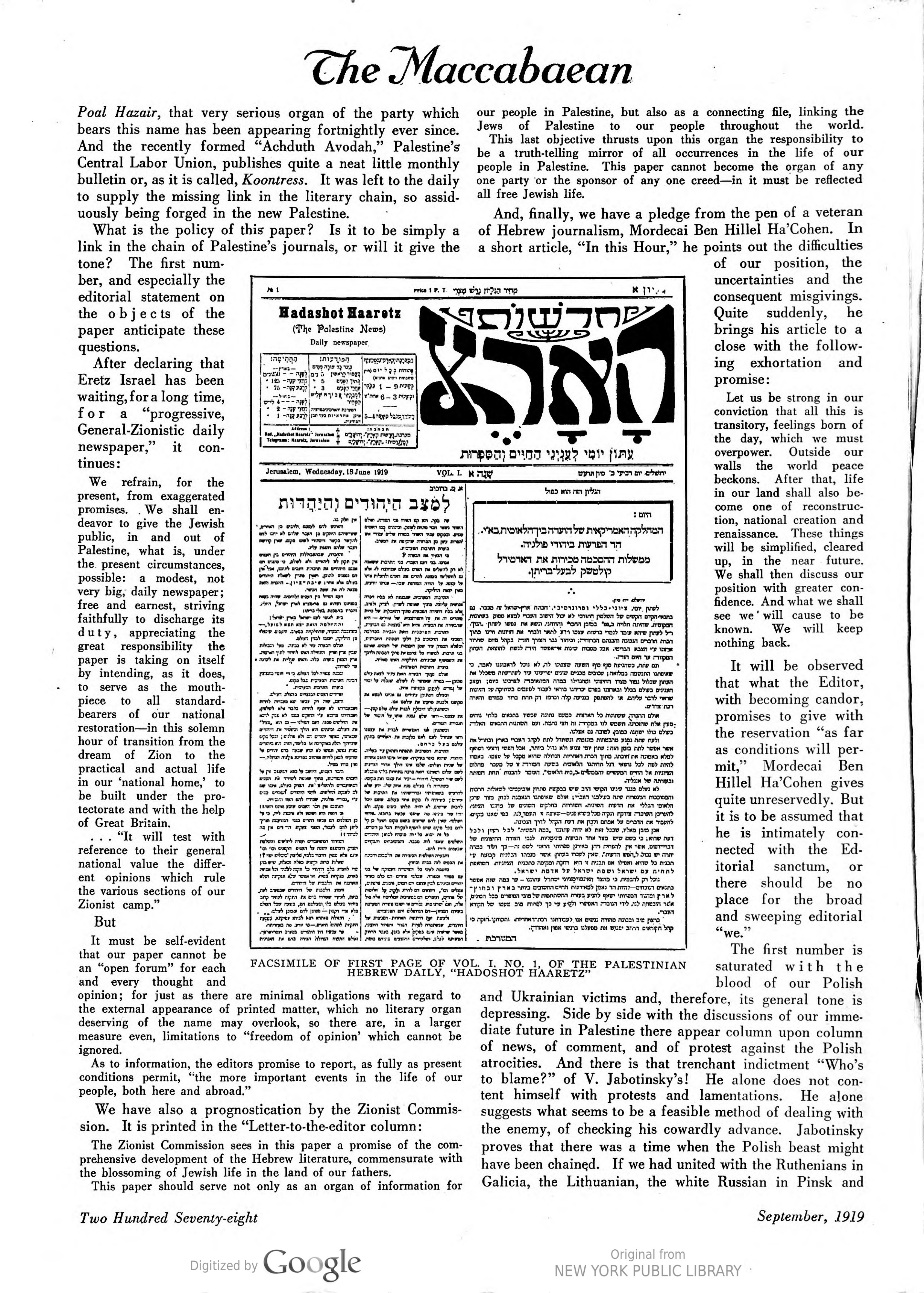
N THE twentieth O day in the month of Sivan in the year five thousand six hundred and seventy-nine (June 18, 1919) there appeared in the city of Jerusalem the first number of the
BARU ALU ZIULIIDUULE VE LIIG new and only Hebrew daily newspaper in Eretz Israel. This day should become a red-letter day in the annals of Jewish journalism. The words “red-letter day” and “annals” are here reproduced with the completest acknowledgment to authors, particularly Jewish authors of all ages, climes and tongues; with the fullest knowledge that whatever the original significance of these words, whatever meaning they have for other people, they are no longer impressive to us. They have been banalized by too frequent application to events for which a much weaker adjective would have been much more to the point. Conscientious Jewish publieists face this dilemma whenever they are called upon to describe an event of genuine importance. They are reminded that the telling word had been used before, usually with reference to some minor event. To apply it would be tantamount to being hackneyed. And yet if any day is to go down as a red-letter day in Jewish journalism the one which hails the appearance in Palestine of a new Hebrew daily is certain to be chosen.
Hadoshot Haaretz—this is the name of our newspaper— must not be confused or identified with its weekly predecessor, Hadoshot me-Haaretz. The absence of the prefix renders the meaning: News of the Land. The other was: News from the Land. There is more than a mere grammatical distinction, which the Hebrew student should be quick to perceive. The weekly was part of a chain published in Egypt, under the name of Palestine News, by the British Army. That chain included an English and an Arabic edition. And each of those editions was intended for a specific purpose. The English one was an issue for the British troops. And it was largely “the stuff to give the troops.” The British Military Authorities in the Occupied Enemy Territory—with practically no enemies—did not presume to settle which language was the predominating one, Hebrew or Arabic. They knew that those were the natives’ languages and that the reading public should be reached by means of both of them. All three editions were printed in Cairo, under supervision of G. H. Q. Certain latitude was allowed the sub-editors of the different papers to include material likely to be of interest to the different sets of readers. Thus, in the Hebrew edition, for example, quite a number of well-known publicists participated. But the contributions were of general Jewish, and literary topics. Anything touching on the political phase or political future of Palestine was studiously excluded.
It is understood that before suspending their publication the authorities made an offer to the Zionist Commission to take over all three editions. Owing to the huge financial outlay the Commission was obliged to decline! It did,
Mr. Gershon Agronsky, who sends this article from Palestine, is with the Jewish Battalions in that country. Before he enlisted he was assistant editor of ihe Zionist weekly Dos Yiddishe Folk, having served previously on the staff of the DL:lalolnhin Tevursich Warld.
however, undertake to provide a responsible agency to take over the Hebrew edition. That agency was found in the person of I. L. Goldberg, one of the Vilna Goldbergs. Mr. Salzman, who was
formerly associated with the Razsviet, the Russian Zionist paper, is said to have a share in the paper, although Mr. Goldberg appears as the "sole, responsible publisher." Dr. Turow, the Palestinian educator, is the editor. So much for the history of the paper.
sie ee ee ee But whatever its antecedents, the appearance of Hadoshot Haareiz at this trying time is an event of incalculable importance. It may be difhcult for one living in America or in Europe to grasp the significance of it for Palestinian Jewry. One’s choice of newspapers there is as wide, if not wider, than that of his wardrobe. The variety he can have served with his breakfast is certainly larger than the war-time menu. But Palestine has not had a daily for close on to four years. And there is not a paper in a European language, excepting a French sheet in Beirut, outside of Egypt. For four years what Hugo calls “that gigantic machine, the printing press, forever pumping in all the intellectual sap of society, forever vomiting fresh materials for its work,” stood mournfully still. For four years not a wheel of that gigantic machine moved in Palestine. The war stopped all Hebrew publications: the frequent reviews, the quarterlies, monthlies, weeklies and Ben Yehuda’s daily Ha-Or. Only here and there an obstinate paper was left to agonize for a few months and to die. In a remarkably short time the bud of the new Palestinian literature was nipped. Add to that, all normal means of communication were cut—notably after the expulsion of our people from Judaea. Families were separated and neighboring communities found themselves as far removed one from the other as if an impassable sea had divided them. There was no news to be had from within nor from without. Every traveler—and they were few and far between—had to be a sort of purveyor of information, a harbinger of tidings, such as they were! The proverbial Palestinian “Mah- nishmah?” or “What’s the news?” followed, where it did not supersede, the “Shalom.” The people in Judaea, in Shomron and in the Galil—not to speak of the thousands of refugees in Syria and Turkey—lived on what may be called the word of mouth. But it was, of necessity, a distorted word. Only in the light of these conditions can the acute mental suffering of the People of the Book, living in the Land of the Book, be understood. Only in this way can their keen joy at the revival of the printed word be appreciated. And the large number of publications testify that the printed word has been revived. Our current literature in Palestine is fairly on its way towards an unprecedented development. Hadoshot Haaretz is not now, by any means the only publication. A few reviews appeared immediately Judaea was liberated by Allenby’s forces. The