The Maccabaem
SEPTEMBER, 1919
Max Nordau’s Zionist Beginnings
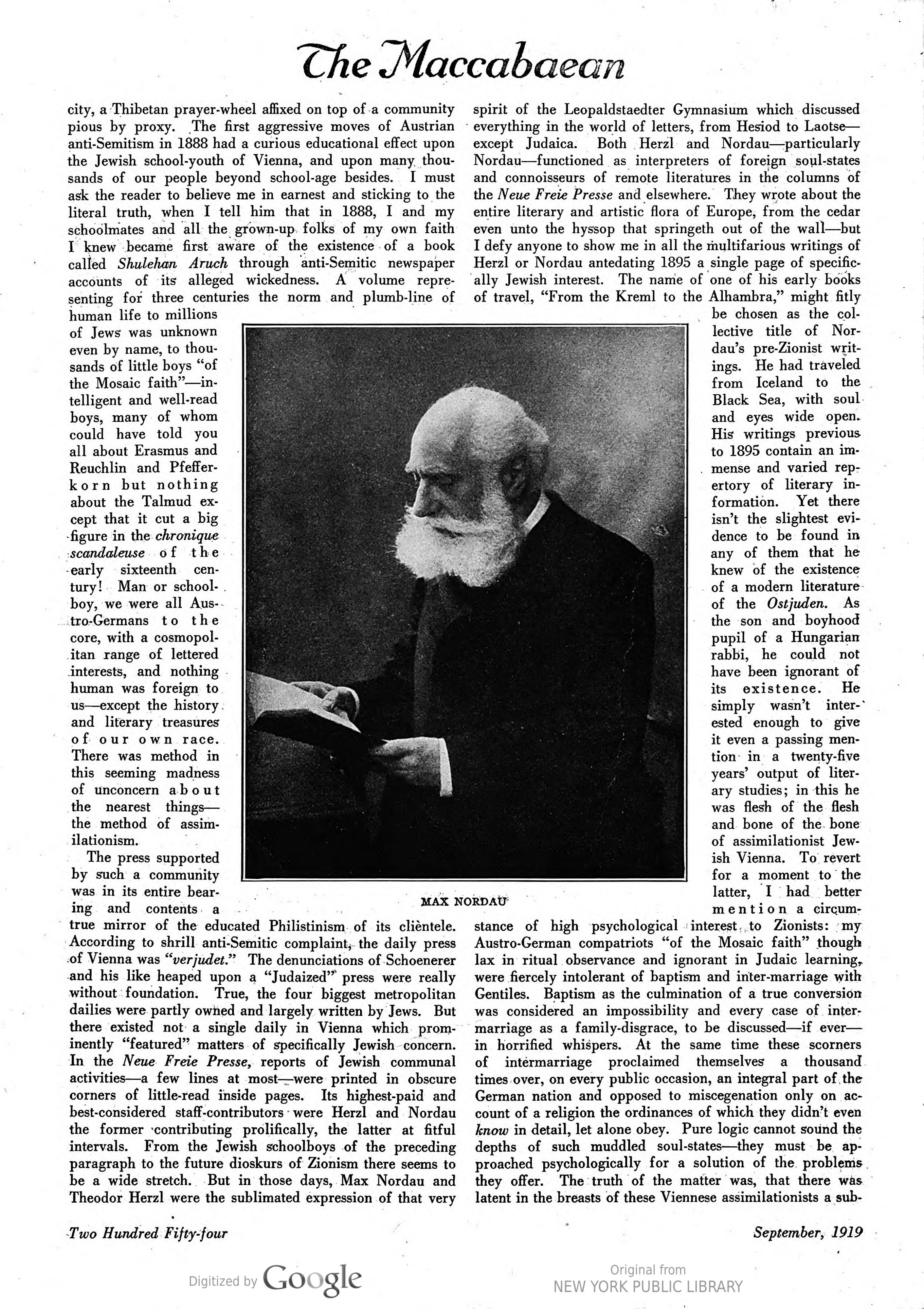
THE Zionist beginnings of Max Nordau, as recorded in his "Zionistische Schriften," are not only synchronous with but part of the beginnings of modern Zionism itself. To review them, at a moment when his seventieth birthday lends timeliness to the effort, is to revert in thought to the raison d'être of the entire movement, to its historical origins in Western Europe and to the social atmosphere of baffled and confounded assimilationism that gave it birth. At this "boom" period of American Zionism, with its inevitable attenuation of well-informed thought, such retrospects, however brief, are an urgent educational need. We are living through a time when Zionism sells itself, in the commercial slang of the day, to our American-Jewish masses through the testimonials of eminent statesmen rather than through a popular study of its classics. Let us welcome, therefore, a jubilee-date which impels us to gain a better understanding of essentials by backward vistas of twenty-five years ago.
Modern Zionism, as an international mass-movement, could never have originated in the Ghettoes of the East. No fair understanding of Herzl, Nordau, and the prelim; inaries of 1896 is possible unless it be clearly understood that Jewish nationalism, so far from being the antipode of assimilationism, is in fact its inevitable outcome and presumes its existence. Without assimilationism, no Zionism. The entire modern movement is a verdict upon Jewish emancipation on trial. Where there is no emancipation, as in the Jewish East, there can be neither trial nor verdict. Not the dreamers of the Eastern Ghettoes to whom Jewish nationality was a self-understood thing, were destined to inter- nationalize the Judenstaat idea, but two Parisian Maranos of Austro-Hungarian.birth, hurled back into the lap of their own nation by the events of 1890-95 with süch stunning force as to dissolve their cosmopolitan soul-states: Theodor Herzl and Max Nordau. The details of their catharsis are a Tale of Two Cities—Vienna and Paris. In swiftly sketching the social atmosphere of Jewish Vienna a’ quarter of a century ago, I am aided by an accident of birth and early training. The Vienna of the Eighties, with its Jewish
bourgeoisie cocksure of social acceptance, happens to be the city of my childhood. The Vienna of the early Nineties, with a Jewish bourgeoisie forced to defend its status against a city of hostile hundred thousands, is the metropolis of my early student days. I am consequently a living witness to Viennese developments preceding the first Zionist message ever addressed to an astonished European West.
To all outward appearances, anti-Jewish sentiment in Vienna of the early Eighties was confined to a few exclusive circles of the feudal and priestly caste—jockey-clubs, officers’ mess-rooms, and the salons of the ancien régime. Occasional snubs which these circles administered to a handful of Jewish arrivistes were of little concern to the community at large. In 1884, when the first Viennese parliamentary candidate [Dr. Pattai] on an avowedly anti-Semitic platform failed of election, Jewish Vienna took his defeat as a matter of course. Anti-Semitism, for some years to come, was like one of those mysterious rivers of the Jugoslav mountains, which run deep below the surface, through miles of subterranean caverns, to burst forth in open daylight in the most unexpected places. No one in the early Eighties had any suspicion of the astounding propagative force of anti-Jewish sentiment within the bosom of Viennese society. In those days, no Jew I ever knew or heard of conceived of himself as a member of a national minority. We were all “ Austro-Germans of the Mosaic Faith.” A few words about that faith are requisite to an understanding of the situation. The religion taught in our schools and professed in our homes had only a pale and ghostly resemblance to actual Judaism. In its formal aspect, it consisted of a deism devo- tionally supported by a few Jewish traditions which hadn’t been as yet reformed out of existence. In its bearings upon the life and conduct of its professors, it was a six-day athiesm, tempered by a few seventh-day and high-holiday observances and by an uneasy consciousness of a Jupiter tonans getting his thunderbolts ready around Rosh-ha-shona and Yom-Kippur. Dr. Guedeman— with whom Max Nordau had his first Zionist passage-at-arms in 1897—was chief-rabbi of the Kultus-Gemeinde; a man justly renowned for his piety and learning, but resembling, in his official capa-