With the Zionist Commission in Palestine
MY six months' service on the Zionist Commission has been completed. A report is due to the organization at whose request, or, I should rather say, invitation, I was called to take active part in the re-establishment of the Jewish Homeland—one of the greatest and most adventurous enterprises which the great war has helped to make prominent among the tumultuous upheavals of present-day history. Small as my own share has been, it has been a great privilege for me to have taken this part.
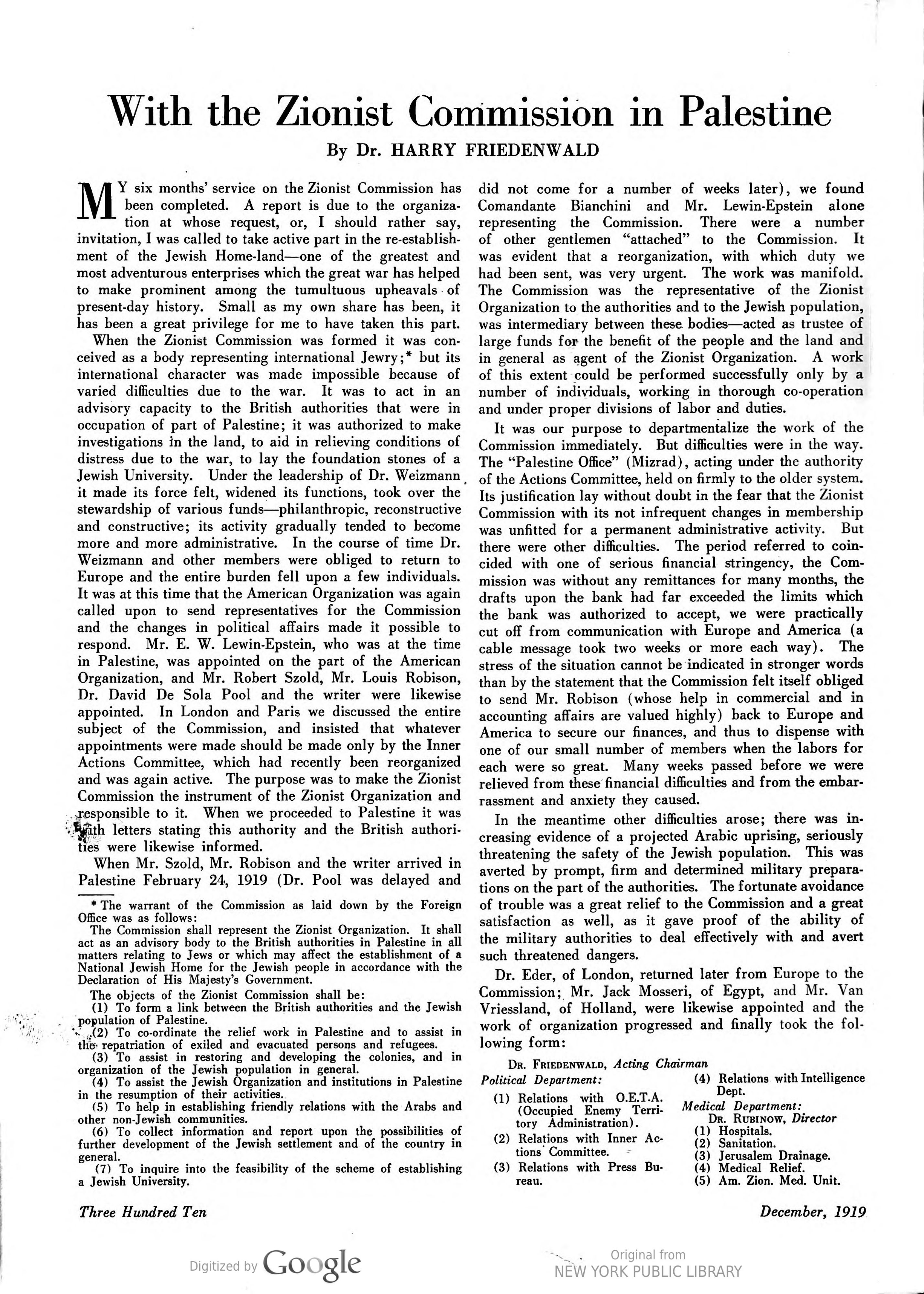
When the Zionist Commission was formed it was conceived as a body representing international Jewry;* but its international character was made impossible because of varied difficulties due to the war. It was to act in an advisory capacity to the British authorities that were in occupation of part of Palestine; it was authorized to make investigations in the land, to aid in relieving conditions of distress due to the war, to lay the foundation stones of a Jewish University. Under the leadership of Dr. Weizmann, it made its force felt, widened its functions, took over the stewardship of various funds —philanthropic, reconstructive and constructive; its activity gradually tended to become more and more administrative. In the course of time Dr. Weizmann and other members were obliged to return to Europe and the entire burden fell upon a few individuals. It was at this time that the American Organization was again called upon to send representatives for the Commission and the changes in political affairs made it possible to respond. Mr. E. W. Lewin-Epstein, who was at the time in Palestine, was appointed on the part of the American Organization, and Mr. Robert Szold, Mr. Louis Robison, Dr. David De Sola Pool and the writer were likewise appointed. In London and Paris we discussed the entire subject of the Commission, and insisted that whatever appointments were made should be made only by the Inner Actions Committee, which had recently been reorganized and was again active. The purpose was to make the Zionist Commission the instrument of the Zionist Organization and responsible to it. When we proceeded to Palestine it was with letters stating this authority and the British authorities were likewise informed.
When Mr. Szold, Mr. Robison and the writer arrived in Palestine February 24, 1919 (Dr. Pool was delayed and
* The warrant of the Commission as laid down by the Foreign Office was as follows:
The Commission shall represent the Zionist Organization. It shall act as an advisory body to the British authorities in Palestine in all matters relating to Jews or which may affect the establishment of a National Jewish Home for the Jewish people in accordance with the Declaration of His Majesty's Government.
The objects of the Zionist Commission shall be:
(1) To form a link between the British authorities and the Jewish population of Palestine.(2) To co-ordinate the relief work in Palestine and to assist in the repatriation of exiled and evacuated persons and refugees.(3) To assist in restoring and developing the colonies, and in organization of the Jewish population in general.(4) To assist the Jewish Organization and institutions in Palestine in the resumption of their activities.(5) To help in establishing friendly relations with the Arabs and other non-Jewish communities.(6) To collect information and report upon the possibilities of further development of the Jewish settlement and of the country in general.(7) To inquire into the feasibility of the scheme of establishing a Jewish University.
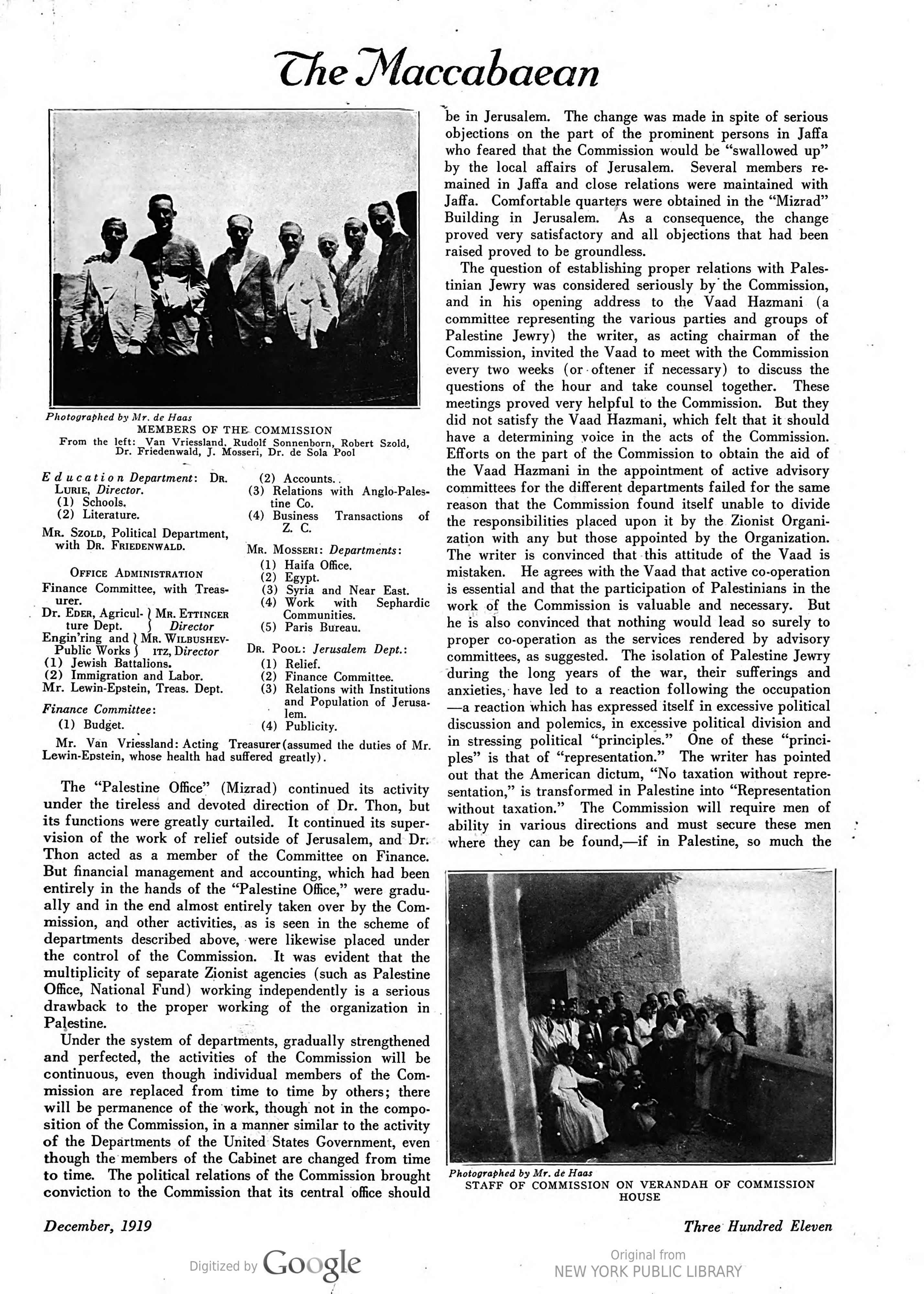
did not come for a number of weeks later), we found Comandante Bianchini and Mr. Lewin-Epstein alone representing the Commission. There were a number of other gentlemen "attached" to the Commission. It was evident that a reorganization, with which duty we had been sent, was very urgent. The work was manifold. The Commission was the representative of the Zionist Organization to the authorities and to the Jewish population, was intermediary between these bodies—acted as trustee of large funds for the benefit of the people and the land and in general as agent of the Zionist Organization. A work of this extent could be performed successfully only by a number of individuals, working in thorough co-operation and under proper divisions of labor and duties.
It was our purpose to departmentalize the work of the Commission immediately. But difhiculties were in the way. The “Palestine Office” (Mizrad), acting under the authority of the Actions Committee, held on firmly to the older system. Its justification lay without doubt in the fear that the Zionist Commission with its not infrequent changes in membership was unfitted for a permanent administrative activity. But there were other difficulties. The period referred to coincided with one of serious financial stringency, the Commission was without any remittances for many months, the drafts upon the bank had far exceeded the limits which the bank was authorized to accept, we were practically cut off from communication with Europe and America (a cable message took two weeks or more each way). The stress of the situation cannot be’indicated in stronger words than by the statement that the Commission felt itself obliged to send Mr. Robison (whose help in commercial and in accounting aflairs are valued highly) back to Europe and America to secure our finances, and thus to dispense with one of our small number of members when the labors for each were so great. Many weeks passed before we were relieved from these financial difficulties and from the embarrassment and anxietv they caused.
In the meantime other difficulties arose; there was increasing evidence of a projected Arabic uprising, seriously threatening the safety of the Jewish population. This was averted by prompt, firm and determined military preparations on the part of the authorities. The fortunate avoidance of trouble was a great relief to the Commission and a great satisfaction as well, as it gave proof of the ability of the military authorities to deal effectively with and avert such threatened dangers.
Dr. Eder, of London, returned later from Europe to the Commission; Mr. Jack Mosseri, of Egypt, and Mr. Van Vriessland, of Holland, were likewise appointed and the work of organization progressed and finally took the following form:
DR. FRIEDENWALD, Acting ChairmanPolitical Department:(1) Relations with O.E.T.A.(Occupied Enemy Territory Administration).(4) Relations with Intelligence Dept.(2) Relations with Inner Actions Committee.Medical Department:DR. RUBINOW, Director(3) Relations with Press Bureau.(1) Hospitals.(2) Sanitation.(3) Jerusalem Drainage.(4) Medical Relief.(5) Am. Zion. Med. Unit.