Zalman Rublinsky: a Penitent Apostate
Translator's Note: In Englishing this sketch—and several others by the same author—I had to abridge, for lack of space, but I have carefully refrained from putting a gloss upon the occasional ruggedness and scriptural simplicity of many passages in the original, which lend a characteristic tang and flavor to its diction. The lettered peasant—the laborer who, after a toilsome day, lays his spade aside to write the annals of his people—is too precious a type of our new Jewish folk-life to be presented to English readers in any but his own garb.—J. F.
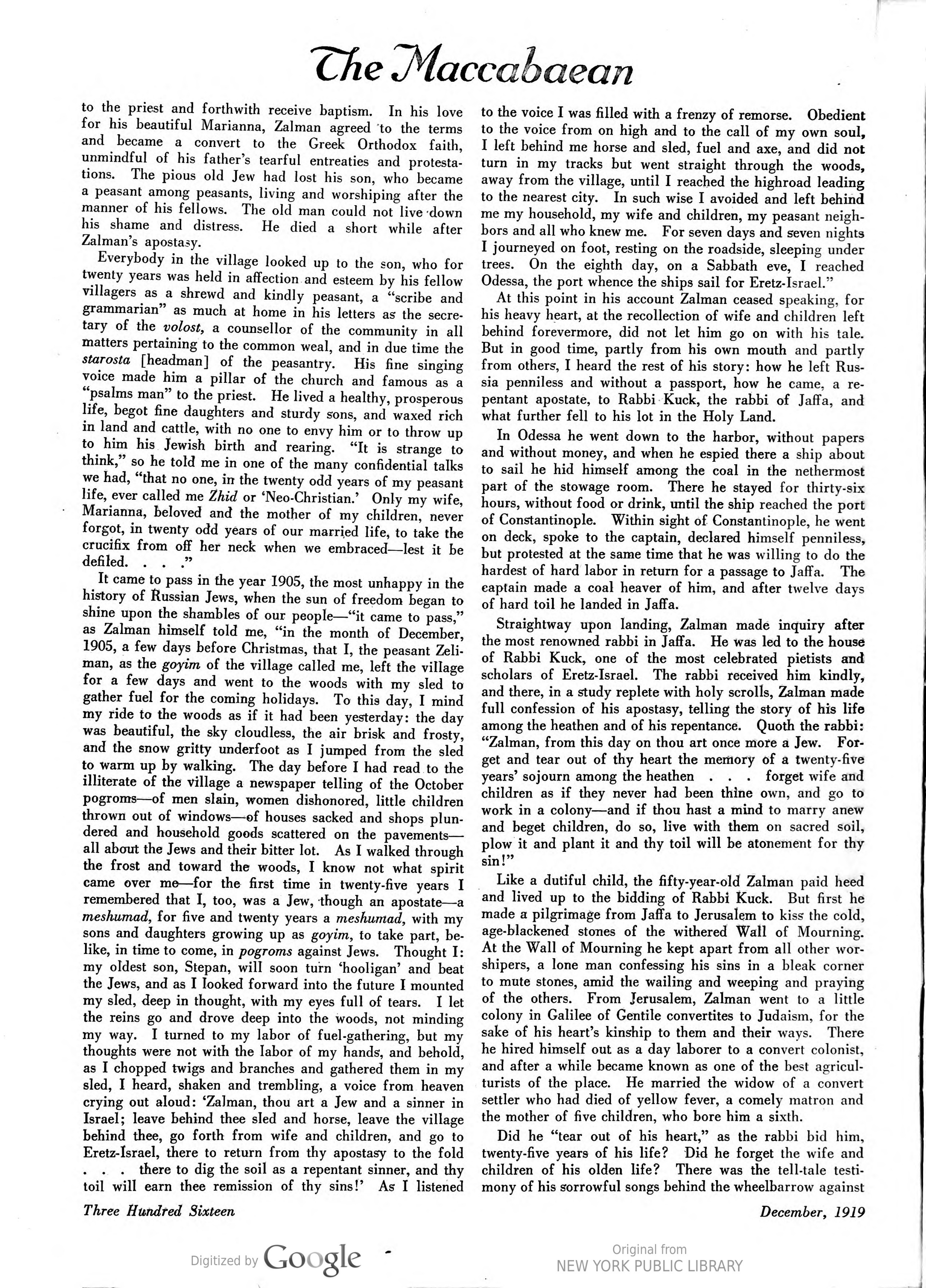
WE of this group-picture have been drudging for several years behind wheelbarrows, digging the soil, leveling dust mounds, filling up ruts and holes and planing roads. We laid out the street net and ditched up the canalization of the homestead Tel-Aviv near Jaffa, at the border of the sea.
Zalman Rublinsky was the oldest of our group of wheelbarrow drudges—of the “volunteer convict gang” as the town jokers called us. Our group, which you now behold in photographic presentment, consisted of all sorts—even a meshumad was not missing in our little clan. When I look at the picture my heart is heavy with sorrow. For therein I see fulfilled the untoward lot of our Jewish youth. Only a few years ago we of this group worked together for an idea, for a new hope of the old heirdom—and now, after a moment of time, we are scattered to all the four winds—not one to stay upon the ground he digged—and what became of us?
Just this: the first of the group right counting from left to Zevi Bortnov, has found his niche since in the memorial volume called "Yizkor," published in honor of the fallen Ha-Shomerim, the mounted guardsmen of the New Zion. He fell during an Arab raid, not in fair fight but killed from behind by a foe he had no chance to face. The second of the group, a cap- maker by trade, has somewhere sunk from sight in our American galuth. The third, a little before the war, strayed from Eretz-Israel to Paris, joined the Foreign ZALMAN RUBLINSKY
our Jewish nationalist now scattered all over brother against brother, own, for countries that and my heart is heavy.
Zalman Rublinsky, as told before, was the oldest worker of our group —his beard began to turn grey. Yet he was the gayest of us all, an inveterate joker, a song-bird, a fellow full of comic quips and quirks. True, between whiles, in the resting spells from our heavy labor, his gay mood would leave him. In such moments he sang heart-gripping little Russian folk-songs, full of amorous passion, of infinite longing, of the nostalgia of the steppes on the banks of the Dnieper. Then he would suddenly change to dolorous Yom Kippur tunes or to the wailing incantations of the Greek Orthodox Church. Whatever songs he sang —and the manner of his singing —told the tragedy of one human life. I taught him a little Hebrew —only the most necessary words —to fit him for the position of street sweeper and sprinkler of the colony of Tel-Aviv. That was my opportunity for getting nearer to the soul of this goysche Jew. And now I
will tell what I know, both from his own lips and those of others, of his most strange career.
His father was the only Jew —a pious one—of a little village near the town of Boral, government of Poltava. A lone Jew between goyim, he taught his son Chumish and Tenach and told him of Eretz-Israel where Jews had been aforetime a nation by
themselves. But Zalman was the only Jewish child among a lot of healthy little peasant lads and lassies, and his surroundings took a stronger hold on him than the Jewishness of his father. He grew up a gay-hearted youth, a songster and fiddler of renown, the best dancer in the village, well liked by the peasant girls and their brothers. As he grew to man's estate, he fell in love with a healthy, wholesome, good-looking peasant girl, Marianna, the daughter of the wealthiest peasant in the village. The girl loved him, and her father, knowing Zalman for a strong-limbed, hard-working youth, did not object to the match. He offered his son-in-law-to-be ten desjatines of good soil and a handsome house, on condition that he go without delay, accompanied by two sponsors of the village gentry,