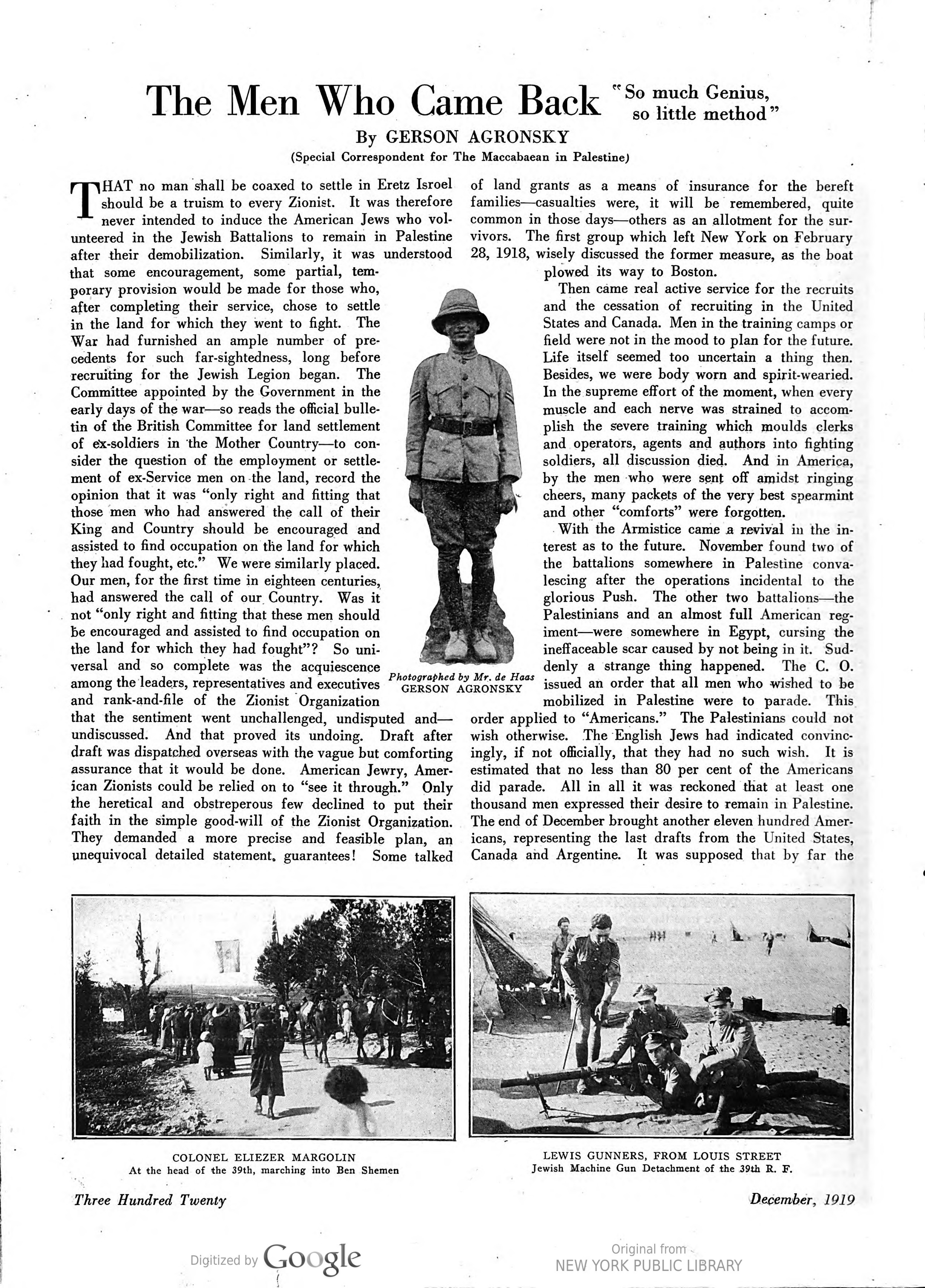
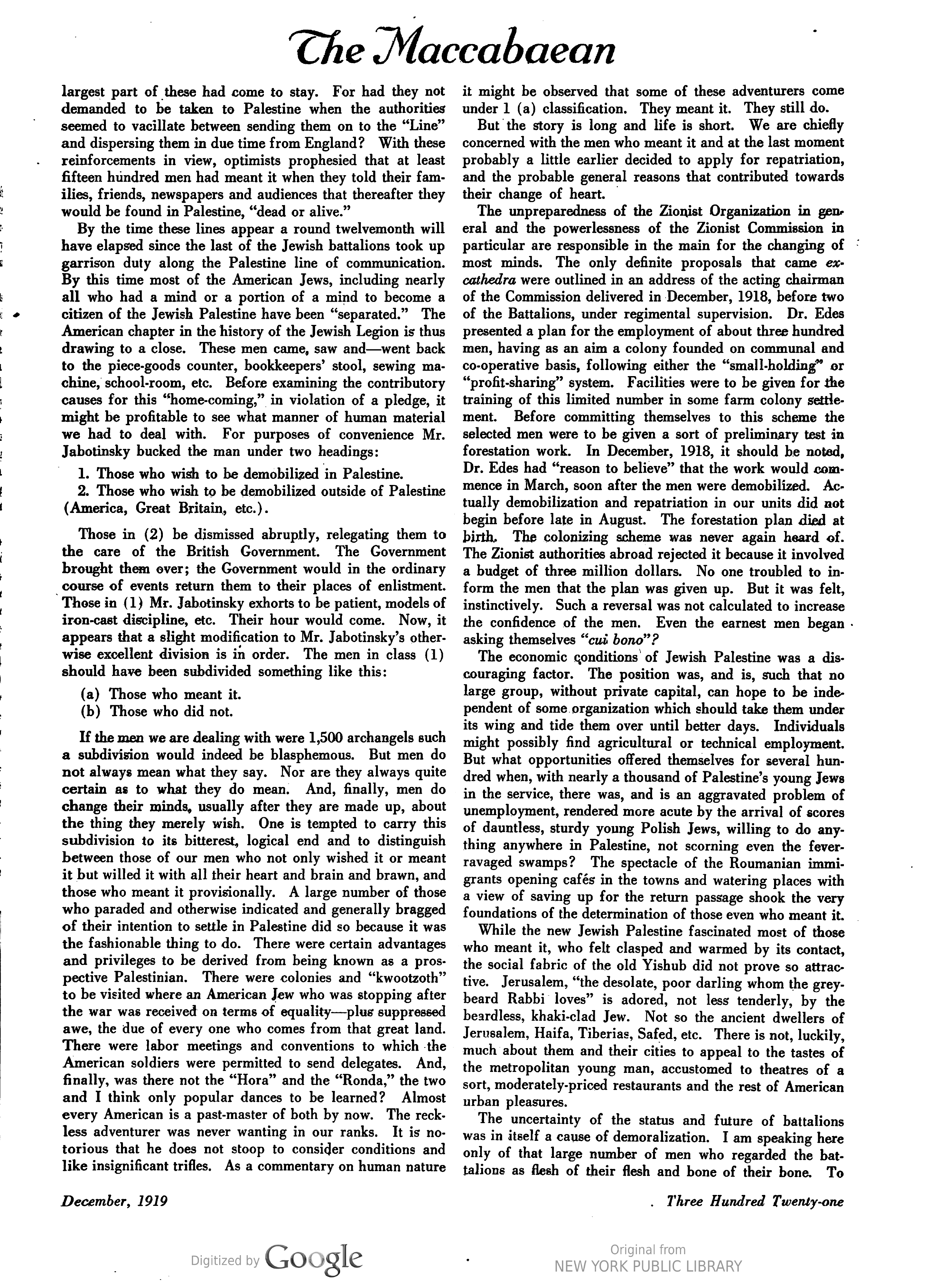
The Men Who Came Back "So much Genius, so little method"
(Special Correspondent for The Maccabaean in Palestine)
THAT no man shall be coaxed to settle in Eretz Isroel should be a truism to every Zionist. It was therefore never intended to induce the American Jews who volunteered in the Jewish Battalions to remain in Palestine after their demobilization. Similarly, it was understood that some encouragement, some partial, temporary provision would be made for those who, after completing their service, chose to settle in the land for which they went to fight. The War had furnished an ample number of precedents for such far-sightedness, long before recruiting for the Jewish Legion began. The Committee appointed by the Government in the early days of the war—so reads the official bulletin of the British Committee for land settlement of ex-soldiers in the Mother Country—to consider the question of the employment or settlement of ex-Service men on the land, record the opinion that it was “only right and fitting that those men who had answered the call of their King and Country should be encouraged and assisted to find occupation on the land for which they had fought, etc.” We were similarly placed. Our men, for the first time in eighteen centuries, had answered the call of our Country. Was it not “only right and fitting that these men should be encouraged and assisted to find occupation on the land for which they had fought”? So universal and so complete was the acquiescence among the leaders, representatives and executives and rank-and-file of the Zionist Organization that the sentiment went unchallenged, undisputed and— undiscussed. And that proved its undoing. Draft after draft was dispatched overseas with the vague but comforting assurance that it would be done. American Jewry, American Zionists could be relied on to “see it through.” Only the heretical and obstreperous few declined to put their faith in the simple good-will of the Zionist Organization. They demanded a more precise and feasible plan, an unequivocal detailed statement, guarantees! Some talked
of land grants as a means of insurance for the bereft families—casualties were, it will be remembered, quite common in those days—others as an allotment for the survivors. The first group which left New York on February 28, 1918, wisely discussed the former measure, as the boat lInwad Ite waır tn Raectan.
u ee a BE En 2" ER a a ze ” Then came real active service for the recruits and the cessation of recruiting in the United States and Canada. Men in the training camps or field were not in the mood to plan for the future. Life itself seemed too uncertain a thing then. Besides, we were body worn and spirit-wearied. In the supreme effort of the moment, when every muscle and each nerve was strained to accomplish the severe training which moulds clerks and operators, agents and authors into fighting soldiers, all discussion died.. And in America, by the men who were sent off amidst ringing cheers, many packets of the very best spearmint and other “comforts” were forsotten.
With the Armistice came a revival in the interest as to the future. November found two of the battalions somewhere in Palestine convalescing after the operations incidental to the glorious Push. The other two battalions—the Palestinians and an almost full American reg- iment—were somewhere in Egypt, cursing the ineffaceable scar caused by not being in it. Suddenly a strange thing happened. The C. O. issued an order that all men who wished to be mobilized in Palestine were to parade. This order applied to “Americans.” The Palestinians could not wish otherwise. The English Jews had indicated convincingly, if not officially, that they had no such wish. It is estimated that no less than 80 per cent of the Americans did parade. All in all it was reckoned that at least one thousand men expressed their desire to remain in Palestine. The end of December brought another eleven hundred Americans, representing the last drafts from the United States, Canada and Argentine. It was supposed that by far the