Jacob Dinesohn
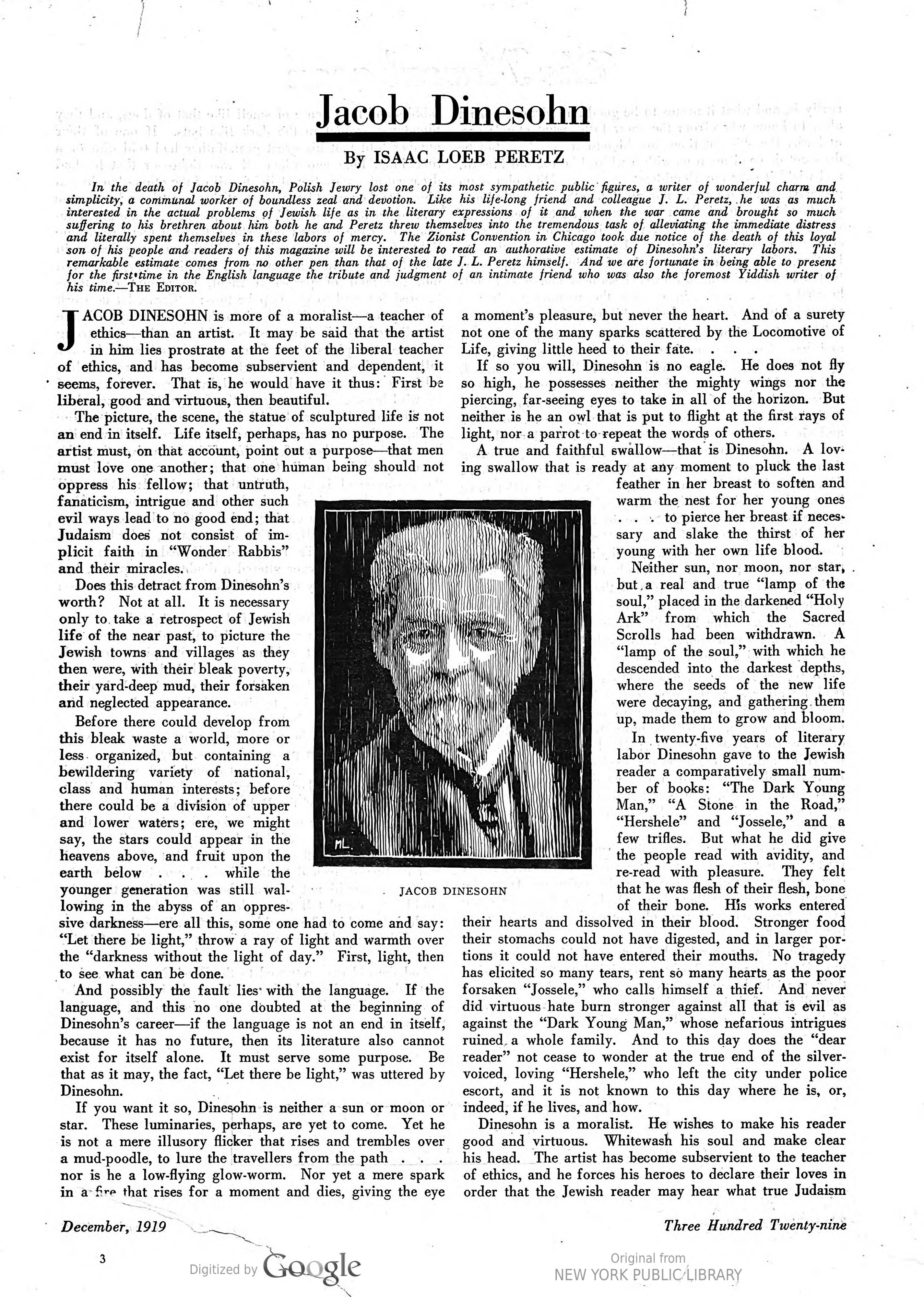
In the death of Jacob Dinesohn, Polish Jewry lost one of its most sympathetic public figures, a writer of wonderful charm and simplicity, a communal worker of boundless zeal and devotion. Like his life-long friend and colleague J. L. Peretz, he was as much interested in the actual problems of Jewish life as in the literary expressions of it and when the war came and brought so much suffering to his brethren about him both he and Peretz threw themselves into the tremendous task of alleviating the immediate distress and literally spent themselves in these labors of mercy. The Zionist Convention in Chicago took due notice of the death of this loyal son of his people and readers of this magazine will be interested to read an authoritative estimate of Dinesohn's literary labors. This remarkable estimate comes from no other pen than that of the late J. L. Peretz himself. And we are fortunate in being able to present for the first time in the English language the tribute and judgment of an intimate friend who was also the foremost Yiddish writer of his time.—THE EDITOR.
JACOB DINESOHN is more of a moralist—a teacher of ethics—than an artist. It may be said that the artist in him lies prostrate at the feet of the liberal teacher of ethics, and has become subservient and dependent, it seems, forever. That is, he would have it thus: First be liberal, good and virtuous, then beautiful.
The picture, the scene, the statue of sculptured life is not an end in itself. Life itself, perhaps, has no purpose. The artist must, on that account, point out a purpose—that men must love one another; that one human being should not oppress his fellow; that untruth, fanaticism, intrigue and other such evil ways lead to no good end; that Judaism does not consist of implicit faith in "Wonder Rabbis" and their miracles.
Does this detract from Dinesohn's worth? Not at all. It is necessary only to take a retrospect of Jewish life of the near past, to picture the Jewish towns and villages as they then were, with their bleak poverty, their yard-deep mud, their forsaken and neglected appearance.
Before there could develop from this bleak waste a world, more or less organized, but containing a bewildering variety of national, class and human interests; before there could be a division of upper and lower waters; ere, we might say, the stars could appear in the heavens above, and fruit upon the earth below. . . . while the younger generation was still wallowing in the abyss of an oppressive darkness—ere all this, some one had to come and say: "Let there be light," throw a ray of light and warmth over the "darkness without the light of day." First, light, then to see what can be done.
And possibly the fault lies with the language. If the language, and this no one doubted at the beginning of Dinesohn's career—if the language is not an end in itself, because it has no future, then its literature also cannot exist for itself alone. It must serve some purpose. Be that as it may, the fact, "Let there be light," was uttered by Dinesohn.
If you want it so, Dinesohn is neither a sun or moon or star. These luminaries, perhaps, are yet to come. Yet he is not a mere illusory flicker that rises and trembles over a mud-poodle, to lure the travellers from the path . . . nor is he a low-flying glow-worm. Nor yet a mere spark in a fire that rises for a moment and dies, giving the eye
a moment's pleasure, but never the heart. And of a surety not one of the many sparks scattered by the Locomotive of Life, giving little heed to their fate.
If so you will, Dinesohn is no eagle. He does not fly so high, he possesses neither the mighty wings nor the piercing, far-seeing eyes to take in all of the horizon. But neither is he an owl that is put to flight at the first rays of light, nor a parrot to repeat the words of others.
A true and faithful swallow—that is Dinesohn. A loving swallow that is ready at any moment to pluck the last feather in her breast to soften and warm the nest for her young ones. . . . to pierce her breast if necessary and slake the thirst of her young with her own life blood.
Neither sun, nor moon, nor star, but a real and true "lamp of the soul," placed in the darkened "Holy Ark" from which the Sacred Scrolls had been withdrawn. A "lamp of the soul," with which he descended into the darkest depths, where the seeds of the new life were decaying, and gathering them up, made them to grow and bloom.
In twenty-five years of literary labor Dinesohn gave to the Jewish reader a comparatively small number of books: "The Dark Young Man," "A Stone in the Road," "Hershele" and "Jossele," and a few trifles. But what he did give the people read with avidity, and re-read with pleasure. They felt that he was flesh of their flesh, bone of their bone. His works entered
their hearts and dissolved in their blood. Stronger food their stomachs could not have digested, and in larger portions it could not have entered their mouths. No tragedy has elicited so many tears, rent so many hearts as the poor forsaken "Jossele," who calls himself a thief. And never did virtuous hate burn stronger against all that is evil as against the "Dark Young Man," whose nefarious intrigues ruined a whole family. And to this day does the "dear reader" not cease to wonder at the true end of the silver-voiced, loving "Hershele," who left the city under police escort, and it is not known to this day where he is, or, indeed, if he lives, and how.
Dinesohn is a moralist. He wishes to make his reader good and virtuous. Whitewash his soul and make clear his head. The artist has become subservient to the teacher of ethics, and he forces his heroes to declare their loves in order that the Jewish reader may hear what true Judaism