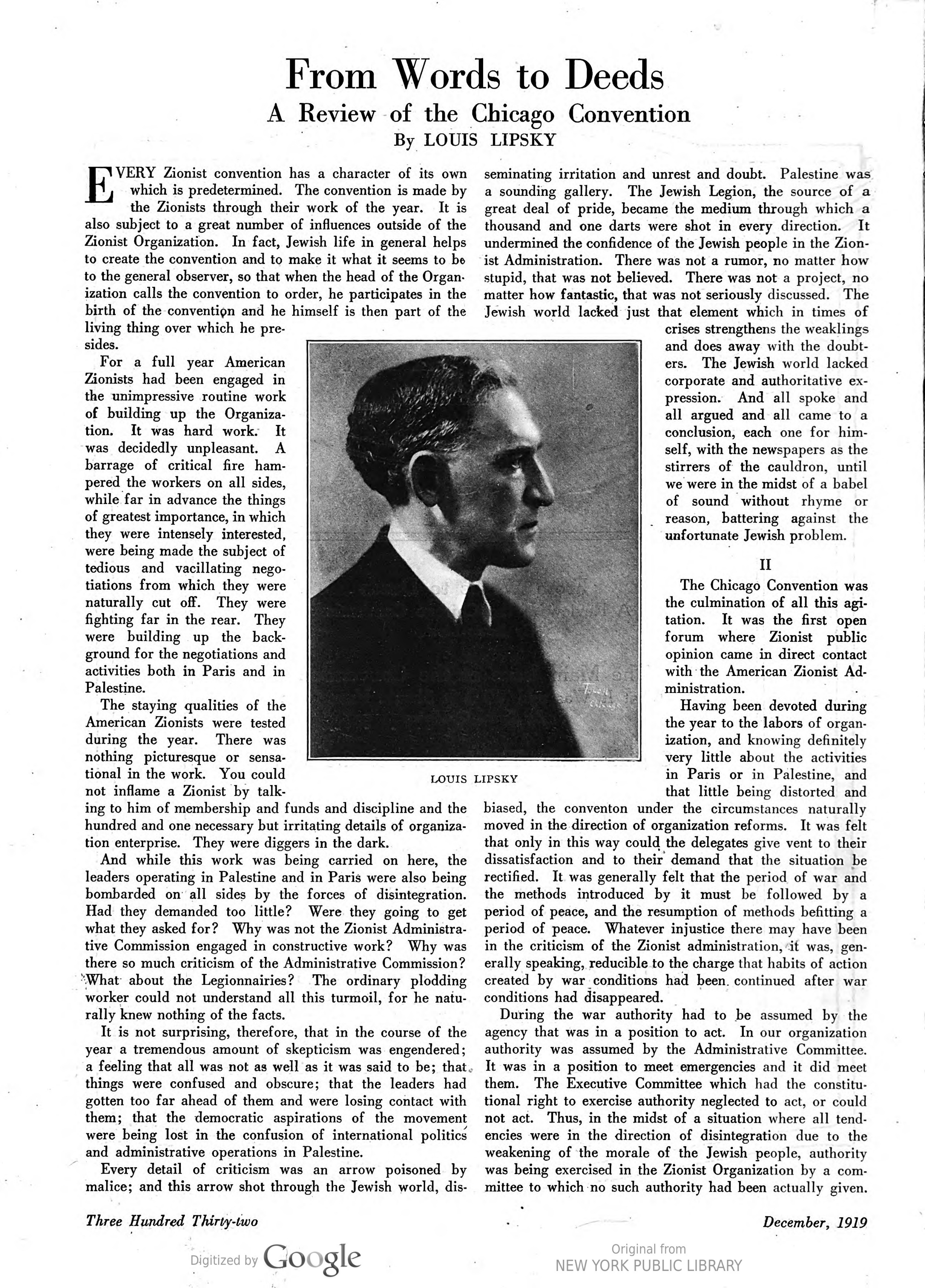
From Words to DeedsA Review of the Chicago ConventionBy LOUIS LIPSKY
EVERY Zionist convention has a character of its own which is predetermined. The convention is made by the Zionists through their work of the year. It is also subject to a great number of influences outside of the Zionist Organization. In fact, Jewish life in general helps to create the convention and to make it what it seems to be to the general observer, so that when the head of the Organization calls the convention to order, he participates in the birth of the convention and he himself is then part of the living thing over which he presides.
For a full year American Zionists had been engaged in the unimpressive routine work of building up the Organization. It was hard work. It was decidedly unpleasant. A barrage of critical fire hampered the workers on all sides, while far in advance the things of greatest importance, in which they were intensely interested, were being made the subject of tedious and vacillating negotiations from which they were naturally cut off. They were fighting far in the rear. They were building up the background for the negotiations and activities both in Paris and in Palestine.
The staying qualities of the American Zionists were tested during the year. There was nothing picturesque or sensational in the work. You could LovIS not inflame a Zionist by talking to him of membership and funds and discipline and the hundred and one necessary but irritating details of organization enterprise. They were diggers in the dark.
And while this work was being carried on here, the leaders operating in Palestine and in Paris were also being bombarded on’ all sides by the forces of disintegration. Had they demanded too little? Were they going to get what they asked for? Why was not the Zionist Administrative Commission engaged in constructive work? Why was there so much criticism of the Administrative Commission? "What' about the Legionnairies? The ordinary plodding worker could not understand all this turmoil, for he naturally knew nothing of the facts.
It is not surprising, therefore, that in the course of the year a tremendous amount of skepticism was engendered; a feeling that all was not as well as it was said to be; that. things were confused and obscure; that the leaders had gotten too far ahead of them and were losing contact with them; that the democratic aspirations of the movement were being lost in the confusion of international politics and administrative operations in Palestine.
Every detail of criticism was an arrow poisoned by malice; and this arrow shot through the Jewish world, dis-
seminating irritation and unrest and doubt. Palestine was a sounding gallery. The Jewish Legion, the source of a great deal of pride, became the medium through which a thousand and one darts were shot in every direction. It undermined the confidence of the Jewish people in the Zionist Administration. There was not a rumor, no matter how stupid, that was not believed. There was not a project, no matter how fantastic, that was not seriously discussed. The Jewish world lacked just that element which in times of crises strengthens the weaklings WITT and does away with the doubt- =. ee ers. The Jewish world lacked ve, ee corporate and authoritative exer pression. And all spoke and WE 2:5 all argued and all came to a 5 Rn conclusion, each one for him- BR ü self, with the newspapers as the r1 \ SAT stirrers of the cauldron, until Rene we were in the midst of a babel we of sound without rhyme or BT _ reason, battering against the De unfortunate Jewish problem.
II
The Chicago Convention was the culmination of all this agitation. It was the first open forum where Zionist public opinion came in direct contact with the American Zionist Administration.
Having been devoted during the year to the labors of organization, and knowing definitely very little about the activities in Paris or in Palestine, and that little being distorted and
biased, the conventon under the circumstances naturally moved in the direction of organization reforms. It was felt that only in this way could the delegates give vent to their dissatisfaction and to their demand that the situation be rectified. It was generally felt that the period of war and the methods introduced by it must be followed by a period of peace, and the resumption of methods befitting a period of peace. Whatever injustice there may have been in the criticism of the Zionist administration, it was, generally speaking, reducible to the charge that habits of action created by war conditions had been. continued after war conditions had disappeared.