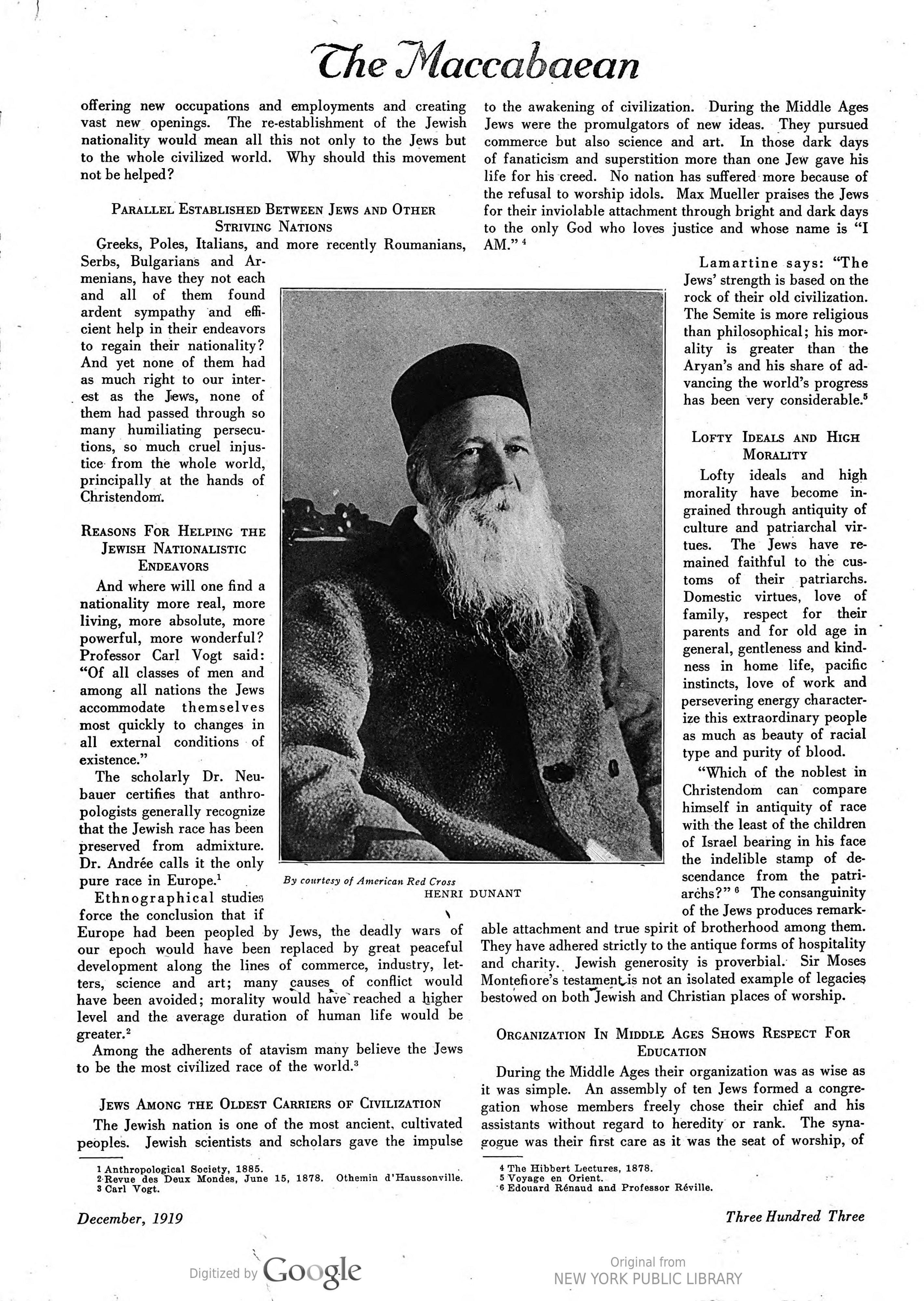
The Jews and Palestine in the 20th Century
(“Written in 1883. Not printed because of lack of money and support.”—From the author’s notes)
Translated from the original manuscript by Ida Welt, Geneva, 1919
POSITION OF JEWS AMONG NATIONS, RECOGNIZED BY NAPOLEON
THE Jews have rightly been called the kings of the epoch, kings of commerce and industry, kings of the press; they seem to govern the destiny of the world. They are a unique people, whose imperishable nationality has kept them intact from the rest of humanity, and whose influence on society could never be indifferent. In our days it has become a vast power.
It was the privilege of England and France to inaugurate this new era of tolerance and justice in their favor, and thus to destroy many old prejudices. The Anglo-Saxons were moved by the sentiment of general equity and the French acted in accordance with their favorite maxim "Equality for All." Napoleon was in the apogee of his glory and his empire embraced almost the whole continent of Europe when on May 30, 1806, he issued a decree calling for an assembly of Jewish delegates from all his states. This Hebrew council or Sanhedrin took place in February, 1807, and justified Napoleon's belief that Mosaic commandments could be harmonized with French laws.1
Within a century of the political emancipation of the Jews of Western Europe a profound change has taken place. Through their patience, perseverance and industry, Jews assumed and maintained a leading place in all branches of human activity. In 1844, Disraeli observed that political matters were directed by Jews in several European countries. Some of these statesmen were Baron de Worms, Lord Herschell, Lord Rothschild, Crémieux, Sir Moses Montefiore, and of course Disraeli, later Lord Beaconsfield.
PLAN OF RENDERING PALESTINE TO THE JEWS
The future may hold even better things in store for the children of Judah than they are enjoying today. Their reconstitution as an independent nationality does not create astonishment nor surprise. It no longer seems impracticable to the many who formerly thought it an impossible dream. Thus yesterday's utopia becomes today's reality.
In the case of gradual occupation of Judea by the Jews, no mistake must be made in regard to the animating spirit or to the leading motives. This labor of peace must be considered by Christendom as the reparation of grave injustice, as the restitution according to unwritten law. The spirit of the Crusades has ceased long ago; the more liberal idea of our epoch demand the justice of rendering its country to a wandering nation which had been violently torn from its soil. There can be no question of a general exodus, nor even persuasion of Jewish families, settled in other countries, to emigrate to the East. Everything on their side shall be voluntary and spontaneous. As we find Swiss and others settled, often since generations, as merchants, bankers, scientists or artists in France or England or Italy, and as none of these governments think of
1 After the Declaration of Rights of Man, on February 28, 1790, the Constituent French Assembly had decreed the Emancipation of the Jews, on September 28, 1791.
sending them back to their respective countries, just so ought no government to compel its Jews to go away nor exclude them from holding public office.
ADVANTAGES TO JEWISH EMIGRANTS
If a Jewish free and independent state, its neutrality solemnly recognized by the great powers, were constituted in Palestine, it would call forth the antique and ardent love of the Hebrews for their real home, The Holy Land. Wealthy Jewish families would, without dropping their allegiance to their various adopted countries, be proud to establish residence in the land of their ancestors. Today, when means of communication increase so rapidly, many members of such families would consider it a privilege to exert their influence, their activity and their valuable experience in this new country. But, besides these, hundreds of thousands of Jews now living under oppression, would be eager to avail themselves of the opportunity to carry on their work in the home of their forefathers, which to them would become their real country.
ADVANTAGES TO JEWS WHO DO NOT EMIGRATE
The great majority of Jews, disseminated throughout the world since centuries, are very much attached to the right of nationality. The Jews, who choose to remain in the various countries, would be more respected just as soon as their brethren would form an officially recognized country in Palestine. In any case since the Napoleonic era no one will lose the rights of naturalization who desires to preserve them.
In our times all strata of society are undergoing perpetual changes, the most unexpected events take place—and a new leaven is also working in Israel. Jews everywhere look eagerly ahead. Their civil and political emancipation was only the prelude towards a higher and more complete liberation.
NEW AVENUES OF COMMERCE AND INDUSTRY
Why could this industrious, active, persevering people not be the energetic, courageous pioneer of a new civilization? Great regions of Asia, once so rich, are now deserted. In the midst of ruins of old splendor, could Jerusalem, Tiberias, Damascus or Nineveh not be rebuilt and become the rivals of the great cities of the Occident? Fair cities as New York, Boston, Philadelphia, San Francisco, Sidney and Melbourne do not look back upon centuries of existence. Did not Chicago arise from its ruins by magic? One's imagination can picture the power and influence of the big Jewish business men, the kings of finance, once they were given the opportunity of initiating such a glorious enterprise. They would attract a multitude of Jews and others with their resources of capital, of unspent force of creation, of organization and administration. The European countries that do not possess any flourishing colonies, would be the gainers of such a large field of activity,