How to Build Up Our Settlement
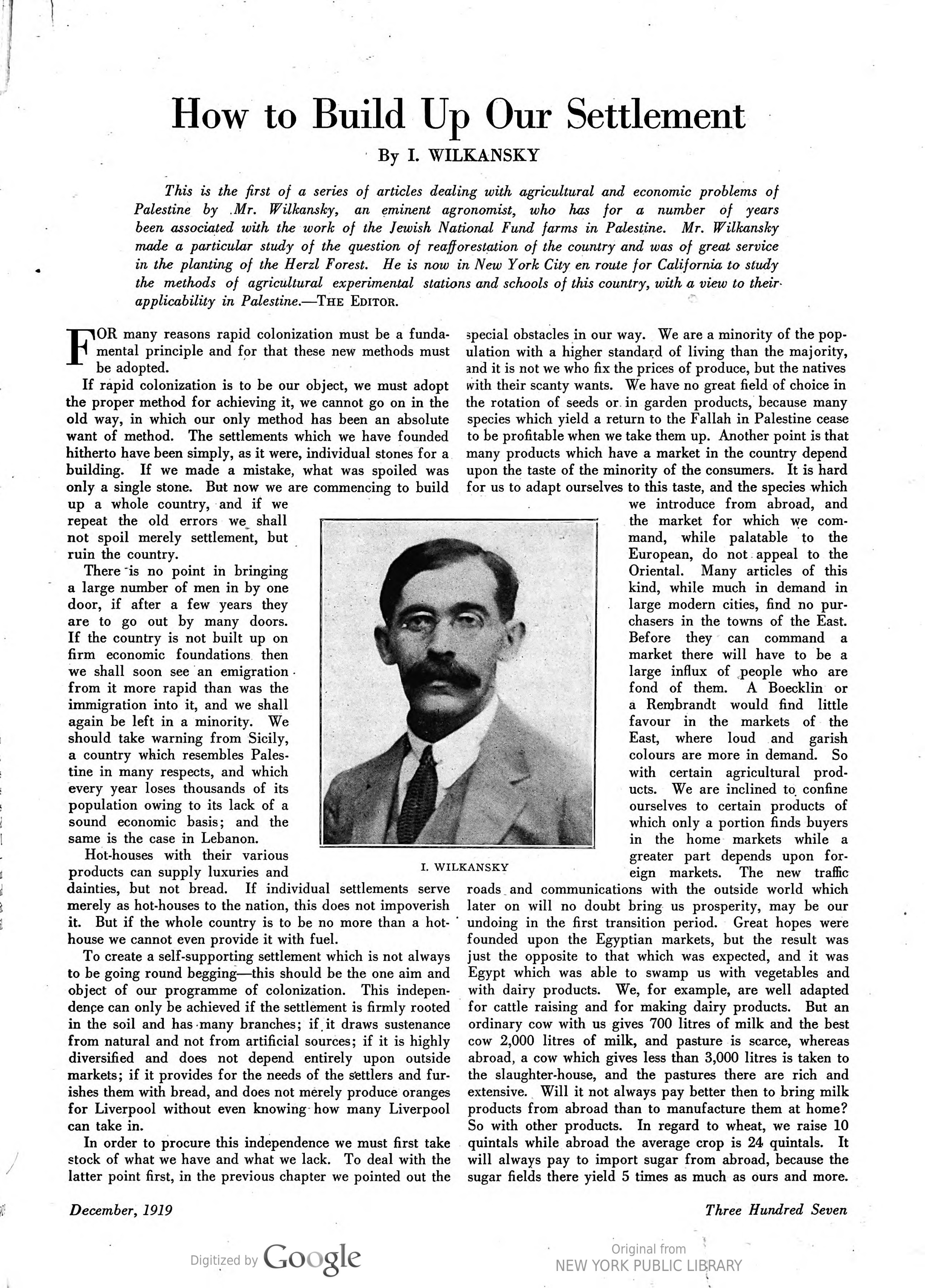
This is the first of a series of articles dealing with agricultural and economic problems of Palestine by Mr. Wilkansky, an eminent agronomist, who has for a number of years been associated with the work of the Jewish National Fund farms in Palestine. Mr. Wilkansky made a particular study of the question of reafforestation of the country and was of great service in the planting of the Herzl Forest. He is now in New York City en route for California to study the methods of agricultural experimental stations and schools of this country, with a view to their applicability in Palestine.—THE EDITOR.
FOR many reasons rapid colonization must be a fundamental principle and for that these new methods must be adopted.
If rapid colonization is to be our object, we must adopt the proper method for achieving it, we cannot go on in the old way, in which our only method has been an absolute want of method. The settlements which we have founded hitherto have been simply, as it were, individual stones for a building. If we made a mistake, what was spoiled was only a single stone. But now we are commencing to build up a whole country, and if we repeat the old errors we shall not spoil merely settlement, but ruin the country.
There is no point in bringing a large number of men in by one door, if after a few years they are to go out by many doors. If the country is not built up on firm economic foundations. then we shall soon see an emigration from it more rapid than was the immigration into it, and we shall again be left in a minority. We should take warning from Sicily, a country which resembles Palestine in many respects, and which every year loses thousands of its population owing to its lack of a sound economic basis; and the same is the case in Lebanon.
Hot-houses with their various products can supply luxuries and dainties, but not bread. If individual settlements serve merely as hot-houses to the nation, this does not impoverish it. But if the whole country is to be no more than a hot-house we cannot even provide it with fuel.
To create a self-supporting settlement which is not always to be going round begging —this should be the one aim and object of our programme of colonization. This independence can only be achieved if the settlement is firmly rooted in the soil and has many branches; if it draws sustenance from natural and not from artificial sources; if it is highly diversified and does not depend entirely upon outside markets; if it provides for the needs of the settlers and furnishes them with bread, and does not merely produce oranges for Liverpool without even knowing how many Liverpool can take in.
In order to procure this independence we must first take stock of what we have and what we lack. To deal with the latter point first, in the previous chapter we pointed out the
special obstacles in our way. We are a minority of the population with a higher standard of living than the majority, and it is not we who fix the prices of produce, but the natives with their scanty wants. We have no great field of choice in the rotation of seeds or in garden products, because many species which yield a return to the Fallah in Palestine cease to be profitable when we take them up. Another point is that many products which have a market in the country depend upon the taste of the minority of the consumers. It is hard for us to adapt ourselves to this taste, and the species which
we introduce from abroad, and the market for which we command, while palatable to the European, do not appeal to the Oriental. Many articles of this kind, while much in demand in large modern cities, find no purchasers in the towns of the East. Before they can command a market there will have to be a large influx of people who are fond of them. A Boecklin or a Rembrandt would find little favour in the markets of the East, where loud and garish colours are more in demand. So with certain agricultural products. We are inclined to confine ourselves to certain products of which only a portion finds buyers in the home markets while a greater part depends upon foreign markets. The new traffic
roads and communications with the outside world which later on will no doubt bring us prosperity, may be our undoing in the first transition period. Great hopes were founded upon the Egyptian markets, but the result was just the opposite to that which was expected, and it was Egypt which was able to swamp us with vegetables and with dairy products. We, for example, are well adapted for cattle raising and for making dairy products. But an ordinary cow with us gives 700 litres of milk and the best cow 2,000 litres of milk, and pasture is scarce, whereas abroad, a cow which gives less than 3,000 litres is taken to the slaughter-house, and the pastures there are rich and extensive. Will it not always pay better then to bring milk products from abroad than to manufacture them at home? So with other products. In regard to wheat, we raise 10 quintals while abroad the average crop is 24 quintals. It will always pay to import sugar from abroad, because the sugar fields there yield 5 times as much as ours and more.