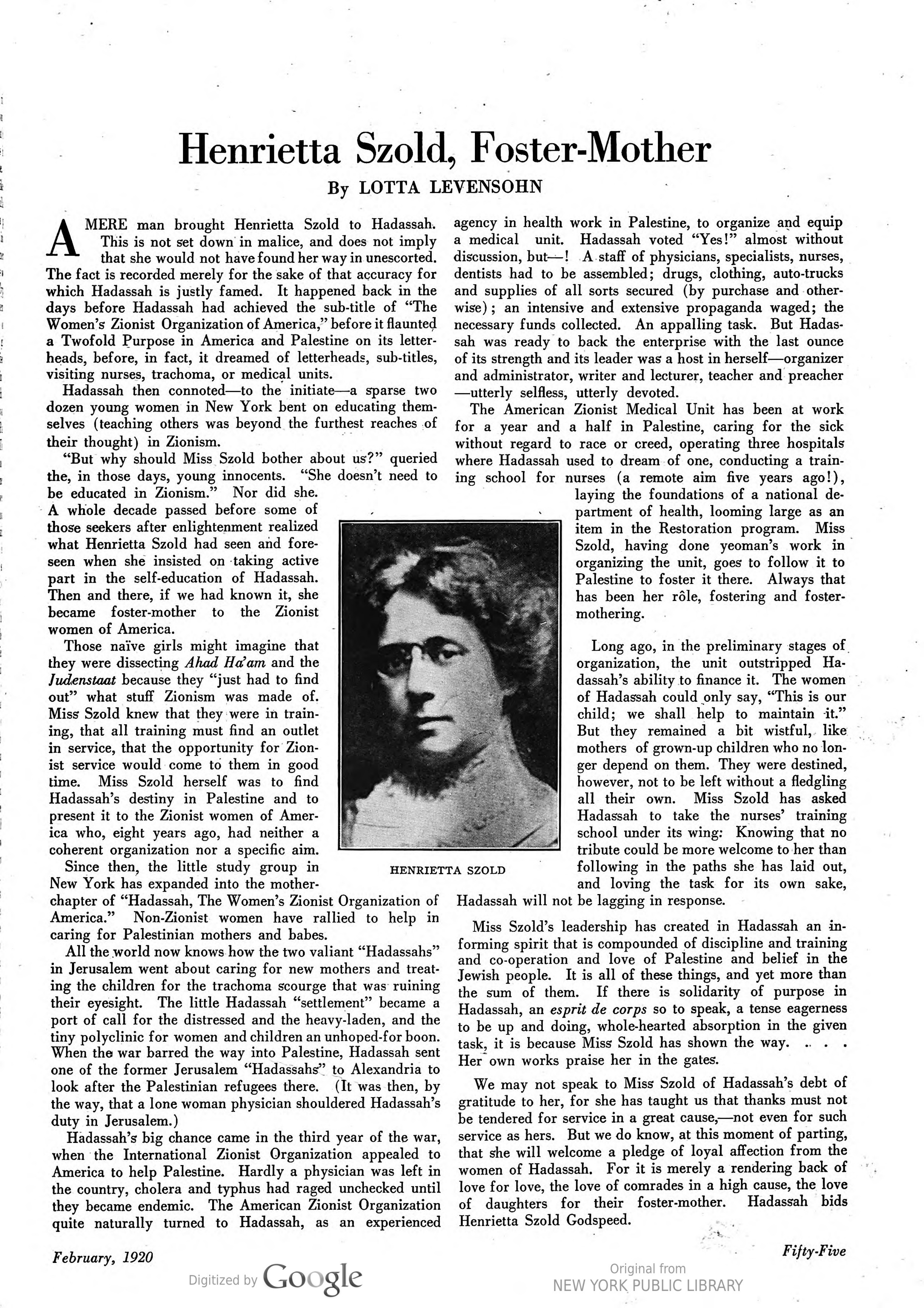
Henrietta Szold, Foster-Mother
A MERE man brought Henrietta Szold to Hadassah. This is not set down in malice, and does not imply that she would not have found her way in unescorted. The fact is recorded merely for the sake of that accuracy for which Hadassah is justly famed. It happened back in the days before Hadassah had achieved the sub-title of "The Women's Zionist Organization of America," before it flaunted a Twofold Purpose in America and Palestine on its letterheads, before, in fact, it dreamed of letterheads, sub-titles, visiting nurses, trachoma, or medical units.
Hadassah then connoted—to the initiate—a sparse two dozen young women in New York bent on educating themselves (teaching others was beyond the furthest reaches of their thought) in Zionism.
"But why should Miss Szold bother about us?" queried the, in those days, young innocents. "She doesn't need to be educated in Zionism." Nor did she. A whole decade passed before some of those seekers after enlightenment realized what Henrietta Szold had seen and foreseen when she insisted on taking active part in the self-education of Hadassah. Then and there, if we had known it, she became foster-mother to the Zionist women of America.
Those naïve girls might imagine that they were dissecting Ahad Ha'am and the Judenstaat because they "just had to find out" what stuff Zionism was made of. Miss Szold knew that they were in training, that all training must find an outlet in service, that the opportunity for Zionist service would come to them in good time. Miss Szold herself was to find Hadassah's destiny in Palestine and to present it to the Zionist women of America who, eight years ago, had neither a coherent organization nor a specific aim.
Since then, the little study group in New York has expanded into the mother- chapter of "Hadassah, The Women's Zionist Organization of America." Non-Zionist women have rallied to help in caring for Palestinian mothers and babes.
All the world now knows how the two valiant "Hadassahs" in Jerusalem went about caring for new mothers and treating the children for the trachoma scourge that was ruining their eyesight. The little Hadassah "settlement" became a port of call for the distressed and the heavy-laden, and the tiny polyclinic for women and children an unhoped-for boon. When the war barred the way into Palestine, Hadassah sent one of the former Jerusalem "Hadassahs" to Alexandria to look after the Palestinian refugees there. (It was then, by the way, that a lone woman physician shouldered Hadassah's duty in Jerusalem.)
Hadassah's big chance came in the third year of the war, when the International Zionist Organization appealed to America to help Palestine. Hardly a physician was left in the country, cholera and typhus had raged unchecked until they became endemic. The American Zionist Organization quite naturally turned to Hadassah, as an experienced
agency in health work in Palestine, to organize and equip a medical unit. Hadassah voted "Yes!" almost without discussion, but—! A staff of physicians, specialists, nurses, dentists had to be assembled; drugs, clothing, auto-trucks and supplies of all sorts secured (by purchase and otherwise); an intensive and extensive propaganda waged; the necessary funds collected. An appalling task. But Hadassah was ready to back the enterprise with the last ounce of its strength and its leader was a host in herself—organizer and administrator, writer and lecturer, teacher and preacher—utterly selfless, utterly devoted.
The American Zionist Medical Unit has been at work for a year and a half in Palestine, caring for the sick without regard to race or creed, operating three hospitals where Hadassah used to dream of one, conducting a training school for nurses (a remote aim five years ago!), laying the foundations of a national department of health, looming large as an item in the Restoration program. Miss Szold, having done yeoman's work in organizing the unit, goes to follow it to Palestine to foster it there. Always that has been her rôle, fostering and fostermothering.
Long ago, in the preliminary stages of organization, the unit outstripped Hadassah's ability to finance it. The women of Hadassah could only say, "This is our child; we shall help to maintain it." But they remained a bit wistful, like mothers of grown-up children who no longer depend on them. They were destined, however, not to be left without a fledgling all their own. Miss Szold has asked Hadassah to take the nurses' training school under its wing: Knowing that no tribute could be more welcome to her than following in the paths she has laid out, and loving the task for its own sake, Hadassah will not be lagging in response.
Miss Szold's leadership has created in Hadassah an informing spirit that is compounded of discipline and training and co-operation and love of Palestine and belief in the Jewish people. It is all of these things, and yet more than the sum of them. If there is solidarity of purpose in Hadassah, an esprit de corps so to speak, a tense eagerness to be up and doing, whole-hearted absorption in the given task, it is because Miss Szold has shown the way. . . . Her own works praise her in the gates.
We may not speak to Miss Szold of Hadassah's debt of gratitude to her, for she has taught us that thanks must not be tendered for service in a great cause,—not even for such service as hers. But we do know, at this moment of parting, that she will welcome a pledge of loyal affection from the women of Hadassah. For it is merely a rendering back of love for love, the love of comrades in a high cause, the love of daughters for their foster-mother. Hadassah bids Henrietta Szold Godspeed.