"Balfouria"
On page 60 of this issue our Palestine Correspondent, Mr. Gershon Agronsky, writing under date of November 22, 1919, points out the differences that have arisen between the Jewish Legionaires who have been invited to settle on the colony "Balfouria" and the Administration of the American Zion Commonwealth with regard to certain fundamental principles governing the administration of this colony. The following article by Mr. Rosenblatt, President of the American Zion Commonwealth, though not intended as a reply to the contentions of the Legionaires, gives a clear statement of the actual facts in the case.—THE EDITOR.
WHAT and where is Balfouria? Rumors, often contradictory, have gone forth about a colony established by the American Zion Commonwealth for Jewish Legionaires, who are to settle "upon the soil for which they fought."
The story can be told in a few words. The American Zion Commonwealth was organized (under the laws of the State of New York) on September 10, 1914, for the purpose of buying and developing land in Palestine for its members (and their friends, whenever such members cannot take personal possession of their lands).
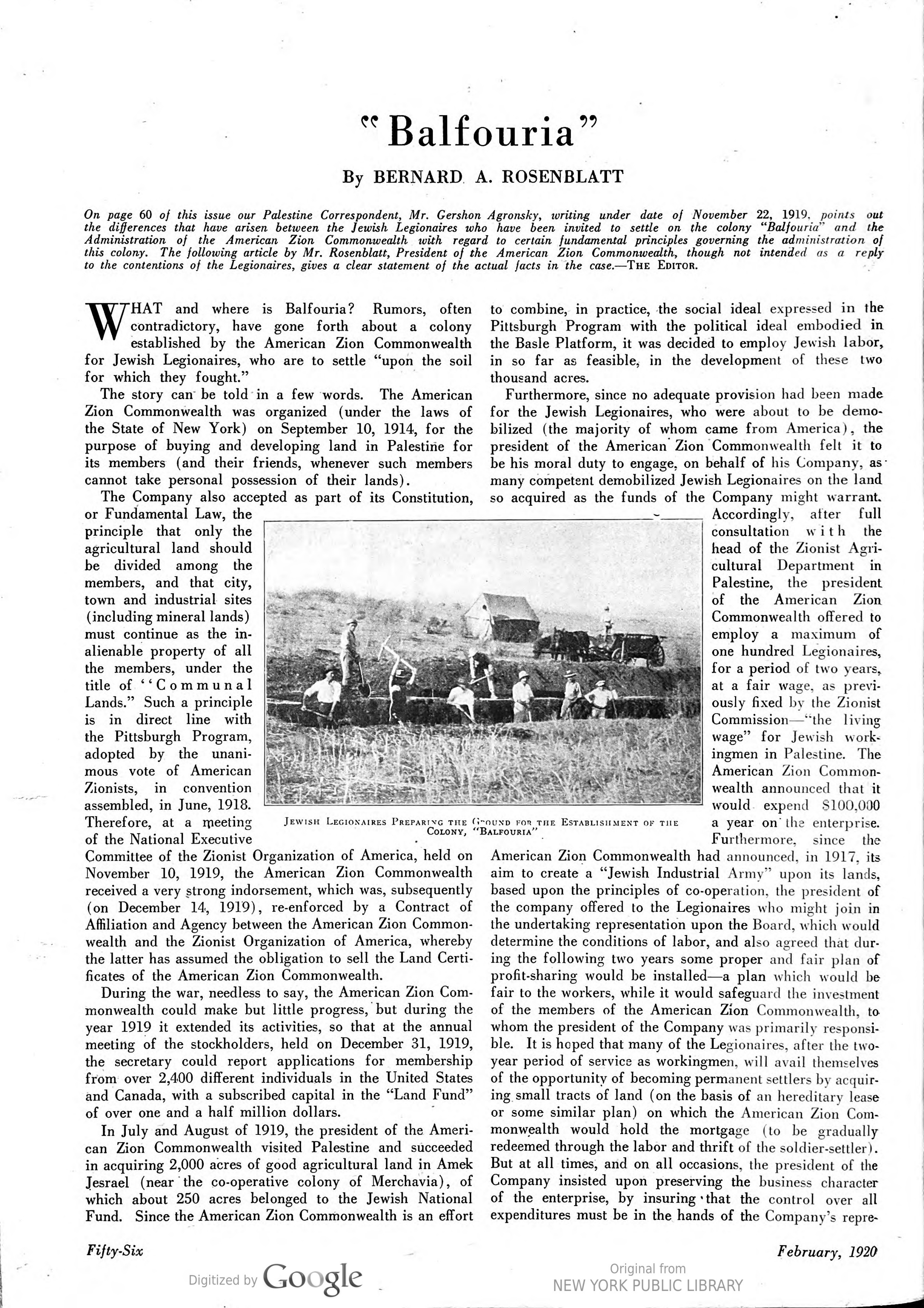
The Company also accepted as part of its Constitution, or Fundamental Law, the principle that only the agricultural land should be divided among the members, and that city, town and industrial sites (including mineral lands) must continue as the inalienable property of all the members, under the title of "Communal Lands." Such a principle is in direct line with the Pittsburgh Program, adopted by the unanimous vote of American Zionists, in convention assembled, in June, 1918. Therefore, at a meeting of the National Executive JEWISH LEGIONAIRES PREPARING THE COLONY,
Committee of the Zionist Organization of America, held on November 10, 1919, the American Zion Commonwealth received a very strong indorsement, which was, subsequently (on December 14, 1919), re-enforced by a Contract of Affiliation and Agency between the American Zion Commonwealth and the Zionist Organization of America, whereby the latter has assumed the obligation to sell the Land Certificates of the American Zion Commonwealth.
During the war, needless to say, the American Zion Commonwealth could make but little progress, but during the year 1919 it extended its activities, so that at the annual meeting of the stockholders, held on December 31, 1919, the secretary could report applications for membership from over 2,400 different individuals in the United States and Canada, with a subscribed capital in the “Land Fund” of over one and a half million dollars. r
In July and August of 1919, the president of the American Zion Commonwealth visited Palestine and succeeded in acquiring 2,000 acres of good agricultural land in Amek Jesrael (near the co-operative colony of Merchavia), of which about 250 acres belonged to the Jewish National Fund. Since the American Zion Commonwealth is an effort
to combine, in practice, the social ideal expressed in the Pittsburgh Program with the political ideal embodied in the Basle Platform, it was decided to employ Jewish labor, in so far as feasible, in the development of these two thousand acres.
Furthermore, since no adequate provision had been made for the Jewish Legionaires, who were about to be demobilized (the majority of whom came from America), the president of the American Zion Commonwealth felt it to be his moral duty to engage, on behalf of his Company, as many competent demobilized Jewish Legionaires on the land so acquired as the funds of the Company might warrant.
Accordingly, after full consultation with the head of the Zionist Agricultural Department in Palestine, the president of the American Zion Commonwealth offered to employ a maximum of one hundred Legionaires, for a period of two years, at a fair wage, as previously fixed by the Zionist Commission— "the living wage” for Jewish workingmen in Palestine. The American Zion Commonwealth announced that it would. expend S100,000 a year on’ ihe enterprise. Furthermore since tha
American Zion Commonwealth had announced, in 1917, its aim to create a "Jewish Industrial Army" upon its lands, based upon the principles of co-operation, the president of the company offered to the Legionaires who might join in the undertaking representation upon the Board, which would determine the conditions of labor, and also agreed that during the following two years some proper and fair plan of profit-sharing would be installed —a plan which would be fair to the workers, while it would safeguard the investment of the members of the American Zion Commonwealth, to whom the president of the Company was primarily responsible. It is hoped that many of the Legionaires, after the two- year period of service as workingmen, will avail themselves of the opportunity of becoming permanent settlers by acquiring small tracts of land (on the basis of an hereditary lease or some similar plan) on which the American Zion Commonwealth would hold the mortgage (to be gradually redeemed through the labor and thrift of the soldier-settler). But at all times, and on all occasions, the president of the Company insisted upon preserving the business character of the enterprise, by insuring that the control over all expenditures must be in the hands of the Company's repre-