The Heart of Ha-Poel
Letters of a Jewish Workingman from Palestine
The spirit of a new Jewish Social-Democracy in process of growth now on Palestinian soil is making for a unique reconciliation between the ideals of Socialism and Nationalism, in keeping with the singular and unprecedented historical tasks of Jewish labor at work in the rebuilding of a new Eretz-Yisroel. This spirit is classically embodied in a little booklet of a Palestinian workingman named A. D. Gordon, "Briefe aus Palestina" (Welt-Verlag, Berlin, 1919) the inspiring message of which we take pleasure in transmitting to our readers, in English excerpts.—THE EDITOR.
From the First Letter
My Friends—I am addressing you through the public press because I know that in this wise my words will reach you wherever you may dwell. It is a matter of concern to me that my message should reach you. I am not a publicist or man of letters. I am a plain Jew, now writing to you in the manner of one writing to his own family in matters of family concern. And I believe you will be interested to read, for I am not writing about myself, but about our good old mother, our ancient land, so beautiful even now, despite poverty and ruin, that many young mothers might well wish to be so fair of face.
What can be more natural than greetings from the old mother? But we have grown such strangers to our old home—to any home—that a maternal greeting sounds cold and lifeless to most of us. To those who are aliens living in rejection, such a voice from the ancient soil may sound too childlike, too human altogether. The exile, however, does not breed orphans—it breeds abandoned children. All filial sentiment is frozen—but not dead. There is an ember of it in every Jewish soul, invisible often to the naked eye. But an ember is enough, if you know how to stir it into flame. Above all, take heed lest you blow too hard; that means a flare-up and then extinction. One must cautiously, gently remove those ashes of the foreign soil that choke the blast by warding off fresh air. One must free the soul, and the ember will soon be aglow once more. One must speak to the homeless soul quietly, seriously, of things near and dear—nothing but the naked truth! That purifies, that liberates, for it shapes the soul by confronting it with life as it is.
My message from Palestine is therefore plain home-talk. Everything in Palestine wears the same homely, workaday physiognomy as anywhere else. You will find here the same trivialities—the same meannesses, if you like—as anywhere else. And our national work is so small—so microscopically small—that one must have an extraordinarily keen eyesight to see its true importance. Of noise and fireworks we have our ample share in Palestine, but that is only matter of offense and vexation to serious souls. . . .
But if you turn to Palestine with open minds and hearts, with hearts sympathetically feeling the travail of a new world despite its crooked spasms and unbeautiful cries—rest assured your trouble will be repaid. In Palestine, look you, we are with ourselves—everything is ours; our action, our omission, our light, our shadow, our joys, our tribulations. To be sure, you have all manner of cares and sorrows where you are—but your cares and sorrows are senseless; they have no common object. Here in Palestine, the heaviest cares, the most terrible tribulations, have a meaning—no stroke of fate is lost, no sorrow senseless, no spark without its illumination, no tune without its reverberating echo. Those who dwell in Palestine, do and suffer in our cause. Whatever may befall them later on—insolv-
ency, even expatriation—their energies, their devotions, their sufferings, remain. Apart from those that fail, there are the others that sow the good seed, that use their lives as seed corn . . . all this is microscopically small, but it lives . . . bide your time and see! . . .
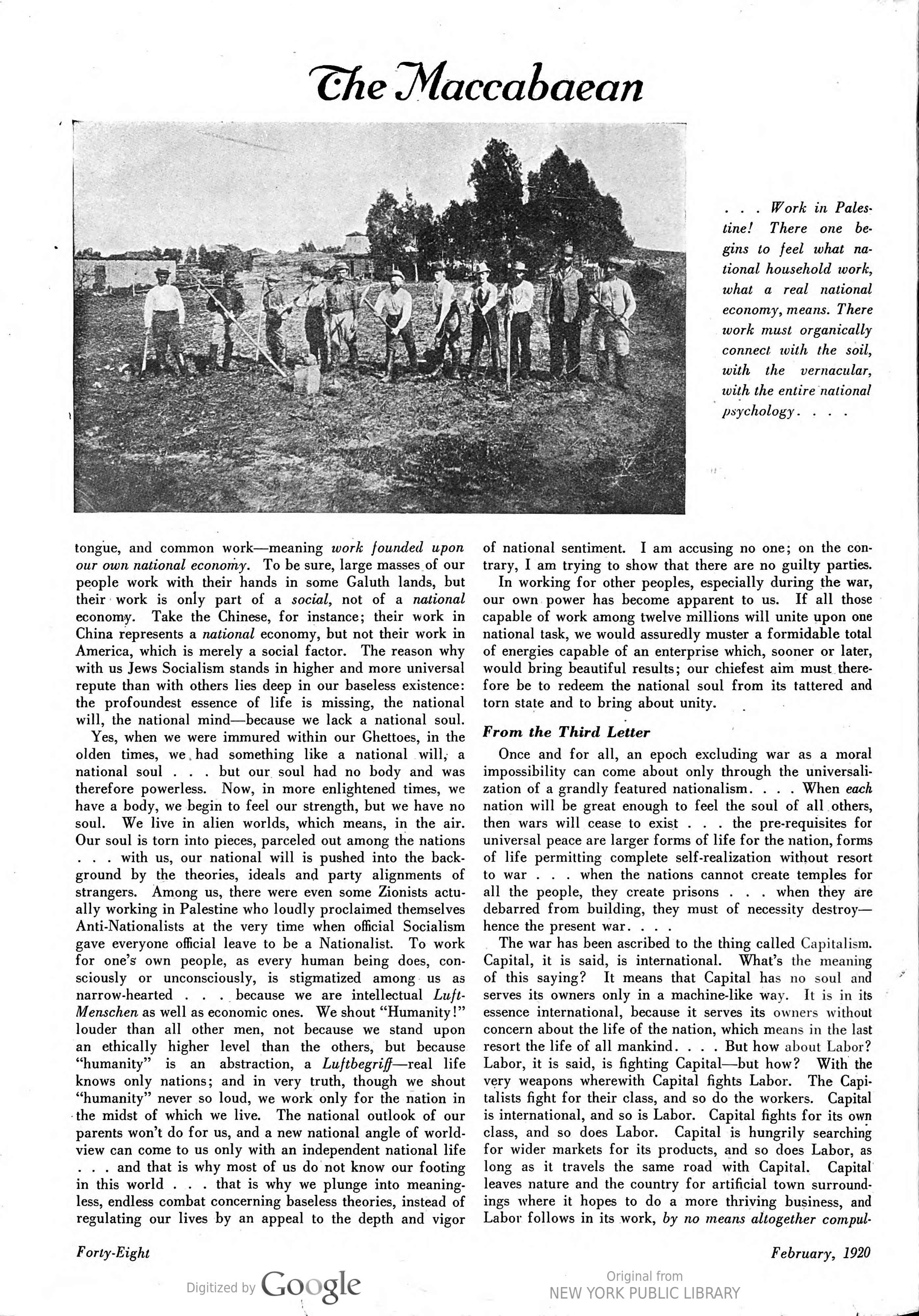
Work here, face to face with a nature of serene majesty, and our future will become clear to you. Our people work the soil here simply, artlessly, sometimes clumsily—and yet, they find their reward in becoming one with the surrounding nature, in taking root in the soil, in expanding with the palm-trees and the lush grass under the same subtropical sun. And when moments of trial come—as often they do—when bad, senseless, unexpected events of evil omen strike from within or without, stunning, darkening one's eyes—the old Haggada is brought to mind of an angel whipping the grass and exclaiming, Grow! . . .
Understand: The week is longer than the Sabbath, the ruin vaster than the rebuilding, the travail stronger than the creature to be born. The birth-throes are terrible, their anguish abysmal, because our souls are small and of little strength. The whole greatness of the creature to be born is not encompassed, two thousand years of national sufferings are not transmuted into a dynamic force available for our work —there is not sense enough as yet to sum up the value of such an asset. . . . .
One privilege at least do we share—we who stand firm upon Palestinian ground—the bitterness we taste is the anguish of delivery in birth—a pain that cannot be felt in Galuth—our hope and our courage is like the hope and high courage of women with child. . . .
You, my friends, who read this can be of important help to Palestine, if Palestine can give you something of vital import—something that you are seeking, unconsciously perhaps, with your souls. It would be an evil thing, both for you and for the country, if you were only to give not to take. . . . It is high time to strike out for a vital connection, a living contact between the Jews of Palestine and those of other countries . . . life itself has put this matter upon the order of the day. But this requires a special letter. Meantime, confidence, courage, work—that is what we all need, you and we. Farewell!
From the Second Letter
My Friends—At this time, when there is as much misery and ruin in Galuth lands as in Palestine, one might think, perhaps: nothing simpler than the welding of all individual Jewish wills into one national will for the accomplishment of one national task. And yet, this seemingly simple matter is a coil of tangled problems, like our entire life, because it is a life whereof we have not the shaping; it is nothing but cordage made of alien flax, a by-product of foreign life, and so enmeshed therein that we cannot even define and circumscribe our own life. We have not even the three pillars upon which all nations, even politically dependent ones, are founded: a common land, a common