The River of Pestilence
MESCHIGORJE . . . the village lies, as its name indicates, among the hills. A charming hamlet of farlntastic beauty, about 15 kilometers from Kiev. Red-gleaming hillsides covered with forests, deep ravines and winding forest paths. One of these, in colors green and red, followed the meandering Dnieper.
Back of the hills—a city, or rather a village, peaceful and quiet, dreaming in the sunny calm of the forest.
Although the village was plainly visible from Mt. Vladimir, the highest point of Kiev, the quiet of the hamlet was never disturbed by the noise of the city, by political strife, or by the unbridled passions of man. Life was peaceful and quiet; one took life as one found it behind those green hills.
In this peace there lived numerous Jewish families—old native families, most intimately related to the peasants of the Ukraine. They often quarreled a bit, but the quarreling was mostly on the side of the peasants; in general, they got along about as well as you can expect people to get along, who have been neighbors for generations. And when the first revolution—the March Revolution of 1917—had come, and the Jews had been completely enfranchised, then Jew and Gentile became better friends than ever, inasmuch as they had common interest and a common soil to defend. In the meantime the storm broke in the remainder of the country. Things began to seethe and boil. One government replaced another. Every season brought a new master. The German had been in the land, and gone. Everywhere grew the spirit of revolt. But in Meschigorje there still prevailed an idyllic calm.
Until the Bolsheviki finally conquered the Ukraine, and the wild bestial counter-revolution of the Petlura Party began. It was in the winter months of 1919, when the hills of Meschigorje were still closely and warmly enveloped in their shining mantle of snow. The emissaries of Petlura, the national hero of the Ukraine, and of his so-called Directory, hastened through the land, found their way into the villages, into the suburbs of the cities. fed the flames, appealed to the lowest instincts of the peasants, whipped their slow blood to an insane fanaticism and beastly lust for blood; and inasmuch as they could find no better object for their propaganda, they took the old-fashioned method of oppressing and blaming the Jews. Any movement for the independence of the Ukraine would have found scant favor among the peasants. There still showed in their views a high respect for Great Russia, and a complete separation had little appeal. These peasants were indifferent and had no national pride. Furthermore, it was not so easy to combat the Bolsheviki in the country districts. The peasant had no confidence in any form of government, and was rather partial to the Bolsheviki, who had overwhelmed him at least with promises. But the Jew was the best fuel to start the fire with. Day in and day out, agitators told the peasants the most terrible stories; under the mask of Bolshevism the Jews had assumed control of the country; they were the real rulers in Christendom; in Kiev they had transformed the Holy Church of St. Sophia into a bath-house; they had abused and tortured the priests; they had com-
mitted sacrilege; they had taken the peasant's crops and cattle to sell them in Moscow, where the Jew Lenine, like a Czar, etc., etc. And by no means did their words fall on deaf ears. At first, of course, the old peasants shook their heads incredulously. They could scarcely believe that these Jews, with whom they had been on good terms for so many heavy years, who so often had stood by them in time of trouble, who even had protected them as well as they could during the German occupation, who were such good Ukrainians and loved their native sod so much, were to blame for all these crimes that were laid at their doors. The peasants' brains were befogged. Old pictures from the times of their ancestors, from the times of the wild Heidainaken battles (in the seventeenth and eighteenth centuries) arose from unknown depths. The Beast was gradually freed from the weak bonds of humanity.
And thus two months had passed; the snow melted, and spring came. With the indefinable unrest that spring always produces, the demands of blood gone wild increased. The young men were impatient. Hadn't they just returned from the war? And wasn't murder their business? They had brought along all the tools of death—rifles, bayonets, machine-guns, and hand-grenades. Even a small-bore cannon was buried in the village—a relic of the famous retreat of the Russian Army. And all these arms were waiting for someone to use them.
For a long time the Jews could not bring themselves to believe in the danger which threatened them. It appeared improbable and unnatural that Ivan, Nikita, Petro, or Michilow, their neighbors and old friends, could really do them any harm. Even when they heard of the terrible events in Schitomir, Ovrutsch, Peroskrov, and numerous other places where pogroms had occurred, butcheries of the Ukrania, they hoped: We shall escape this cup of bitterness. In the cities, indeed, it is different, there Jews and Christians live as though separated by iron walls—two hostile camps. There the keen rivalry between Jew and Christian is sharpened by purely economic considerations. The small Christian merchant sees in the Jew a mighty rival whom he can get rid of only by murder and pillage. And the inhabitant of the cities is demoralized and degenerated, no real peasant and yet no educated inhabitant of the city, therefore, full of hate, envy, and distrust. And finally they talk so much of politics nowadays, perhaps—who knows— perhaps our people were going too far in the cities; the loud and impatient young people who were bent upon making common cause with the Bolsheviki may really have aroused the displeasure of the people. But alas! we can’t restrain our youth. But here in our village there is not a trace of all this, we have not even a real Bolshevistic government; of course we have a Revkom (Revolutionary Committee) and even a Kombed (Committee of the poorest peasants) who are supposed to represent a sort of a government. but these are all Christians, not a trace of a Jew.
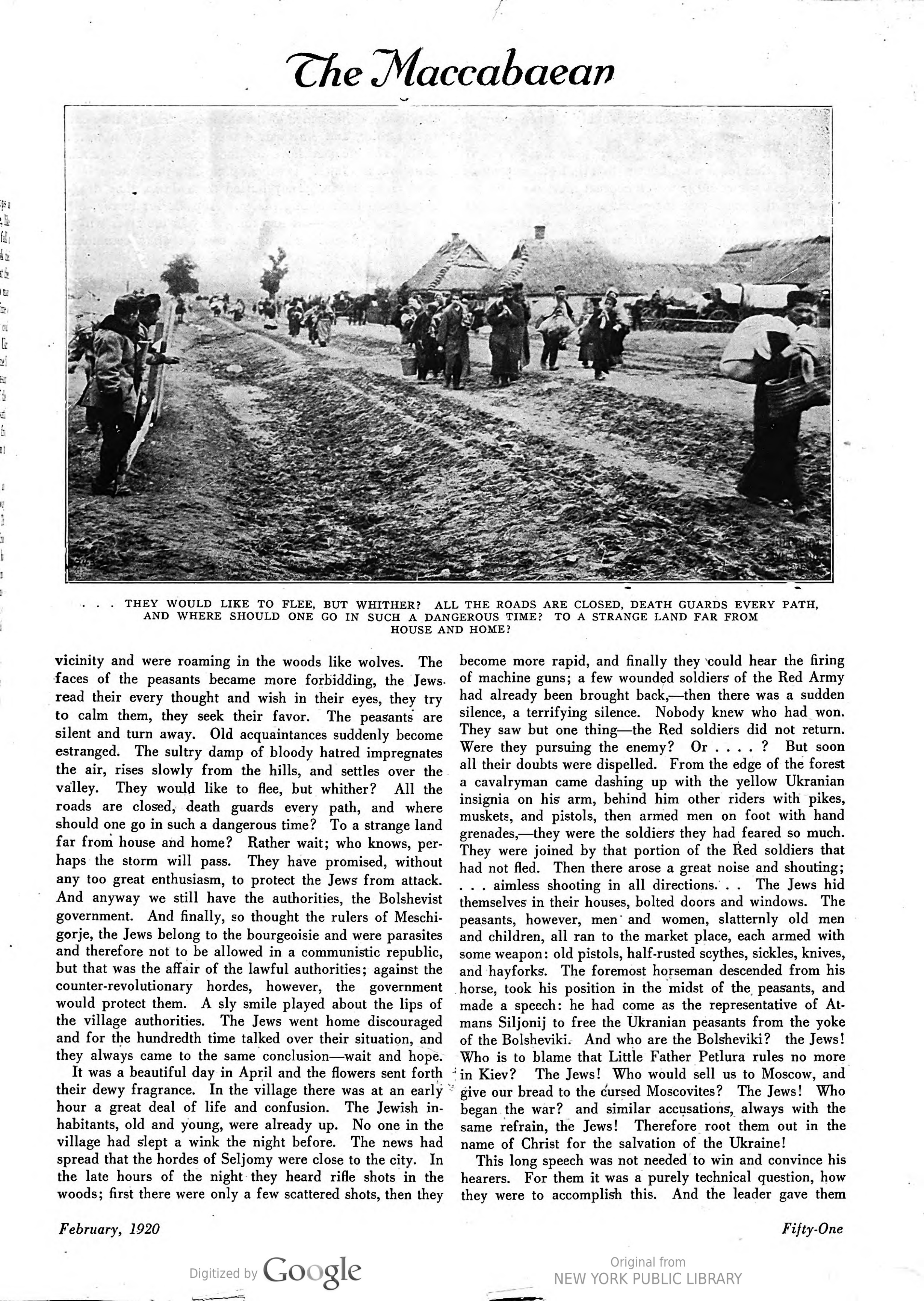
Thus the frightened Jews consoled themselves and hoped. Daily new rumors arrived. In the cities and villages round about the cruel butchery had started. The troops of Sel-jomy, the Petlura captain, had already appeared in the