From Dan to Beersheba
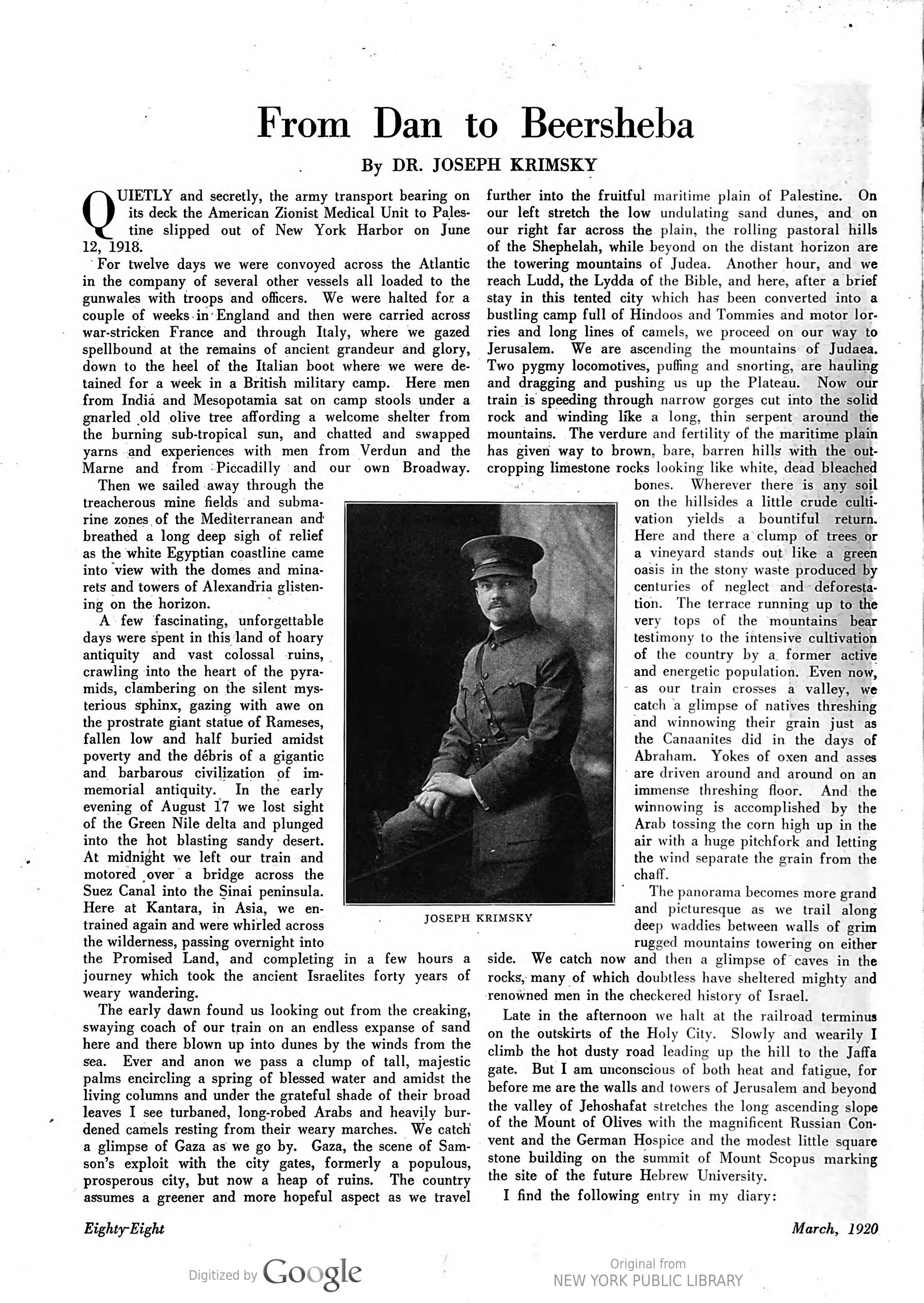
QUIETLY and secretly, the army transport bearing on its deck the American Zionist Medical Unit to Palestine slipped out of New York Harbor on June 12, 1918.
‘For twelve days we were convoyed across the Atlantic in the company of several other vessels all loaded to the gunwales with troops and officers. We were halted for a couple of weeks:in’ England and then were carried across war-stricken France and through Italy, where we gazed spellbound at the remains of ancient grandeur and glory, down to the heel of the Italian boot where we were detained for a week in a British military camp. Here men from India and Mesopotamia sat on camp stools under a gnarled old olive tree affording a welcome shelter from the burning sub-tropical sun, and chatted and swapped yarns and experiences with men from Verdun and the Marne and from :Piccadilly and our own Broadway.
Then we sailed away through the treacherous mine fields and submarine zones of the Mediterranean and breathed a long deep sigh of relief as the white Egyptian coastline came into view with the domes and minarets and towers of Alexandria glistening on the horizon.
A few fascinating, unforgettable days were spent in this land of hoary antiquity and vast colossal ruins, crawling into the heart of the pyramids, clambering on the silent mysterious sphinx, gazing with awe on the prostrate giant statue of Rameses, fallen low and half buried amidst poverty and the débris of a gigantic and barbarous civilization of immemorial antiquity. In the early evening of August 17 we lost sight of the Green Nile delta and plunged into the hot blasting sandy desert. At midnight we left our train and motored over a bridge across the Suez Canal into the Sinai peninsula. Here at Kantara, in Asia, we entrained again and were whirled across the wilderness, passing overnight into the Promised Land, and completing in a few hours a journey which took the ancient Israelites forty years of weary wandering.
The early dawn found us looking out from the creaking, swaying coach of our train on an endless expanse of sand here and there blown up into dunes by the winds from the sea. Ever and anon we pass a clump of tall, majestic palms encircling a spring of blessed water and amidst the living columns and under the grateful shade of their broad leaves I see turbaned, long-robed Arabs and heavily burdened camels resting from their weary marches. We catch a glimpse of Gaza as we go by. Gaza, the scene of Sam- son’s exploit with the city gates, formerly a populous, prosperous city, but now a heap of ruins. The country assumes a ereener and more hopeful aspect as we travel
further into the fruitful maritime plain of Palestine. On our left stretch the low undulating sand dunes, and on our right far across the plain, the rolling pastoral hills of the Shephelah, while beyond on the distant horizon are the towering mountains of Judea. Another hour, and we reach Ludd, the Lydda of the Bible, and here, after a brief stay in this tented city which has been converted into a bustling camp full of Hindoos and Tommies and motor lorries and long lines of camels, we proceed on our way to Jerusalem. We are ascending the mountains of Judaea. Two pygmy locomotives, puffing and snorting, are hauling and dragging and pushing us up the Plateau. Now our train is speeding through narrow gorges cut into the solid rock and winding like a long, thin serpent around the mountains. The verdure and fertility of the maritime plain has given way to brown, bare, barren hills with the out- cropping limestone rocks looking like white, dead bleached
bones. Wherever there is any soil on the hillsides a little crude cultivation yields a bountiful return. Here and there a clump of trees or a vineyard stands out like a green oasis in the stony waste produced by centuries of neglect and -deforestation. The terrace running up to the very tops of the mountains bear testimony to the intensive cultivation of the country by a. former active and energetic population. Even now, as our train crosses a valley, we catch a glimpse of natives threshing and winnowing their grain just as the Canaanites did in the days of Abraham. Yokes of oxen and asses are driven around and around on an immense threshing floor. And: the winnowing is accomplished by the Arab tossing the corn high up in the air with a huge pitchfork and letting the wind separate the grain from the chafl.
The panorama becomes more grand and picturesque as we trail along deep waddies between walls of grim rugged mountains towering on either side. We catch now and then a glimpse of caves in the rocks, many of which doubtless have sheltered mighty and renowned men in the checkered history of Israel.
Late in the afternoon we halt at the railroad terminus on the outskirts of the Holy City. Slowly and wearily I climb the hot dusty road leading up the hill to the Jaffa gate. But I am unconscious of both heat and fatigue, for before me are the walls and towers of Jerusalem and beyond the valley of Jehoshafat stretches the long ascending slope of the Mount of Olives with the magnificent Russian Convent and the German Hospice and the modest little square stone building on the summit of Mount Scopus marking the site of the future Hebrew University.
I find the following entry in my diary: