The author of this article is well known to the Hebrew and Yiddish reading public under the pen name of Zvi Ben Shalom. He has written extensively on Palestine subjects, among them being two plays in Hebrew, "The Tyrant"—a play of Palestine of the Fifth Century, and "The Eternal City," a one-act playlet which recently appeared in the Hatoren. Mr. Sackler has been identified with the Zionist movement for many years and is now Assistant Secretary for Organization of the Zionist Organization of America.—THE EDITOR.
manage to allay a craving, so indomitable and all-pervading—the craving immortally epitomized by Jehuda Halevi in his agonizing wail that his heart was in the East, while he was on the very end of the West. As far as I am concerned, and until the glorious day arrives, I shall feed on scraps, the precious scraps from the Land of Dreams.
I had my first taste of them when a mere lad of ten. A Shadar (which may be rendered accurately as an "Official Emissary of the High Rabbinate of the Holy Land") was grandfather's guest for a week. He was a tall man, with an iron-gray beard and, barring his street-wrap, was entirely clad in white. A dreamy haze hovered perpetually over his benign countenance and his voice was of an unearthly softness. Grandfather never tired of asking questions and I hung breathlessly on the lips of the mysterious stranger, as he was chanting in low cadences his tales of the Land of Israel.
Came next the Love of Zion and the Guilt of Samaria, the two gems of modern imaginative Hebrew literature.
An obscure Jew, living in cold and dreary Russia, in Kovno, lifts a magic wand, and a new Palestine springs up, a secular—or, if you will—a profane Palestine. So it was not merely a land where the eternal fire was burning on the altar and consumed the sacrifices of the pious and the sinful. Nor was it merely a land of sacred ruins and holy tombstones, of incessant wails and rigorous piety. There was also love and political cabal; ordinary, human, luring, carnal love and mean, despicable and provoking intrigue. What a relief to find in the land of your dreams all the signs of human habitation, a land where you can live and love and strive and err and repent. And I blessed the name of "Abraham Mapo of Kovno" for having rescued my land from the realm of shadows and from the sombre graveyard and given it back to me as the Land of the Living.
Then came more books, not half as fascinating, but more informative; illustrated magazine articles, exhibits of arts and crafts and the narrative of eye-witnesses (the happy Hajees!) whose feet have actually trod on holy soil. Some of these were elevating, others depressing. But all of them were food for a famished heart, and all of them helped to complete the details of the canvas, whose first dim outlines had been made by the Book of Books, the mysterious Shadar and the obscure Jew from Kovno.
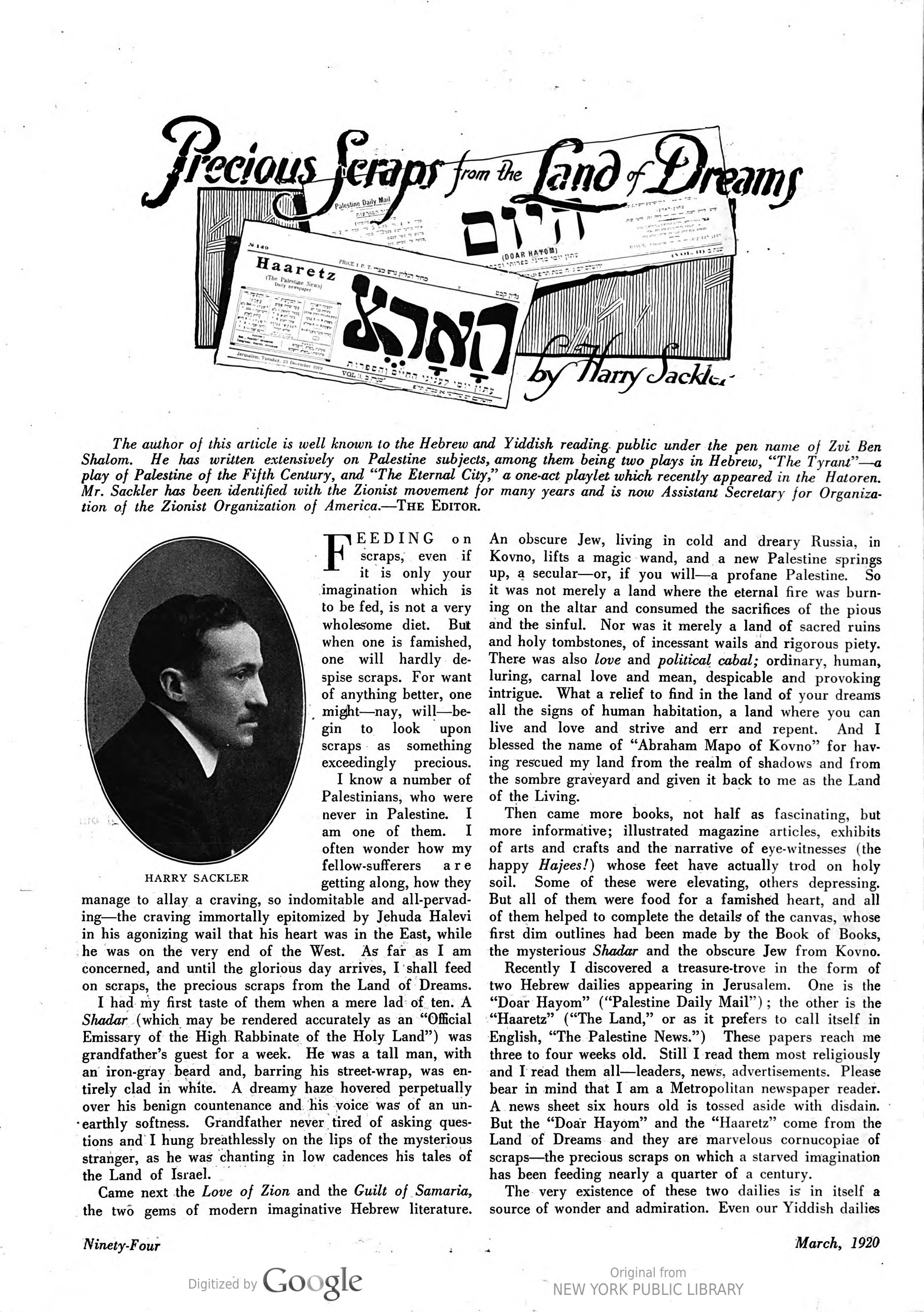
Recently I discovered a treasure-trove in the form of two Hebrew dailies appearing in Jerusalem. One is the "Doar Hayom" ("Palestine Daily Mail"); the other is the "Haaretz" ("The Land," or as it prefers to call itself in English, "The Palestine News."). These papers reach me three to four weeks old. Still I read them most religiously and I read them all—leaders, news, advertisements. Please bear in mind that I am a Metropolitan newspaper reader. A news sheet six hours old is tossed aside with disdain. But the "Doar Hayom" and the "Haaretz" come from the Land of Dreams and they are marvelous cornucopiae of scraps—the precious scraps on which a starved imagination has been feeding nearly a quarter of a century.
The very existence of these two dailies is in itself a source of wonder and admiration. Even our Yiddish dailies