Baron Edmond de Rothschild
I.
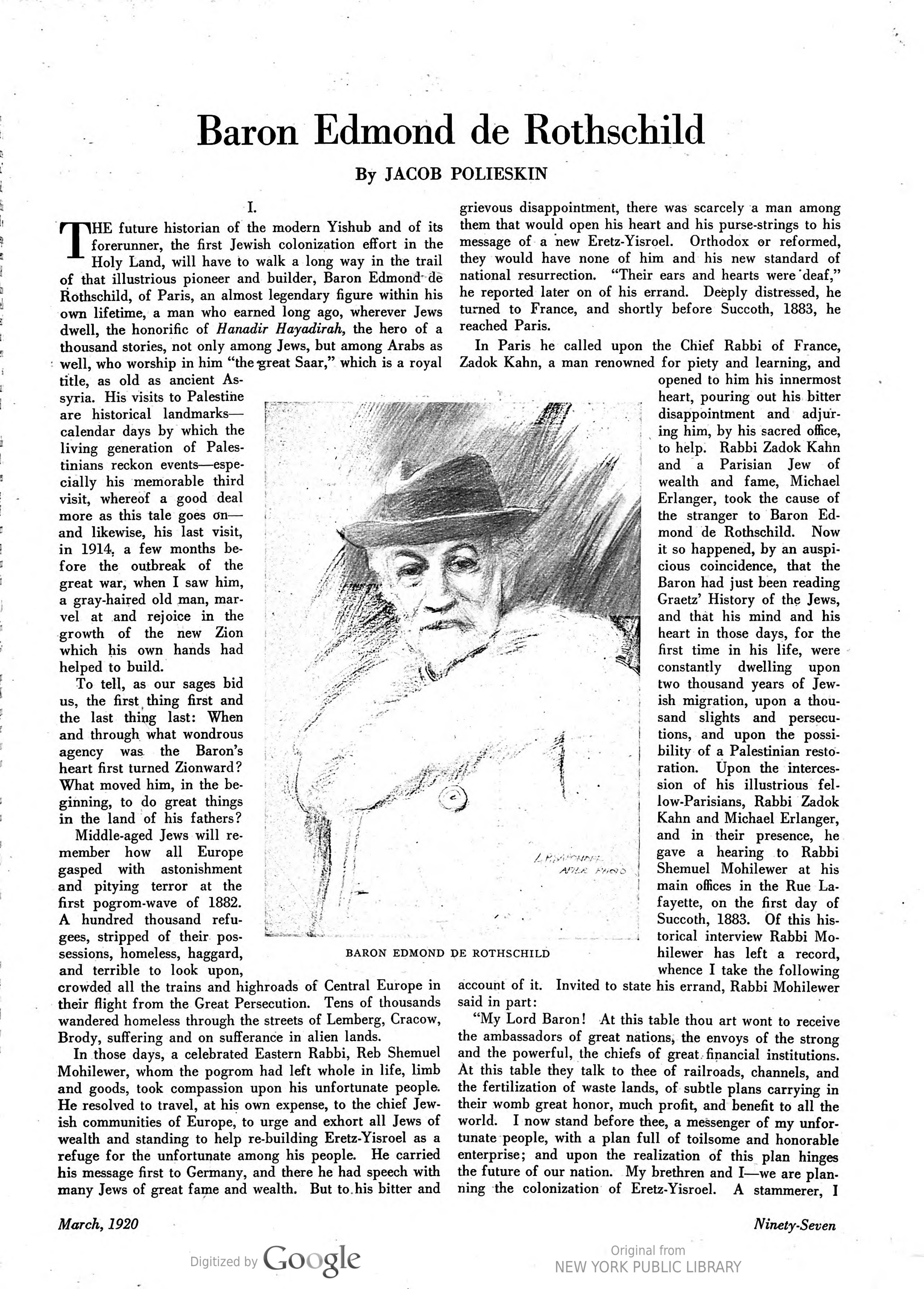
THE future historian of the modern Yishub and of its forerunner, the first Jewish colonization effort in the Holy Land, will have to walk a long way in the trail of that illustrious pioneer and builder, Baron Edmond de Rothschild, of Paris, an almost legendary figure within his own lifetime, a man who earned long ago, wherever Jews dwell, the honorific of Hanadir Hayadirah, the hero of a thousand stories, not only among Jews, but among Arabs as well, who worship in him “the great Saar,” which is a royal title, as old as ancient Assyria. His visits to Palestine are historical landmarks— calendar days by which the living generation of Palestinians reckon events—especially his memorable third visit, whereof a good deal more as this tale goes on— and likewise, his last visit, in 1914, a few months before the outbreak of the great war, when I saw him, a gray-haired old man, marvel at and rejoice in the growth of the new Zion which his own hands had helped to build.
To tell, as our sages bid us, the first thing first and the last thing last: When and through what wondrous ageney was the Baron’s heart first turned Zionward’? What moved him, in the beginning, to do great things in the land of his fathers?
Middle-aged Jews will remember how all Europe gasped with astonishment and pitying terror at the first pogrom-wave of 1882. A hundred thousand refugees, stripped of their possessions, homeless, haggard, BARON EDMOND and terrible to look upon, crowded all the trains and highroads of Central Europe in their flight from the Great Persecution. Tens of thousands wandered homeless through the streets of Lemberg, Cracow, Brody, suffering and on sufferance in alien lands.
In those days, a celebrated Eastern Rabbi, Reb Shemuel Mohilewer, whom the pogrom had left whole in life, limb and goods, took compassion upon his unfortunate people. He resolved to travel, at his own expense, to the chief Jewish communities of Europe, to urge and exhort all Jews of wealth and standing to help rebuilding Eretz-Yisroel as a refuge for the unfortunate among his people. He carried his message first to Germany, and there he had speech with many Jews of great fame and wealth. But to.his bitter and
grievous disappointment, there was scarcely a man among them that would open his heart and his purse-strings to his message of a new Eretz-Yisroel. Orthodox or reformed, they would have none of him and his new standard of national resurrection. “Their ears and hearts were "deaf,” he reported later on of his errand. Deeply distressed, he turned to France, and shortly before Succoth, 1883, he rearhan Paris.
In Paris he called upon the Chief Rabbi of France, Zadok Kahn, a man renowned for piety and learning, and
the Chief Rabbi of France, d for piety and learning, and opened to him his innermost heart, pouring out his bitter disappointment and adjuring him, by his sacred office, to help. Rabbi Zadok Kahn and a Parisian Jew of wealth and fame, Michael Erlanger, took the cause of the stranger to Baron Edmond de Rothschild. Now it so happened, by an auspicious coincidence, that the Baron had just been reading Graetz’ History of the Jews, and that his mind and his heart in those days, for the first time in his life, were constantly dwelling upon two thousand years of Jewish migration, upon a thousand slights and persecutions, and upon the possibility of a Palestinian restoration. Upon the intercession of his illustrious fellow-Parisians, Rabbi Zadok Kahn and Michael Erlanger, and in their presence, he gave a hearing to Rabbi Shemuel Mohilewer at his main offices in the Rue Lafayette, on the first day of Succoth, 1883. Of this historical interview Rabbi Mohilewer has left a record, whence I take the following
“My Lord Baron! At this table thou art wont to receive the ambassadors of great nations, the envoys of the strong and the powerful, the chiefs of great financial institutions. At this table they talk to thee of railroads, channels, and the fertilization of waste lands, of subtle plans carrying in their womb great honor, much profit, and benefit to all the world. I now stand before thee, a messenger of my unfortunate people, with a plan full of toilsome and honorable enterprise; and upon the realization of this plan hinges the future of our nation. My brethren and I—we are planning the colonization of Eretz-Yisroel. A stammerer, I