Joseph Zeff
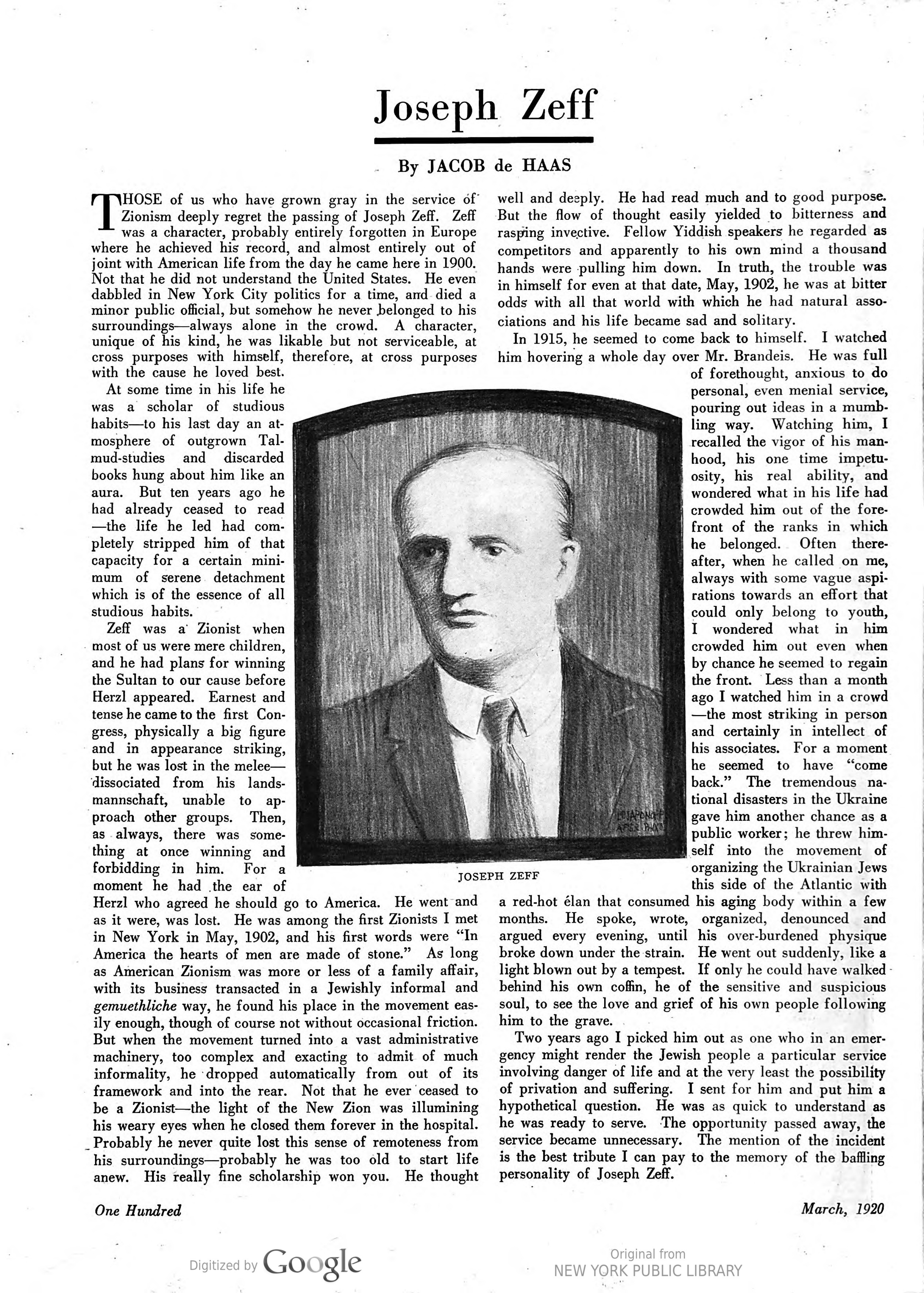
THOSE of us who have grown gray in the service of Zionism deeply regret the passing of Joseph Zeff. Zeff was a character, probably entirely forgotten in Europe where he achieved his record, and almost entirely out of joint with American life from the day he came here in 1900. Not that he did not understand the United States. He even dabbled in New York City politics for a time, and died a minor public official, but somehow he never belonged to his surroundings—always alone in the crowd. A character, unique of his kind, he was likable but not serviceable, at cross purposes with himself, therefore, at cross purposes with the cause he loved best.
At some time in his life he was a scholar of studious habits —to his last day an atmosphere of outgrown Talmud-studies and discarded books hung about him like an aura. But ten years ago he had already ceased to read —the life he led had completely stripped him of that capacity for a certain minimum of serene detachment which is of the essence of all studious habits.
Zeff was a Zionist when most of us were mere children, and he had plans for winning the Sultan to our cause before Herzl appeared. Earnest and tense he came to the first Congress, physically a big figure and in appearance striking, but he was lost in the melee—dissociated from his landsmannschaft, unable to approach other groups. Then, as always, there was something at once winning and forbidding in him. For a moment he had the ear of Herzl who agreed he should go to America. He went and as it were, was lost. He was among the first Zionists I met in New York in May, 1902, and his first words were "In America the hearts of men are made of stone." As long as American Zionism was more or less of a family affair, with its business transacted in a Jewishly informal and gemuethliche way, he found his place in the movement easily enough, though of course not without occasional friction. But when the movement turned into a vast administrative machinery, too complex and exacting to admit of much informality, he dropped automatically from out of its framework and into the rear. Not that he ever ceased to be a Zionist—the light of the New Zion was illumining his weary eyes when he closed them forever in the hospital. Probably he never quite lost this sense of remoteness from his surroundings—probably he was too old to start life anew. His really fine scholarship won you. He thought
well and desply. He had read much and to good purpose. But the flow of thought easily yielded to bitterness and rasping invective. Fellow Yiddish speakers he regarded as competitors and apparently to his own mind a thousand hands were pulling him down. In truth, the trouble was in himself for even at that date, May, 1902, he was at bitter odds with all that world with which he had natural associations and his life became sad and solitary.
In 1915, he seemed to come back to himself. I watched him hovering a whole day over Mr. Brandeis. He was full of forethought, anxious to do personal, even menial service, pouring out ideas in a mumbling way. Watching him, I recalled the vigor of his manhood, his one time impetuosity, his real ability, and wondered what in his life had crowded him out of the forefront of the ranks in which he belonged. Often thereafter, when he called on me, always with some vague aspirations towards an effort that could only belong to youth, I wondered what in him crowded him out even when by chance he seemed to regain the front. Less than a month ago I watched him in a crowd—the most striking in person and certainly in intellect of his associates. For a moment he seemed to have "come back." The tremendous national disasters in the Ukraine gave him another chance as a public worker; he threw himself into the movement of organizing the Ukrainian Jews this side of the Atlantic with
a red-hot élan that consumed his aging body within a few months. He spoke, wrote, organized, denounced and argued every evening, until his overburdened physique broke down under the strain. He went out suddenly, like a light blown out by a tempest. If only he could have walked behind his own coffin, he of the sensitive and suspicious soul, to see the love and grief of his own people following him to the grave.
Two years ago I picked him out as one who in an emergency might render the Jewish people a particular service involving danger of life and at the very least the possibility of privation and suffering. I sent for him and put him a hypothetical question. He was as quick to understand as he was ready to serve. The opportunity passed away, the service became unnecessary. The mention of the incident is the best tribute I can pay to the memory of the baffling personality of Joseph Zeff.