The New Urgency for a Jewish Homeland
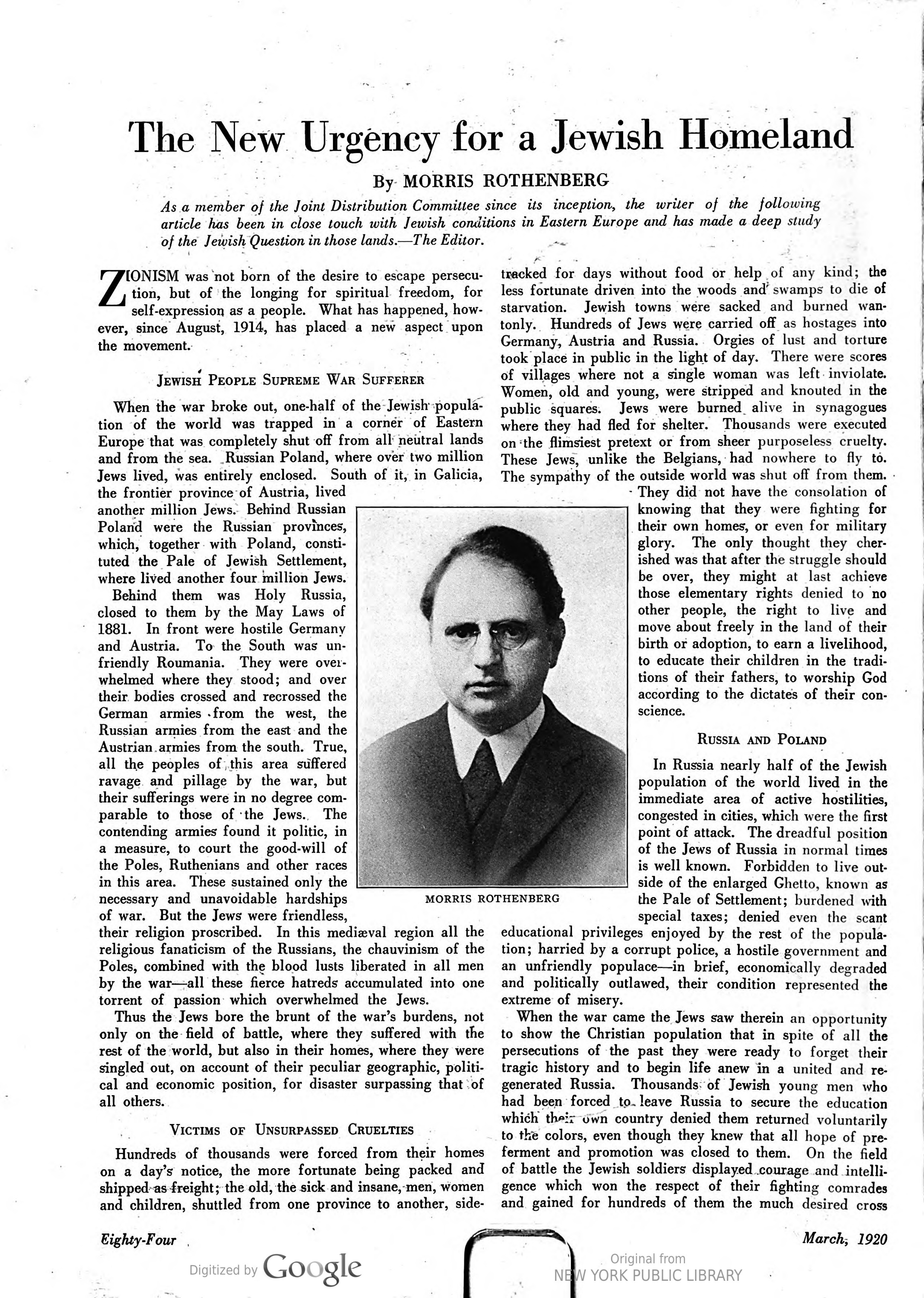
As a member of the Joint Distribution Committee since its inception, the writer of the following article has been in close touch with Jewish conditions in Eastern Europe and has made a deep study of the Jewish Question in those lands.—The Editor.
ZIONISM was not born of the desire to escape persecution, but of the longing for spiritual freedom, for self-expression as a people. What has happened, however, since August, 1914, has placed a new aspect upon the movement.
JEWISH PEOPLE SUPREME WAR SUFFERER
When the war broke out, one-half of the Jewish population of the world was trapped in a corner of Eastern Europe that was completely shut off from all neutral lands and from the sea. Russian Poland, where over two million Jews lived, was entirely enclosed. South of it, in Galicia, the frontier province of Austria, lived another million Jews. Behind Russian Poland were the Russian provinces, which, together with Poland, constituted the Pale of Jewish Settlement, where lived another four million Jews.
Behind them was Holy Russia, closed to them by the May Laws of 1881. In front were hostile Germany and Austria. To the South was unfriendly Roumania. They were overwhelmed where they stood; and over their bodies crossed and recrossed the German armies from the west, the Russian armies from the east and the Austrian armies from the south. True, all the peoples of this area suffered ravage and pillage by the war, but their sufferings were in no degree comparable to those of the Jews. The contending armies found it politic, in a measure, to court the good-will of the Poles, Ruthenians and other races in this area. These sustained only the necessary and unavoidable hardships of war. But the Jews were friendless, their religion proscribed. In this mediæval region all the religious fanaticism of the Russians, the chauvinism of the Poles, combined with the blood lusts liberated in all men by the war—all these fierce hatreds accumulated into one torrent of passion which overwhelmed the Jews.
Thus the Jews bore the brunt of the war's burdens, not only on the field of battle, where they suffered with the rest of the world, but also in their homes, where they were singled out, on account of their peculiar geographic, political and economic position, for disaster surpassing that of all others.
VICTIMS OF UNSURPASSED CRUELTIES
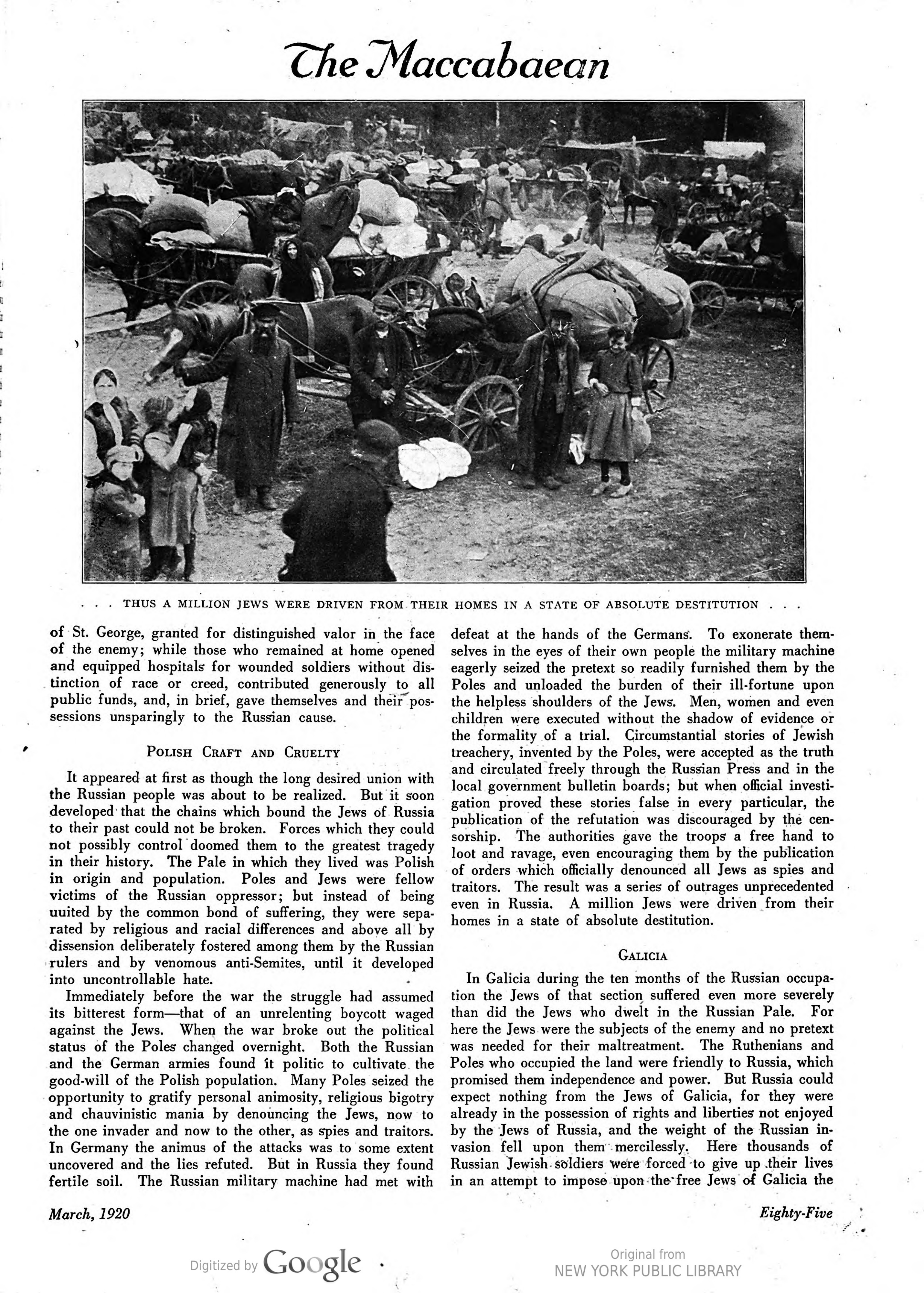
Hundreds of thousands were forced from their homes on a day's notice, the more fortunate being packed and shipped as freight; the old, the sick and insane, men, women and children, shuttled from one province to another, side-
tracked for days without food or help of any kind; the less fortunate driven into the woods and swamps to die of starvation. Jewish towns were sacked and burned wantonly. Hundreds of Jews were carried off as hostages into Germany, Austria and Russia. Orgies of lust and torture took place in public in the light of day. There were scores of villages where not a single woman was left inviolate. Women, old and young, were stripped and knouted in the public squares. Jews were burned alive in synagogues where they had fled for shelter. Thousands were executed on the flimsiest pretext or from sheer purposeless cruelty. These Jews, unlike the Belgians, had nowhere to fly to. The sympathy of the outside world was shut off from them.
They did not have the consolation of knowing that they were fighting for their own homes, or even for military glory. The only thought they cherished was that after the struggle should be over, they might at last achieve those elementary rights denied to no other people, the right to live and move about freely in the land of their birth or adoption, to earn a livelihood, to educate their children in the traditions of their fathers, to worship God according to the dictates of their conscience.
RUSSIA AND POLAND
In Russia nearly half of the Jewish population of the world lived in the immediate area of active hostilities, congested in cities, which were the first point of attack. The dreadful position of the Jews of Russia in normal times is well known. Forbidden to live outside of the enlarged Ghetto, known as the Pale of Settlement; burdened with special taxes; denied even the scant educational privileges enjoyed by the rest of the population; harried by a corrupt police, a hostile government and an unfriendly populace —in brief, economically degraded and politically outlawed, their condition represented the extreme of misery.
When the war came the Jews saw therein an opportunity to show the Christian population that in spite of all the persecutions of the past they were ready to forget their tragic history and to begin life anew in a united and regenerated Russia. Thousands of Jewish young men who had been forced to leave Russia to secure the education which their own country denied them returned voluntarily to the colors, even though they knew that all hope of preferment and promotion was closed to them. On the field of battle the Jewish soldiers displayed courage and intelligence which won the respect of their fighting comrades and gained for hundreds of them the much desired cross