What Can Save the Jewish Congress?
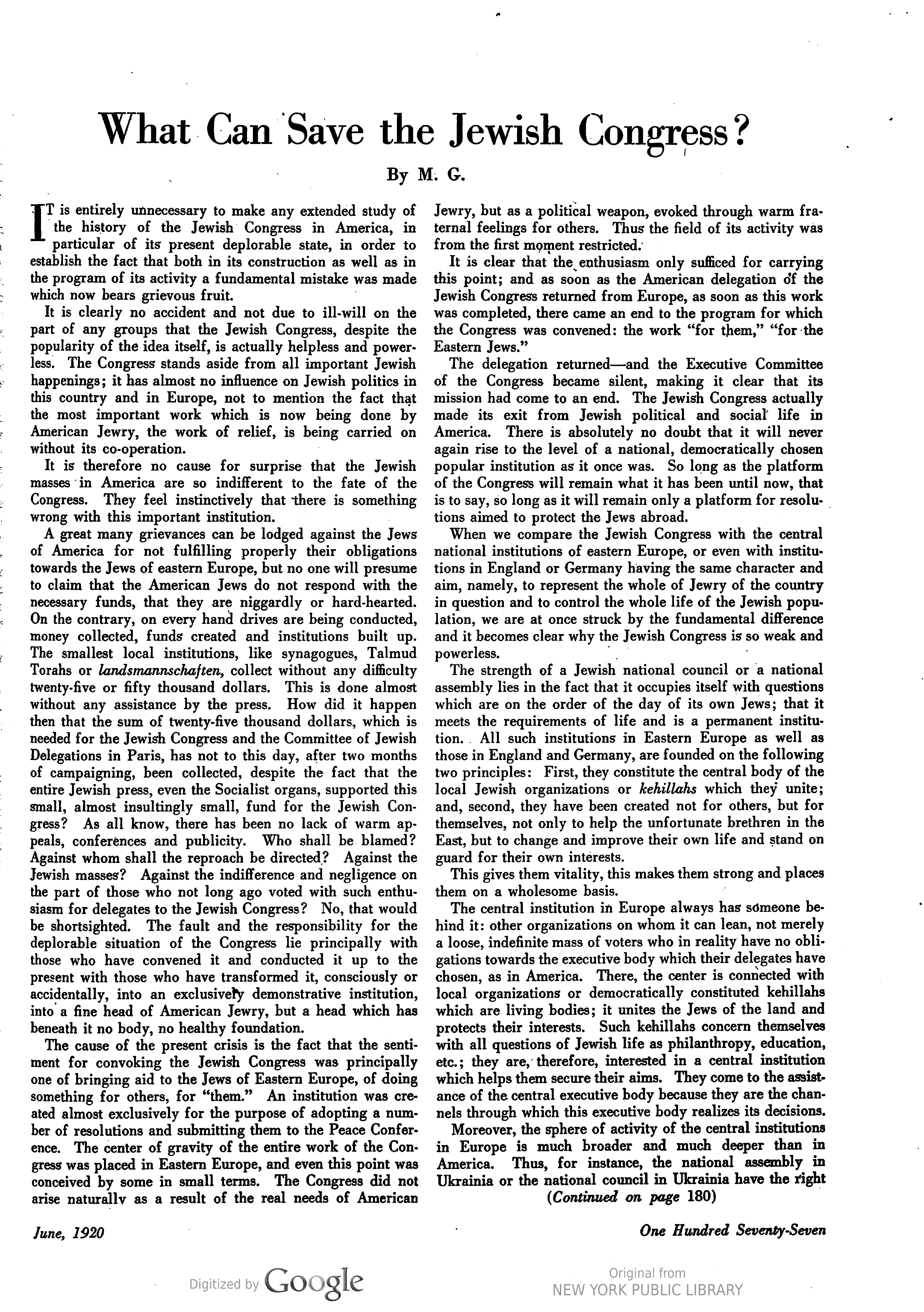
T is entirely unnecessary to make any extended study of I the history of the Jewish Congress in America, in particular of its present deplorable state, in order to establish the fact that both in its construction as well as in the program of its activity a fundamental mistake was made which now bears grievous fruit. \
It is clearly no accident and not due to ill-will on the part of any groups that the Jewish Congress, despite the popularity of the idea itself, is actually helpless and powerless. The Congress stands aside from all important Jewish happenings; it has almost no influence on Jewish politics in this country and in Europe, not to mention the fact that the most important work which is now being done by American Jewry, the work of relief, is being carried on without its co-operation.
It is therefore no cause for surprise that the Jewish masses in America are so indifferent to the fate of the Congress. They feel instinctively that there is something wrong with this important institution.
A great many grievances can be lodged against the Jews of America for not fulfilling properly their obligations towards the Jews of eastern Europe, but no one will presume to claim that the American Jews do not respond with the necessary funds, that they are niggardly or hard-hearted. On the contrary, on every hand drives are being conducted, money collected, funds created and institutions built up. The smallest local institutions, like synagogues, Talmud Torahs or Zandsmannschaften, collect without any difhculty twenty-hive or fifty thousand dollars. This is done almost without any assistance by the press. How did it happen then that the sum of twenty-five thousand dollars, which is needed for the Jewish Congress and the Committee of Jewish Delegations in Paris, has not to this day, after two months of campaigning, been collected, despite the fact that the entire Jewish press, even the Socialist organs, supported this small, almost insultingly small, fund for the Jewish Congress? As all know, there has been no lack of warm appeals, conferences and publicity. Who shall be blamed? Against whom shall the reproach be directed? Against the Jewish masses? Against the indifference and negligence on the part of those who not long ago voted with such enthusiasm for delegates to the Jewish Congress? No, that would be shortsighted. The fault and the responsibility for the deplorable situation of the Congress lie principally with those who have convened it and conducted it up to the present with those who have transformed it, consciously or accidentally, into an exclusivefy demonstrative institution, into a fine head of American Jewry, but a head which has beneath it no body, no healthy foundation.
The cause of the present crisis is the fact that the sentiment for convoking the Jewish Congress was principally one of bringing aid to the Jews of Eastern Europe, of doing something for others, for "them." An institution was created almost exclusively for the purpose of adopting a number of resolutions and submitting them to the Peace Conference. The center of gravity of the entire work of the Congress was placed in Eastern Europe, and even this point was conceived by some in small terms. The Congress did not arise naturally as a result of the real needs of American
Jewry, but as a political weapon, evoked through warm fraternal feelings for others. Thus the field of its activity was from the first moment restricted.
It is clear that the enthusiasm only sufficed for carrying this point; and as soon as the American delegation of the Jewish Congress returned from Europe, as soon as this work was completed, there came an end to the program for which the Congress was convened: the work "for them," "for the Eastern Jews."
The delegation returned—and the Executive Committee of the Congress became silent, making it clear that its mission had come to an end. The Jewish Congress actually made its exit from Jewish political and social life in America. There is absolutely no doubt that it will never again rise to the level of a national, democratically chosen popular institution as it once was. So long as the platform of the Congress will remain what it has been until now, that is to say, so long as it will remain only a platform for resolutions aimed to protect the Jews abroad.
When we compare the Jewish Congress with the central national institutions of eastern Europe, or even with institutions in England or Germany having the same character and aim, namely, to represent the whole of Jewry of the country in question and to control the whole life of the Jewish population, we are at once struck by the fundamental difference and it becomes clear why the Jewish Congress is so weak and powerless.
The strength of a Jewish national council or a national assembly lies in the fact that it occupies itself with questions which are on the order of the day of its own Jews; that it meets the requirements of life and is a permanent institution. All such institutions in Eastern Europe as well as those in England and Germany, are founded on the following two principles: First, they constitute the central body of the local Jewish organizations or kehillahs which they unite; and, second, they have been created not for others, but for themselves, not only to help the unfortunate brethren in the East, but to change and improve their own life and stand on guard for their own interests.
This gives them vitality, this makes them strong and places them on a wholesome basis.
The central institution in Europe always has someone behind it: other organizations on whom it can lean, not merely a loose, indefinite mass of voters who in reality have no obligations towards the executive body which their delegates have chosen, as in America. There, the center is connected with local organizations or democratically constituted kehillahs which are living bodies; it unites the Jews of the land and protects their interests. Such kehillahs concern themselves with all questions of Jewish life as philanthropy, education, etc.; they are, therefore, interested in a central institution which helps them secure their aims. They come to the assistance of the central executive body because they are the channels throush which this executive body realizes its decisions.
Moreover, the sphere of activity of the central institutions in Europe is much broader and much deeper than in America. Thus, for instance, the national assembly in Ukrainia or the national council in Ukrainia have the right (Continued on page 180)