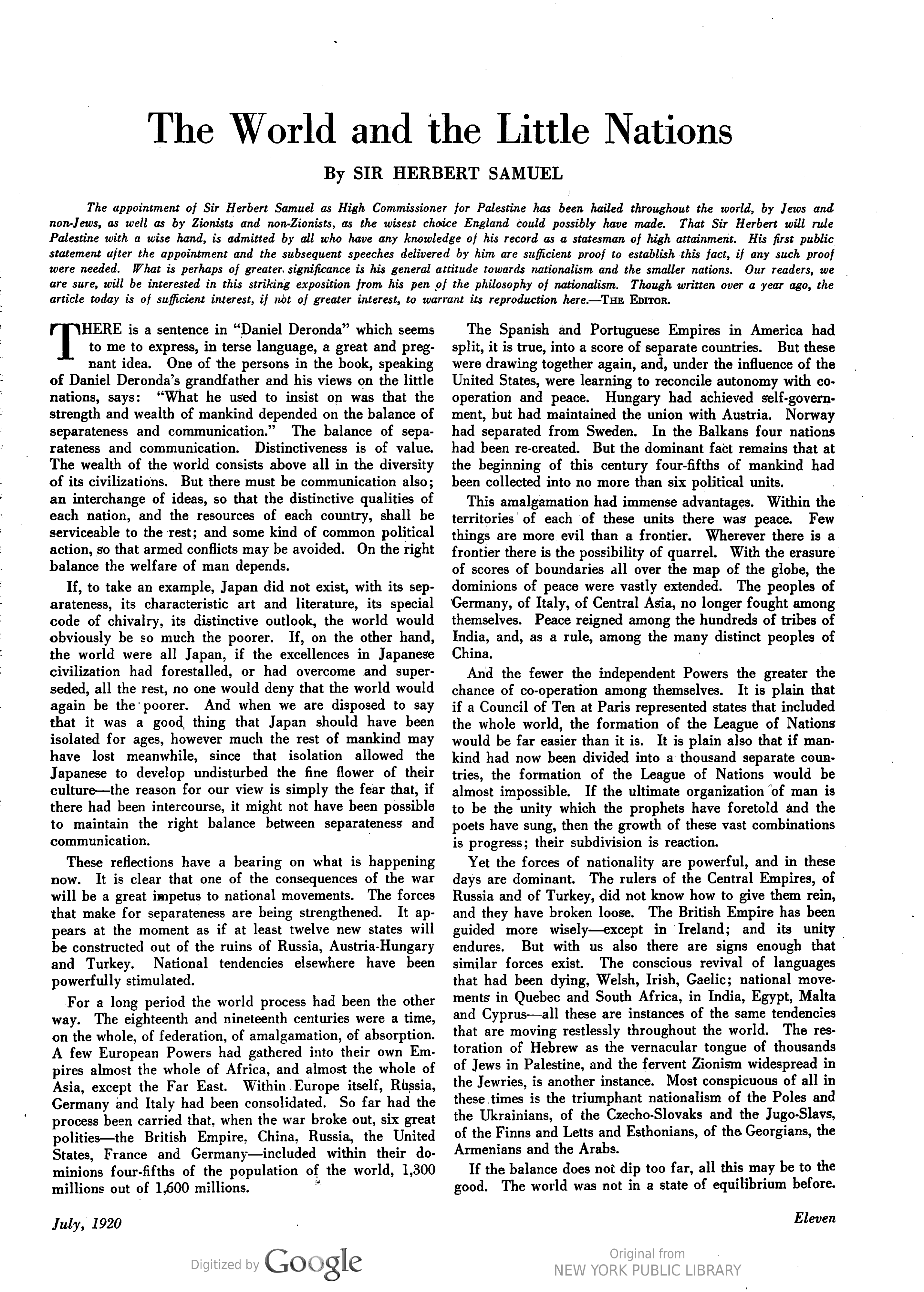
The World and the Little Nations
The appointment of Sir Herbert Samuel as High Commissioner for Palestine has been hailed throughout the world, by Jews and non-Jews, as well as by Zionists and non-Zionists, as the wisest choice England could possibly have made. That Sir Herbert will rule Palestine with a wise hand, is admitted by all who have any knowledge of his record as a statesman of high attainment. His first public statement after the appointment and the subsequent speeches delivered by him are sufficient proof to establish this fact, if any such proof were needed. What is perhaps of greater significance is his general attitude towards nationalism and the smaller nations. Our readers, we are sure, will be interested in this striking exposition from his pen of the philosophy of nationalism. Though written over a year ago, the article today is of sufficient interest, if not of greater interest, to warrant its reproduction here.—THE EDITOR.
THERE is a sentence in "Daniel Deronda" which seems to me to express, in terse language, a great and pregnant idea. One of the persons in the book, speaking of Daniel Deronda's grandfather and his views on the little nations, says: "What he used to insist on was that the strength and wealth of mankind depended on the balance of separateness and communication." The balance of separateness and communication. Distinctiveness is of value. The wealth of the world consists above all in the diversity of its civilizations. But there must be communication also; an interchange of ideas, so that the distinctive qualities of each nation, and the resources of each country, shall be serviceable to the rest; and some kind of common political action, so that armed conflicts may be avoided. On the right balance the welfare of man depends.
If, to take an example, Japan did not exist, with its separateness, its characteristic art and literature, its special code of chivalry, its distinctive outlook, the world would obviously be so much the poorer. If, on the other hand, the world were all Japan, if the excellences in Japanese civilization had forestalled, or had overcome and superseded, all the rest, no one would deny that the world would again be the poorer. And when we are disposed to say that it was a good thing that Japan should have been isolated for ages, however much the rest of mankind may have lost meanwhile, since that isolation allowed the Japanese to develop undisturbed the fine flower of their culture—the reason for our view is simply the fear that, if there had been intercourse, it might not have been possible to maintain the right balance between separateness and communication.
These reflections have a bearing on what is happening now. It is clear that one of the consequences of the war will be a great impetus to national movements. The forces that make for separateness are being strengthened. It appears at the moment as if at least twelve new states will be constructed out of the ruins of Russia, Austria-Hungary and Turkey. National tendencies elsewhere have been powerfully stimulated.
For a long period the world process had been the other way. The eighteenth and nineteenth centuries were a time, on the whole, of federation, of amalgamation, of absorption. A few European Powers had gathered into their own Empires almost the whole of Africa, and almost the whole of Asia, except the Far East. Within Europe itself, Russia, Germany and Italy had been consolidated. So far had the process been carried that, when the war broke out, six great polities—the British Empire, China, Russia, the United States, France and Germany—included within their dominions four-fifths of the population of the world, 1,300 millions out of 1,600 millions.
The Spanish and Portuguese Empires in America had split, it is true, into a score of separate countries. But these were drawing together again, and, under the influence of the United States, were learning to reconcile autonomy with co-operation and peace. Hungary had achieved self-government, but had maintained the union with Austria. Norway had separated from Sweden. In the Balkans four nations had been re-created. But the dominant fact remains that at the beginning of this century four-fifths of mankind had been collected into no more than six political units.
This amalgamation had immense advantages. Within the territories of each of these units there was peace. Few things are more evil than a frontier. Wherever there is a frontier there is the possibility of quarrel. With the erasure of scores of boundaries all over the map of the globe, the dominions of peace were vastly extended. The peoples of Germany, of Italy, of Central Asia, no longer fought among themselves. Peace reigned among the hundreds of tribes of India, and, as a rule, among the many distinct peoples of China.
And the fewer the independent Powers the greater the chance of co-operation among themselves. It is plain that if a Council of Ten at Paris represented states that included the whole world, the formation of the League of Nations would be far easier than it is. It is plain also that if mankind had now been divided into a thousand separate countries, the formation of the League of Nations would be almost impossible. If the ultimate organization of man is to be the unity which the prophets have foretold and the poets have sung, then the growth of these vast combinations is progress; their subdivision is reaction.
Yet the forces of nationality are powerful, and in these days are dominant. The rulers of the Central Empires, of Russia and of Turkey, did not know how to give them rein, and they have broken loose. The British Empire has been guided more wisely—except in Ireland; and its unity endures. But with us also there are signs enough that similar forces exist. The conscious revival of languages that had been dying, Welsh, Irish, Gaelic; national movements in Quebec and South Africa, in India, Egypt, Malta and Cyprus—all these are instances of the same tendencies that are moving restlessly throughout the world. The restoration of Hebrew as the vernacular tongue of thousands of Jews in Palestine, and the fervent Zionism widespread in the Jewries, is another instance. Most conspicuous of all in these times is the triumphant nationalism of the Poles and the Ukrainians, of the Czecho-Slovaks and the Jugo-Slavs, of the Finns and Letts and Esthonians, of the Georgians, the Armenians and the Arabs.
If the balance does not dip too far, all this may be to the good. The world was not in a state of equilibrium before.