"The Right Man in the Right Place"
EMPHATICALLY the right man in the right place." This summing-up of the significance of Sir Herbert's appointment as High Commissioner of Palestine is not a breezy headline dashed off by some ebullient Zionist journalist. It is not pronounced by one whose aim is to create optimistic stimmung. It is not the word of one who loves illusions or who is accustomed to paint things in rosy hue. It is the carefully arrived-at conclusion of Max Nordau.
“Now, Nordau, as is well known, has not been among the amen-sayers of the present Zionist leadership and policies. He has not, it is true, been an active oppon- ‚ent. He has even praised the activities of Weizmann and Sokolow. But even his praise has had the reserve of the critic. Nordau has not hesitated to speak in proximate terms of a Jewish State .in Palestine. When, therefore, Nordau hails the appointment of the Rt. Hon. Herbert Louis Samuel with enthusiasm, we have a right to presume that this appointment means a great step forward in the realization of Zionist aspirations.
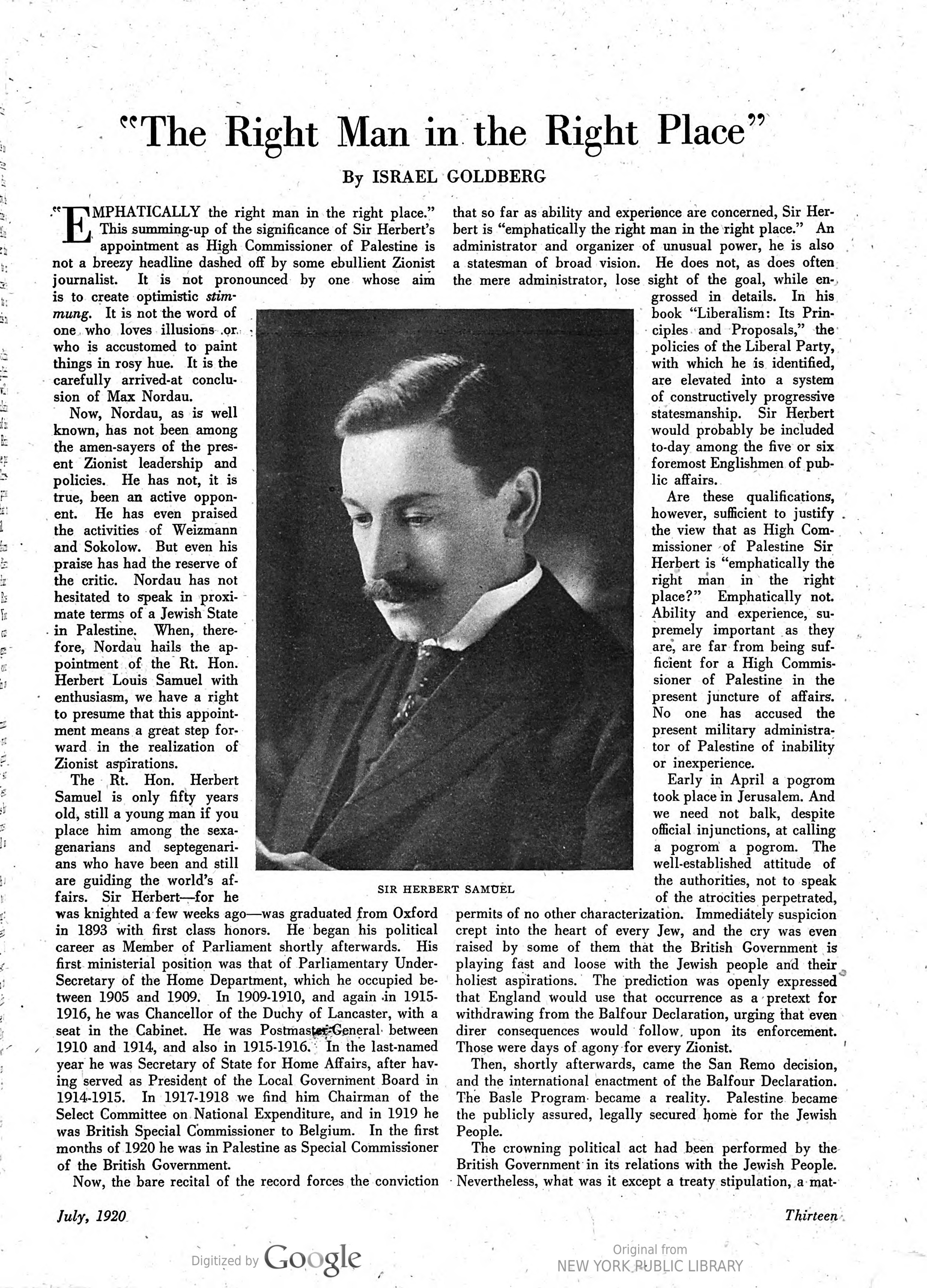
The Rt. Hon. Herbert Se; Samuel is only fifty years ; old, still a young man if you 2 ER place him among the sexa- I.) genarians and septegenari- ans who have been and still AR are guiding the world’s affairs. Sir Herbert—for he a was knighted a few weeks ago— was graduated from Oxford in 1893 with first class honors. He began his political career as Member of Parliament shortly afterwards. His first ministerial position was that of Parliamentary Under-Secretary of the Home Department, which he occupied between 1905 and 1909. In 1909-1910, and again in 1915- 1916, he was Chancellor of the Duchy of Lancaster, with a seat in the Cabinet. He was PostmastefGeneral: between 1910 and 1914, and also in 1915-1916. In the last-named year he was Secretary of State for Home Affairs, after having served as President of the Local Government Board in 1914-1915. In 1917-1918 we find him Chairman of the Select Committee on National Expenditure, and in 1919 he was British Special Commissioner to Belgium. In the first months of 1920 he was in Palestine as Special Commissioner of the British Government.
Now, the bare recital of the record forces the conviction
perience are concerned, Sir Herbert man in the right place." An of unusual power, he is also . He does not, as does often e sight of the goal, while engrossed in details. In his book "Liberalism: Its Principles and Proposals," the policies of the Liberal Party, with which he is identified, are elevated into a system of constructively progressive statesmanship. Sir Herbert would probably be included to-day among the five or six foremost Englishmen of public affairs.
Are these qualifications, however, suflicient to justify . the view that as High Com- . missioner -of Palestine Sir Herbert is “emphatically the right man in the right place?” Emphatically not. Ability and experience, supremely important as they are, are far from being sufficient for a High Commissioner of Palestine in the present juncture of aflairs. No one has accused the present military administrator of Palestine of inability or inexperience.
Early in April a pogrom took place in Jerusalem. And we need not balk, despite official injunctions, at calling a pogrom a pogrom. The well-established attitude of the authorities, not to speak of the atrocities perpetrated, zation. Immediately suspicion
permits of no other characterization. Immediätely suspicion crept into the heart of every Jew, and the cry was even raised by some of them that the British Government is playing fast and loose with the Jewish people and their _ holiest aspirations. The prediction was openly expressed that England would use that occurrence as a pretext for withdrawing from the Balfour Declaration, urging that even direr consequences would follow, upon its enforcement. Those were days of agony for every Zionist.
Then, shortly afterwards, came the San Remo decision, and the international enactment of the Balfour Declaration. The Basle Program: became a reality. Palestine became the publicly assured, legally secured home for the Jewish People.
The crowning political act had been performed by the British Government in its relations with the Jewish People. Nevertheless, what was it except a treaty stipulation, a mat-