Theodor Herzl
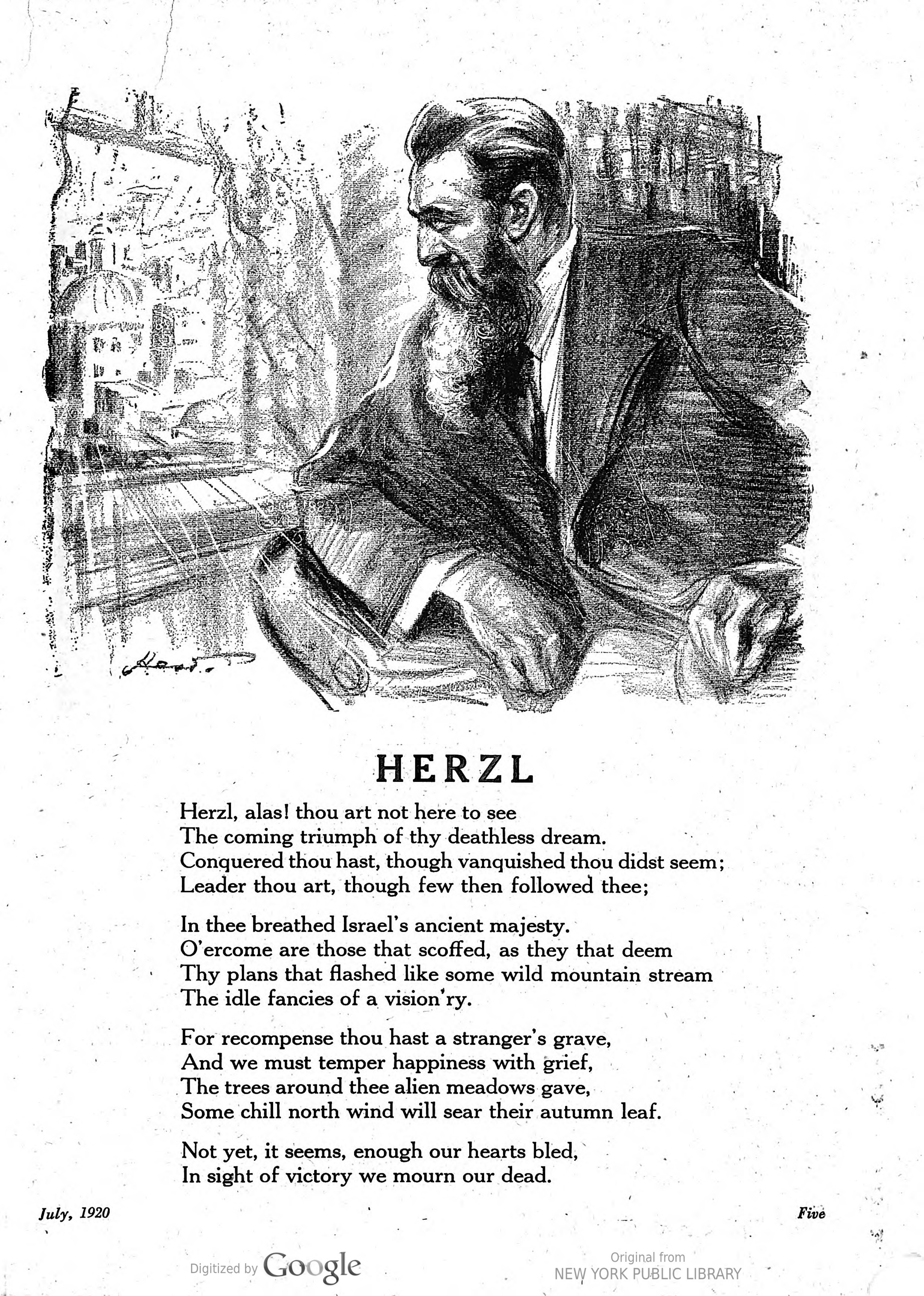
The San Remo decision—this latter-day Jewish national victory—has its Nike. Broken in death, the figure of our immortal leader looms up above the turbulent waves of the times, with the unbroken wings of his spirit far-spread towards the distances. Greek though this simile is, I prefer it to that other and more usual symbol, so oft applied to Herzl, of Moses standing on Mount Nebo. The Jewish figure, indeed, expresses the pathos of the career of Herzl, a pathos it held in common with that of all great dreamers who beheld their Promised Land from afar but were not allowed to enter. But the Greek figure, I believe, holds the greater truth, re-echoes the more heroic note. . . .
We would not, in justice to the great heritage of idealism and vision bequeathed us by Zionism's unforgettable prophet-statesman, continue to speak of him in the minor notes of complaint. Herzl did indeed reach his Mount Nebo, not, however, to be defeated, but to be exalted and transfigured. . . .
We see it now. In this moment of our triumph, we see his life and death in true perspective. A glowing brand upon the sacrificial altar of Israel, the fire of his being was spent in one bright heaven-soaring flame, only to make the sacrifice more perfect. But Herzl's fire served not only as fuel, but also as light. And the light was not extinguished with the flame: like a ray from a distant star it travels through space, to fill all eyes and all hearts with radiance. We, today, bask in the afterglow of Herzl's soul. We ARE Herzl. We are Herzl to the extent of our feeble capacity —or we are nothing. . . .
In view of the significance of Herzl's work, as seen by the light of contemporaneous events, it should prove interesting to the English reader to peruse the following translation of an appreciation, written originally in German, by Nahum Sokolow on the occasion of the tenth anniversary of Herzl's death. I know of no more fitting way of hallowing the Herzl YAHRZEIT in this Year of the Redemption, Shenath Geulah, than by a reverent reading of this tender tribute to the memory of our national Hero.—THE TRANSLATOR.
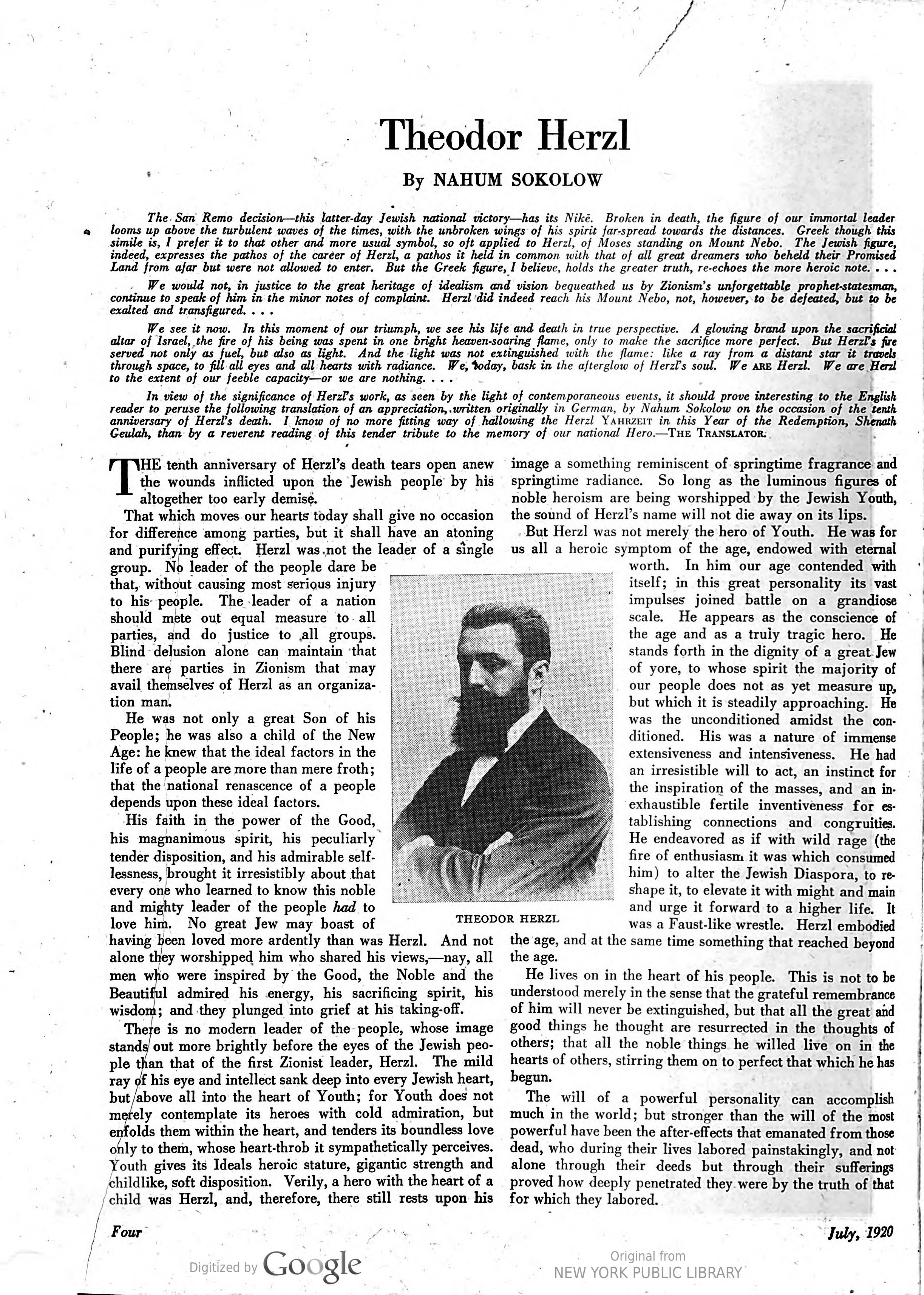
THE tenth anniversary of Herzl's death tears open anew the wounds inflicted upon the Jewish people by his altogether too early demise.
That which moves our hearts today shall give no occasion for difference among parties, but it shall have an atoning and purifying effect. Herzl was not the leader of a single group. No leader of the people dare be that, without causing most serious injury to his people. The leader of a nation should mete out equal measure to all parties, and do justice to all groups. Blind delusion alone can maintain that there are parties in Zionism that may avail themselves of Herzl as an organization man.
He was not only a great Son of his People; he was also a child of the New Age: he knew that the ideal factors in the life of a people are more than mere froth; that the national renascence of a people depends upon these ideal factors.
His faith in the power of the Good, his magnanimous spirit, his peculiarly tender disposition, and his admirable selflessness, brought it irresistibly about that every one who learned to know this noble and mighty leader of the people had to love him. No great Jew may boast of having been loved more ardently than was Herzl. And not alone they worshipped him who shared his views,—nay, all men who were inspired by the Good, the Noble and the Beautiful admired his energy, his sacrificing spirit, his wisdom; and they plunged into grief at his taking-off.
There is no modern leader of the people, whose image stands out more brightly before the eyes of the Jewish people than that of the first Zionist leader, Herzl. The mild ray of his eye and intellect sank deep into every Jewish heart, but above all into the heart of Youth; for Youth does not merely contemplate its heroes with cold admiration, but enfolds them within the heart, and tenders its boundless love only to them, whose heart-throb it sympathetically perceives. Youth gives its Ideals heroic stature, gigantic strength and childlike, soft disposition. Verily, a hero with the heart of a child was Herzl, and, therefore, there still rests upon his
image a something reminiscent of springtime fragrance and springtime radiance. So long as the luminous figures of noble heroism are being worshipped by the Jewish Youth, the sound of Herzl's name will not die away on its lips.
But Herzl was not merely the hero of Youth. He was for us all a heroic symptom of the age, endowed with eternal worth. In him our age contended with itself; in this great personality its vast impulses joined battle on a grandiose scale. He appears as the conscience of the age and as a truly tragic hero. He stands forth in the dignity of a great Jew of yore, to whose spirit the majority of our people does not as yet measure up, but which it is steadily approaching. He was the unconditioned amidst the conditioned. His was a nature of immense extensiveness and intensiveness. He had an irresistible will to act, an instinct for the inspiration of the masses, and an inexhaustible fertile inventiveness for establishing connections and congruities. He endeavored as if with wild rage (the fire of enthusiasm it was which consumed him) to alter the Jewish Diaspora, to reshape it, to elevate it with might and main and urge it forward to a higher life. It was a Faust-like wrestle. Herzl embodied the age, and at the same time something that reached beyond the age.
He lives on in the heart of his people. This is not to be understood merely in the sense that the grateful remembrance of him will never be extinguished, but that all the great and good things he thought are resurrected in the thoughts of others; that all the noble things he willed live on in the hearts of others, stirring them on to perfect that which he has begun.
The will of a powerful personality can accomplish much in the world; but stronger than the will of the most powerful have been the after-effects that emanated from those dead, who during their lives labored painstakingly, and not alone through their deeds but through their sufferings proved how deeply penetrated they were by the truth of that for which they labored.