Kattowitz—Basle—London
THE International Zionist Conference—now in session in London—meets in a happier mood than any Zionist Council was known to assemble in. At the same time, this Conference faces a more difficult task than any similar assembly was ever confronted with.
The task facing the London Conference is an unusual one,—the result of the unusual course of the Zionist movement.
It was but thirty-six years ago, at Kattowitz, that the Zionist movement made its first appearance before the Jewish public, in a timid, diffident way, with the image of Moses Montefiore for its talisman. Thirteen years later, in Basle, it appeared for the first time before the general public, fearlessly decked out in the white-and-blue colors. And now it reappears in London, wearing the wreath of victory received at San Remo.
Kattowitz—Basle—London: how swift ran our course!
It is for the first time in history that a people, having been so long thrust out of its land, and scattered far and wide, without being able to secure for itself in the larger part of the inhabited earth the most elementary human rights —that a people should under such circumstances, and in so short a time, bring to a successful issue its struggle for the universal recognition of its claim upon a homeland and national independence.
This is not the usual course of the world history. This spells a historic leap. Zionism was helped to its quick victory by sheer accident, if, indeed, there be such a thing as accident in human history. The World War has at one stroke cleared away many a great obstacle in the way of Zionism. That brought the movement to its present stage much sooner than might have been expected by way of normal historic evolution.
When men reach a set goal by the usual way, step by step, preparing at each step for the succeeding one, then at the end of the journey they are in every respect prepared for the new task which the moment of attainment entails. Great or small, these tasks cannot prove too hard and unusual, because they were expected and well prepared for. But should men reach a distant goal by an unusual way, through an unexpected leap, as is at present the case of Zionism, then the new tasks that arise must prove unusually difficult, because no adequate preparations have been made for them.
The London Conference finds itself now in the position of a man about to marry off his daughter, whose assets are scattered all over, and who on concluding the marriage contract is called upon to produce the liberal dowry in hard cash. The "politico-legal" recognition of our claims on Palestine is at hand. The Jewish people is now being called upon to avail themselves thereof, expeditiously and prudently. For this purpose are required gigantic funds, well-thought-out plans, strong national discipline. To these treasures the London Conference must find the keys. This is its immense task.
However, even the unusual should not be difficult for an unusual people. With the same faith, in which the Choveve Zion at Kattowitz have empty-handedly engaged in the great task of national reconstruction; with the same confidence in
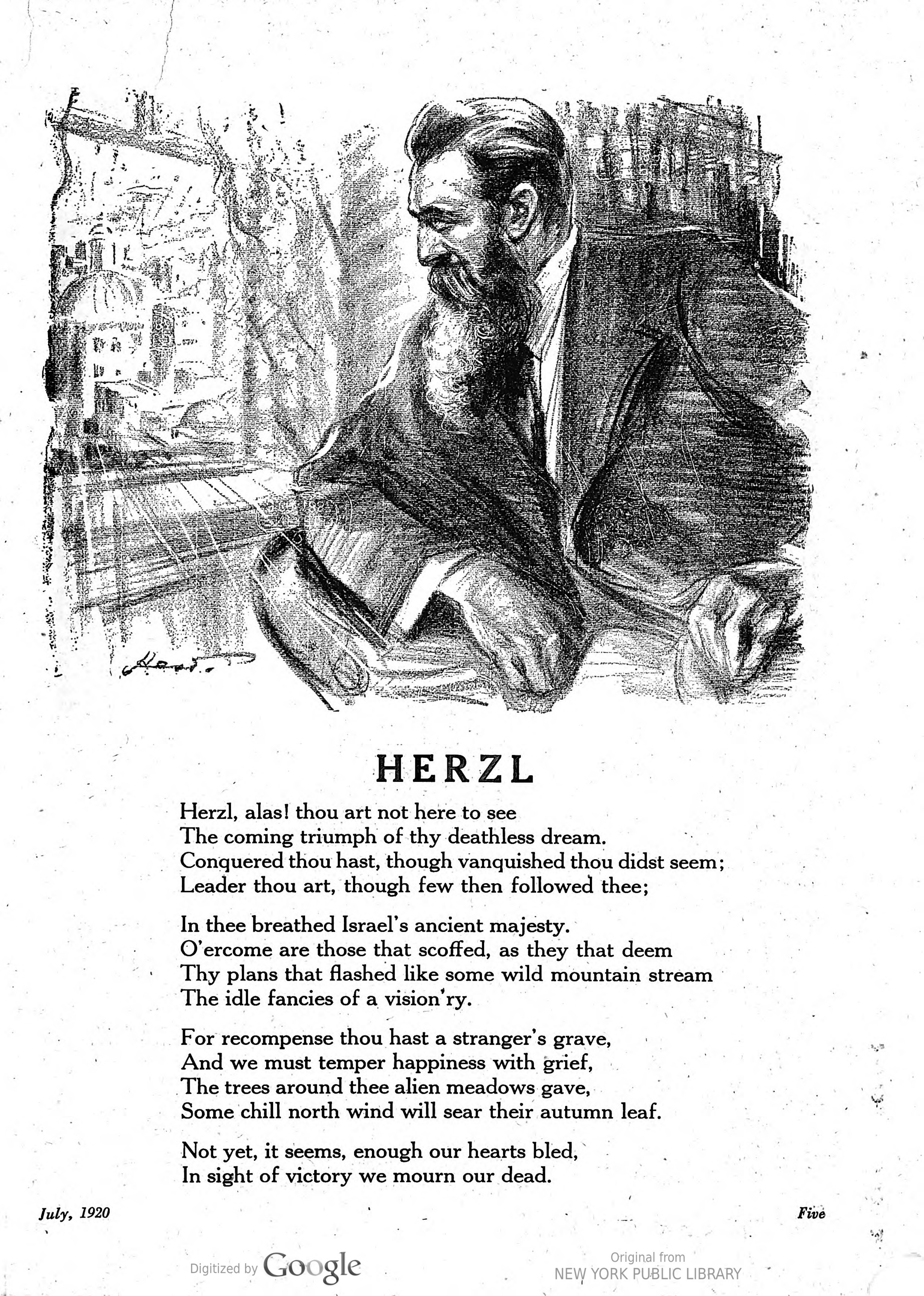
his people and in humanity with which Herzl has issued his astonishingly courageous call to the world at large will the Zionist leaders, in London assembled, seek and find the correct solutions for the great problems of the moment.
The same war which brought us at one leap the politico-legal recognition of the Jewish right to Palestine, together with the gigantic claims involved, has also stirred up mightily the Jewish will to build the historic homeland; the same war which impoverished and ruined millions of Jews in Eastern Europe, has also brought great plenty to the Jewish population in other parts of the world; the same war which has claimed so many Jewish victims on all battle fields, has also raised up hosts of Jewish heroes that are ready for the highest sacrifices in behalf of the liberation of their people and their country.
We have a clear road, we have the will, we have the builders and we have the means.
A national loan or a national gift? Undoubtedly a loan is the more correct way, the surer way. But if a loan is for the present absolutely impossible, if the large donations must now come from the people for the people, then come it will. The small and poor Eretz Israel, the Eretz Israel which is accustomed to receive rather than to give, has just now celebrated a Geulah-week and collected £100,000 in cash, jewelry and other valuables. That is no longer Maaser—tithe—as the advocates of a national gift stipulate, that is a much larger percentage of their possessions. Some gave away practically all that they possessed. This is a new spirit, a new height, which, too, spells a historic leap.
History paid a compliment to the Jewish people through the leap represented by the Balfour Declaration and the San Remo decision. The Jewish people will return the compliment through a corresponding leap, represented by its readiness for sacrifice and by its dedication to social justice.
Social justice—that does not mean necessarily socialism, after the Gospel according to Karl Marx. The Jewish conception of social justice is much older than Marx's. In the new Eretz Israel the land and its natural resources, which are the origin of all wealth, must belong to the people—ki li haaretz: "for mine is the land." In the new Jewish life we must reaffirm anew the high principle of the sanctity of labor. Not the power of labor—all power spells tyranny—but the sanctity of labor.
A leap? This but a figure of speech. As a matter of fact, there are no leaps in history. In this manner we do but designate those events which arrive sooner than men, in their purblindness, expect. The war had to come, and with it the victory of Zionism. Herzl, the farseeing, foresaw and foretold both. But our own willingness to bring sacrifices and our own sense of justice are not new, either. They have since aforetime become deeply rooted in the Jewish blood and the Jewish mind; and the long, hard exile has but purified our sense of these spiritual values.
Vast and difficult are the problems to which the London Conference must find an answer, but the Jewish people is now turning its gaze towards its leaders with confidence and assurance.
Kattowitz—Basle—London—the course runs on. The next stage of the journey is Jerusalem Rebuilt!