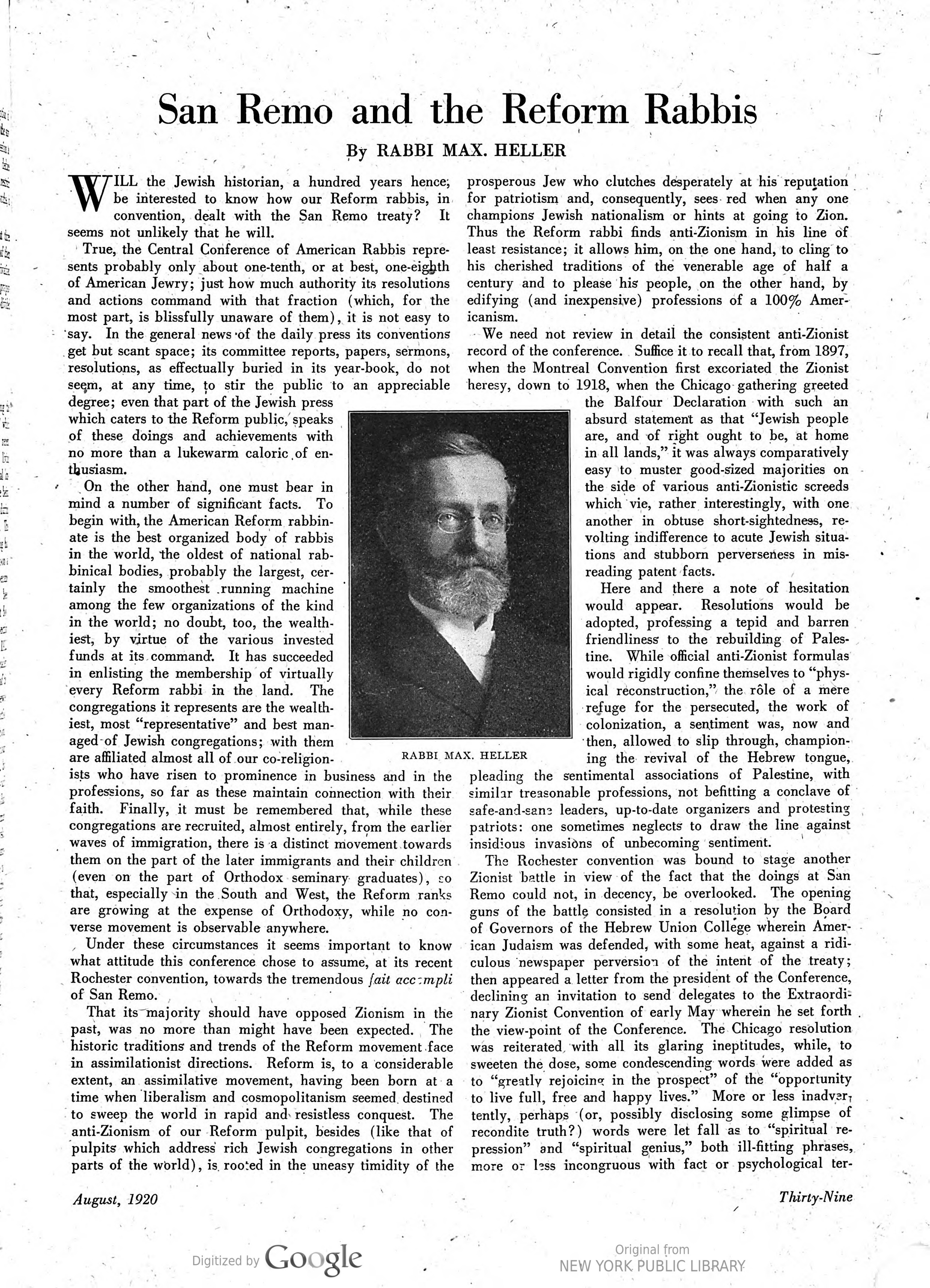
San Remo and the Reform Rabbis
WILL the Jewish historian, a hundred years hence, be interested to know how our Reform rabbis, in convention, dealt with the San Remo treaty? It seems not unlikely that he will.
True, the Central Conference of American Rabbis represents probably only about one-tenth, or at best, one-eighth of American Jewry; just how much authority its resolutions and actions command with that fraction (which, for the most part, is blissfully unaware of them), it is not easy to say. In the general news of the daily press its conventions get but scant space; its committee reports, papers, sermons, resolutions, as effectually buried in its year-book, do not seem, at any time, to stir the public to an appreciable degree; even that part of the Jewish press which caters to the Reform public, speaks of these doings and achievements with no more than a lukewarm caloric of enthusiasm.
On the other hand, one must bear in mind a number of significant facts. To begin with, the American Reform rabbin- ate is the best organized body of rabbis in the world, the oldest of national rabbinical bodies, probably the largest, certainly the smoothest running machine among the few organizations of the kind in the world; no doubt, too, the wealthiest, by virtue of the various invested funds at its command. It has succeeded in enlisting the membership of virtually every Reform rabbi in the land. The congregations it represents are the wealthiest, most “representative” and best managed of Jewish congregations; with them are affiliated almost all of our co-religionists who have risen to prominence in business and in the professions, so far as these maintain connection with their faith. Finally, it must be remembered that, while these congregations are recruited, almost entirely, from the earlier waves of immigration, there is a distinct movement towards them on the part of the later immigrants and their children (even on the part of Orthodox seminary graduates), so that, especially in the South and West, the Reform ranks are growing at the expense of Orthodoxy, while no converse movement is observable anywhere.
‚ Under these circumstances it seems important to know what attitude this conference chose to assume, at its recent Rochester convention, towards the tremendous fait acc:mpli of San Remo. ' '
That its“majority should have opposed Zionism in the past, was no more than might have been expected. The historie traditions and trends of the Reform movement face in assimilationist directions. Reform is, to a considerable extent, an assimilative movement, having been born at a time when liberalism and cosmopolitanism seemed. destined to sweep the world in rapid and: resistless conquest. The anti-Zionism of our Reform pulpit, besides (like that of pulpits which address rich Jewish congregations in other parts of the world), is. roo‘ed in the uneasy timidity of the
prosperous Jew who clutches desperately at his reputation for patriotism and, consequently, sees red when any one champions Jewish nationalism or hints at going to Zion. Thus the Reform rabbi finds anti-Zionism in his line of least resistance; it allows him, on the one hand, to cling to his cherished traditions of the venerable age of half a century and to please his people, on the other hand, by edifying (and inexpensive) professions of a 100% Americanism.
We need not review in detail the consistent anti-Zionist record of the conference. Suffice it to recall that, from 1897, when the Montreal Convention first excoriated the Zionist heresy, down to 1918, when the Chicago gathering greeted the Balfour Declaration with such an absurd statement as that "Jewish people are, and of right ought to be, at home in all lands," it was always comparatively easy to muster good-sized majorities on the side of various anti-Zionistic screeds which vie, rather interestingly, with one another in obtuse shortsightedness, revolting indifference to acute Jewish situations and stubborn perverseness in misreading patent facts.
ER NGT ra re = he Te A er ZIDE Here and there a note of hesitation AS > would appear. Resolutions would be 4 adopted, professing a tepid and barren > friendliness to the rebuilding of Pales- =: tine. While official anti-Zionist formulas ä would rigidly confine themselves to “phys- RT ical reconstruction,” the. röle of a mere ‚refuge for the persecuted, the work of nn colonization, a sentiment was, now and EEITR ‘then, allowed to slip through, champion- SL DELEER ing the. revival of the Hebrew tongue,,. pleading the sentimental associations of Palestine, with similar treasonable professions, not befitting a conclave of safe-and-san: leaders, up-to-date organizers and protesting patriots: one sometimes neglects to draw the line against insidious invasiöns of unbecoming sentiment.
The Rochester convention was bound to stage another Zionist battle in view of the fact that the doings at San Remo could not, in decency, be overlooked. The opening guns of the battle consisted in a resolution by the Board of Governors of the Hebrew Union College wherein Amer- - ican Judaism was defended, with some heat, against a ridiculous 'newspaper perversion of the intent of the treaty; then appeared a letter from the president of the Conference, “ declining an invitation to send delegates to the Extraordi: nary Zionist Convention of early May’ wherein he set forth . the viewpoint of the Conference. The Chicago resolution was reiterated, with all its glaring ineptitudes, while, to sweeten the dose, some condescending words were added as to “greatly rejoicin« in the prospect” of the “opportunity to live full, free and happy lives.” More or less inadvar; tently, perhaps (or, possibly disclosing some glimpse of recondite truth?) words were let fall as to “spiritual repression” and “spiritual genius,” both ill-fitting phrases, more or lss incongruous with fact or psychological ter-