Israel Friedlaender, Zionist and Scholar
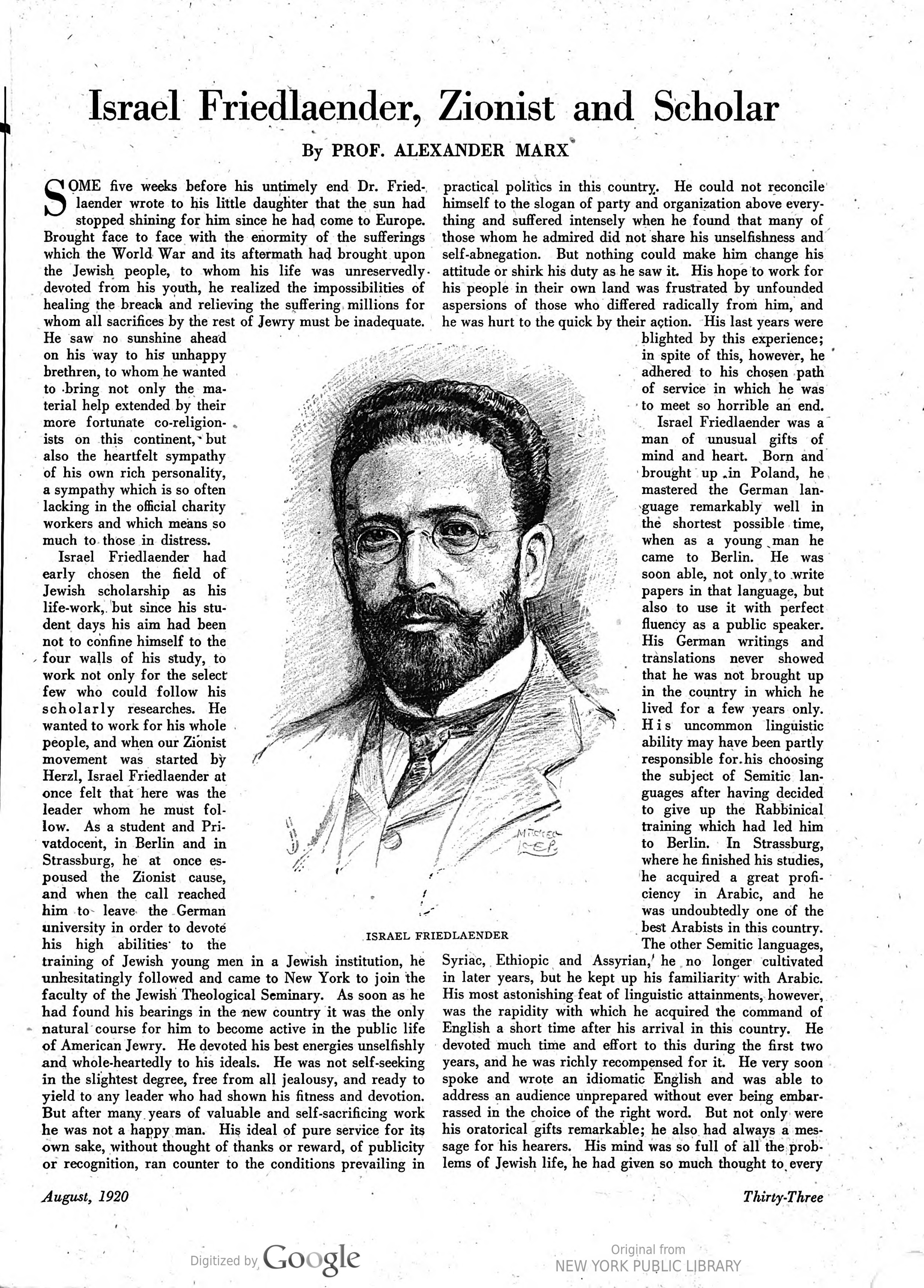
SOME five weeks before his untimely end Dr. Friedlaender wrote to his little daughter that the sun had stopped shining for him since he had come to Europe. Brought face to face with the enormity of the sufferings which the World War and its aftermath had brought upon the Jewish people, to whom his life was unreservedly devoted from his youth, he realized the impossibilities of healing the breach and relieving the suffering millions for whom all sacrifices by the rest of Jewry must be inadequate. He saw no sunshine ahead on his way to his unhappy brethren, to whom he wanted to bring not only the material help extended by their more fortunate co-religionists on this continent, but also the heartfelt sympathy of his own rich personality, a sympathy which is so often lacking in the official charity workers and which means so much to those in distress.
Israel Friedlaender had early chosen the field of Jewish scholarship as his life-work, but since his student days his aim had been not to confine himself to the four walls of his study, to work not only for the select few who could follow his scholarly researches. He wanted to work for his whole people, and when our Zionist movement was started by Herzl, Israel Friedlaender at once felt that here was the leader whom he must follow. As a student and Pri- vatdocent, in Berlin and in Strassburg, he at once es- poused the Zionist cause, and when the call reached him to leave the German university in order to devote his high abilities to the training of Jewish young men in a Jewish institution, he unhesitatingly followed and came to New York to join the faculty of the Jewish Theological Seminary. As soon as he had found his bearings in the new country it was the only natural course for him to become active in the public life of American Jewry. He devoted his best energies unselfishly and whole-heartedly to his ideals. He was not self-seeking in the slightest degree, free from all jealousy, and ready to yield to any leader who had shown his fitness and devotion. But after many years of valuable and self-sacrificing work he was not a happy man. His ideal of pure service for its own sake, without thought of thanks or reward, of publicity or recognition, ran counter to the conditions prevailing in
practical politics in this country. He could not reconcile himself to the slogan of party and organization above everything and suffered intensely when he found that many of those whom he admired did not share his unselfishness and self-abnegation. But nothing could make him change his attitude or shirk his duty as he saw it. His hope to work for his people in their own land was frustrated by unfounded aspersions of those who differed radically from him, and he was hurt to the quick by their action. His last years were
blighted by this experience; in spite of this, however, he adhered to his chosen path of service in which he was to meet so horrible an end.
.. Israel Friedlaender was a man of unusual gifts of mind and heart. Born and ‘brought up .in Poland, he mastered the German lan- ‚guage remarkably well in the shortest possible time, when as a young man he came to Berlin. He was soon able, not only,to write papers in that language, but also to use it with perfect fluency as a public speaker. His German writings and translations never showed that he was not brought up in the country in which he lived for a few years only. His uncommon linguistic ability may have been partly responsible for.his choosing the subject of Semitic languages after having decided to give up the Rabbinical training which had led him to Berlin. In Strassburg, where he finished his studies, he acquired a great proficiency in Arabic, and he was undoubtedly one of the
Fe ER Ede ee ee a ‚best Arabists in this country. ie The other Semitic languages, Syriac, Ethiopic and Assyrian,’ he no longer cultivated in later years, but he kept up his familiarity‘ with Arabic. His most astonishing feat of linguistic attainments,. however, was the rapidity with which he acquired the command of English a short time after his arrival in this country. He devoted much time and effort to this during the first two years, and he was richly recompensed for it. He very soon spoke and wrote an idiomatic English and was able to address an audience unprepared without ever being embarrassed in the choice of the right word. But not only were his oratorical gifts remarkable; he also had always a message for his hearers. His mind was so full of all the.problems of Jewish life, he had given so much thought to every