The National Builder
I SHALL never forget the impression made upon me by the demeanor of an eminent judge during the recent hearing of a notable cause.
He was a man in the prime vigor of life. His brow was serene; his eye calm, but alert; a shadow of a smile hovered around the corner of his mouth. He leaned back on the bench almost carelessly, but yet with the air of one who sees all, hears all, comprehends all.
The keenest legal minds of the country contended before him with the ardor of generals who personal welfare was bound up with a cause of grave moment. His decisions, which gave temporary advantage now to one side, now to the other, were rendered quietly—almost reposefully, yet with incisiveness and inward strength.
Surely no man whose being has taken root in the soil, in whose soul there flickers a spark of native pride, could fail to be moved by the presence of this majestic power. It was the power of the State that spoke; its cumulative wisdom, its magnanimity, its collective character. But most impressive of all, its power. For the word of the judge was recorded, its import executed, and resistance defied at peril of the exercise of armed force.
There is perhaps but one rare functionary whose presence can inspire deeper emotion. That is the statesman. For the statesman combines in his person the power of the judge with the dynamic potency of the National Builder.
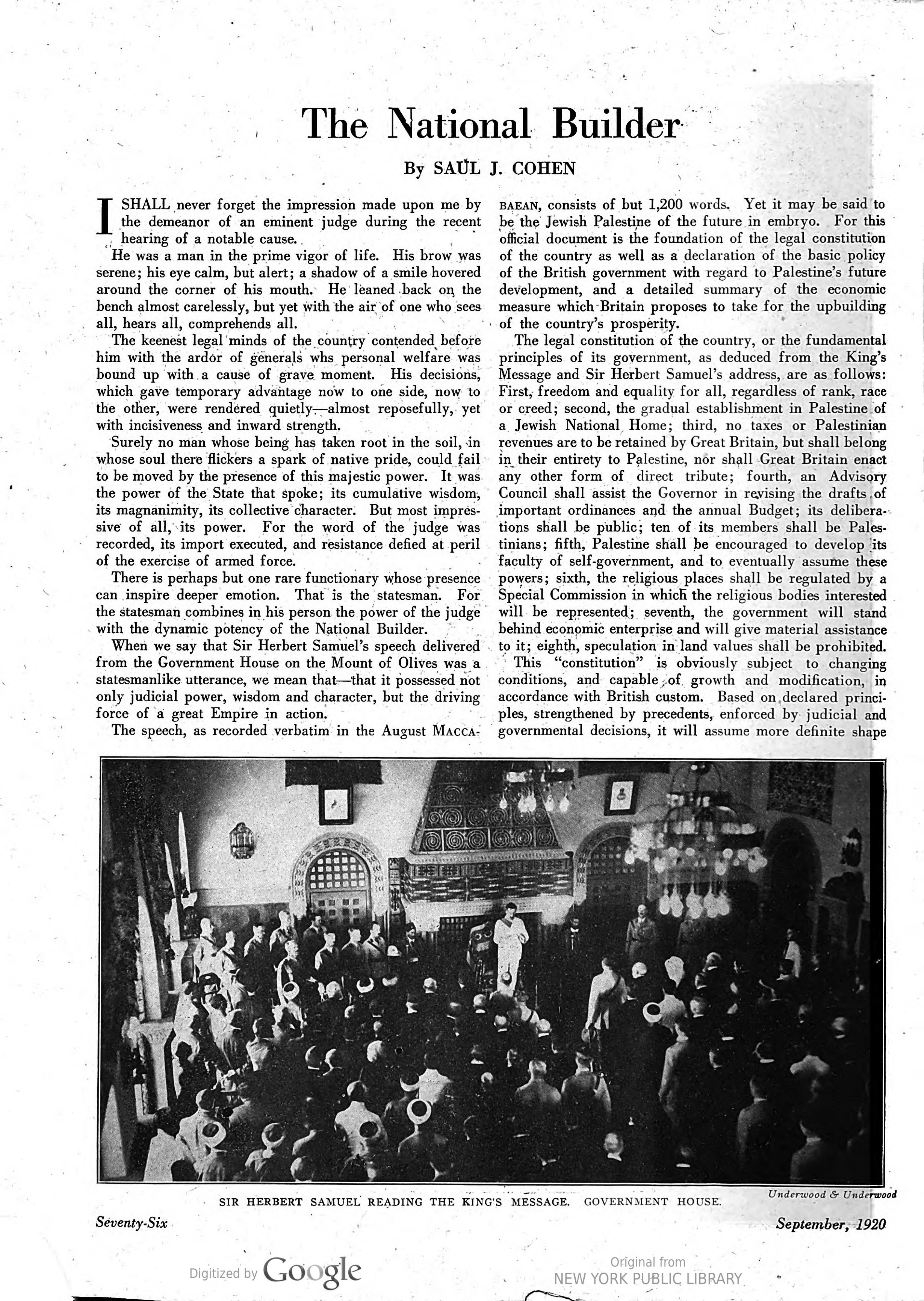
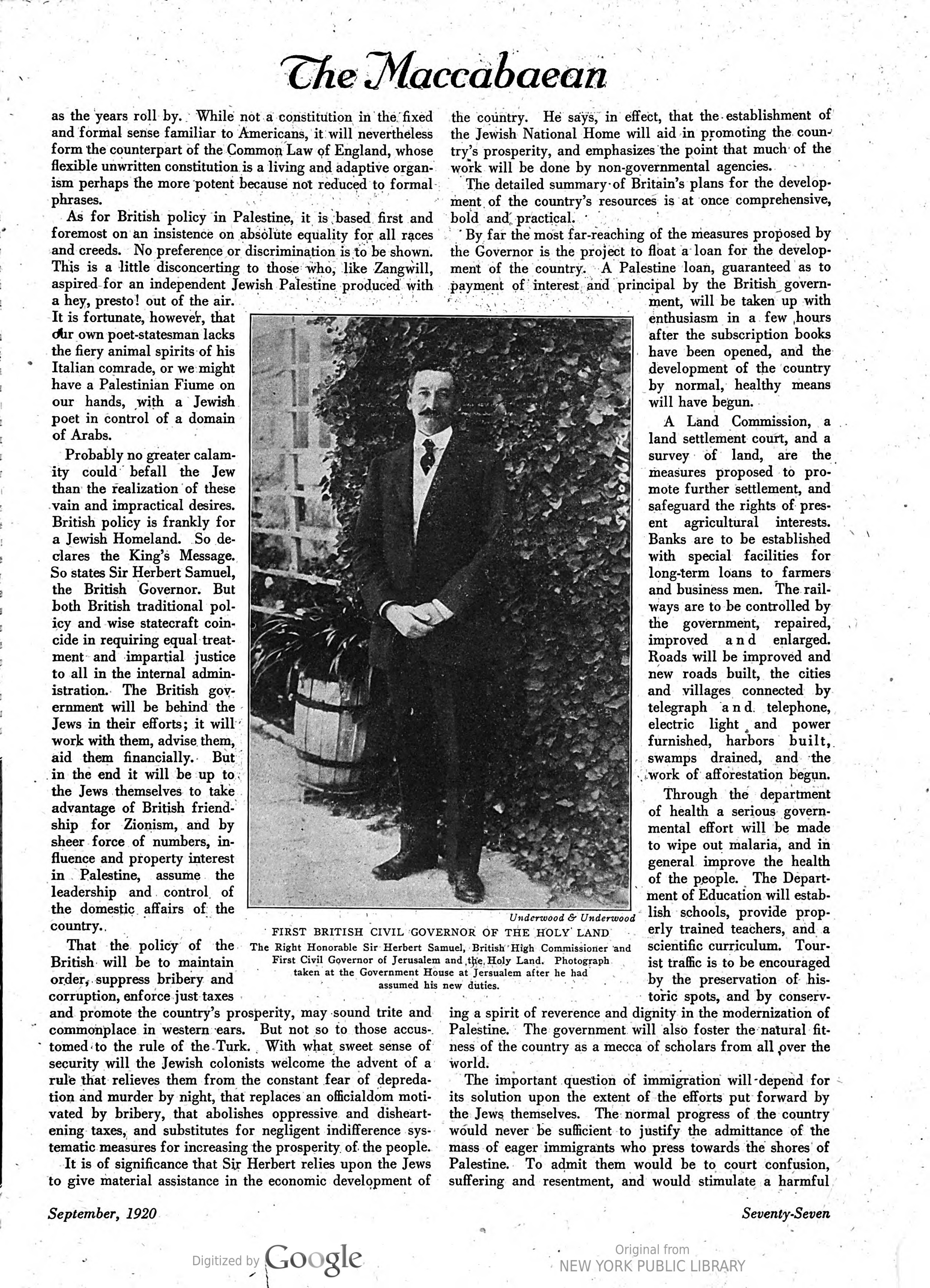
When we say that Sir Herbert Samuel's speech delivered from the Government House on the Mount of Olives was a statesmanlike utterance, we mean that—that it possessed not only judicial power, wisdom and character, but the driving force of a great Empire in action.
The speech, as recorded verbatim in the August MACCA.
BAEAN, consists of but 1,200 words. Yet it may be said to be the Jewish Palestine of the future in embryo. For this official document is the foundation of the legal constitution of the country as well as a declaration of the basic policy of the British government with regard to Palestine's future development, and a detailed summary of the economic measure which Britain proposes to take for the upbuilding of the country's prosperity.
The legal constitution of the country, or the fundamental principles of its government, as deduced from the King's Message and Sir Herbert Samuel's address, are as follows: First, freedom and equality for all, regardless of rank, race or creed; second, the gradual establishment in Palestine of a Jewish National Home; third, no taxes or Palestinian revenues are to be retained by Great Britain, but shall belong in their entirety to Palestine, nor shall Great Britain enact any other form of direct tribute; fourth, an Advisory Council shall assist the Governor in revising the drafts of important ordinances and the annual Budget; its deliberations shall be public; ten of its members shall be Palestinians; fifth, Palestine shall be encouraged to develop its faculty of self-government, and to eventually assume these powers; sixth, the religious places shall be regulated by a Special Commission in which the religious bodies interested will be represented; seventh, the government will stand behind economic enterprise and will give material assistance to it; eighth, speculation in land values shall be prohibited.
This "constitution" is obviously subject to changing conditions, and capable of growth and modification, in accordance with British custom. Based on declared principles, strengthened by precedents, enforced by judicial and governmental decisions, it will assume more definite shape
Underwood & Underwood