Harry Cutler: Zionist and Communal Worker
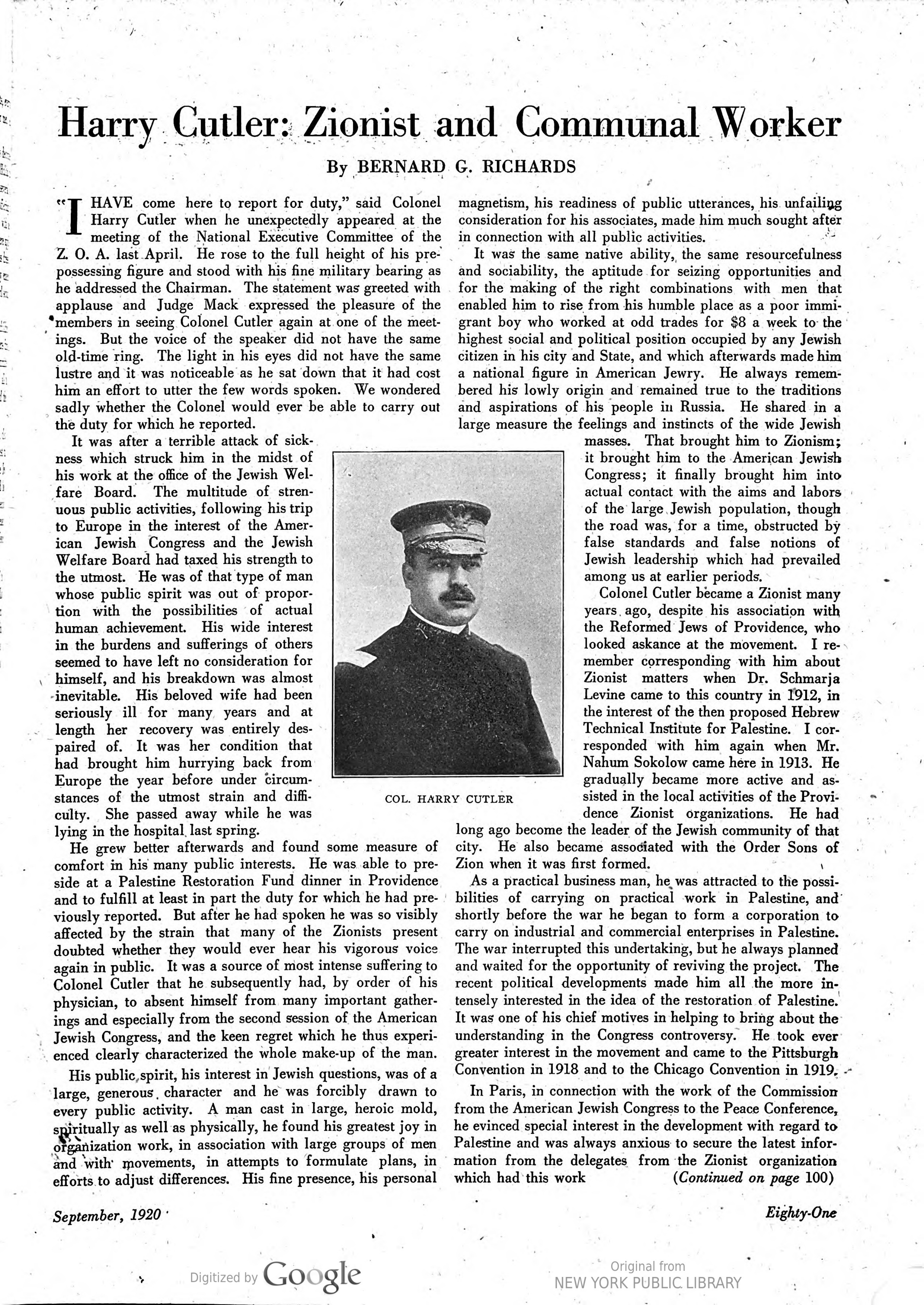
«m HAVE come here to report for duty,” said Colonel I Harry Cutler when he unexpectedly appeared at the meeting of the National Executive Committee of the Z. O. A. last.April. He rose to the full height of his pre-possessing figure and stood with his fine military bearing as he addressed the Chairman. The statement was greeted with applause and Judge Mack expressed the pleasure of the * members in seeing Colonel Cutler again at.one of the meetings. But the voice of the speaker did not have the same old-time ring. The light in his eyes did not have the same lustre and it was noticeable as he sat down that it had cost him an effort to utter the few words spoken. We wondered sadly whether the Colonel would ever be able to carry out the duty for which he reported.
It was after a terrible attack of sickness which struck him in the midst of his work at the office of the Jewish Welfare Board. The multitude of strenuous public activities, following his trip to Europe in the interest of the American Jewish Congress and the Jewish Welfare Board had taxed his strength to the utmost. He was of that type of man whose public spirit was out of proportion with the possibilities of actual human achievement. His wide interest in the burdens and sufferings of others seemed to have left no consideration for himself, and his breakdown was almost inevitable. His beloved wife had been seriously ill for many years and at length her recovery was entirely despaired of. It was her condition that had brought him hurrying back from Europe the year before under circumstances of the utmost strain and difficulty. She passed away while he was lying in the hospital last spring.
He grew better afterwards and found some measure of comfort in his many public interests. He was able to preside at a Palestine Restoration Fund dinner in Providence and to fulfill at least in part the duty for which he had previously reported. But after he had spoken he was so visibly affected by the strain that many of the Zionists present doubted whether they would ever hear his vigorous voice again in public. It was a source of most intense suffering to Colonel Cutler that he subsequently had, by order of his physician, to absent himself from many important gatherings and especially from the second session of the American Jewish Congress, and the keen regret which he thus experienced clearly characterized the whole make-up of the man.
His public spirit, his interest in Jewish questions, was of a large, generous character and he was forcibly drawn to every public activity. A man cast in large, heroic mold, spiritually as well as physically, he found his greatest joy in organization work, in association with large groups of men and with movements, in attempts to formulate plans, in efforts to adjust differences. His fine presence, his personal
magnetism, his readiness of public utterances, his unfailing consideration for his associates, made him much sought after in connection with all public activities.
It was the same native ability, the same resourcefulness and sociability, the aptitude for seizing opportunities and for the making of the right combinations with men that enabled him to rise from his humble place as a poor immigrant boy who worked at odd trades for $8 a week to the highest social and political position occupied by any Jewish citizen in his city and State, and which afterwards made him a national figure in American Jewry. He always remembered his lowly origin and remained true to the traditions and aspirations of his people in Russia. He shared in a large measure the feelings and instincts of the wide Jewish masses. That brought him to Zionism; it brought him to the American Jewish Congress; it finally brought him into actual contact with the aims and labors of the large Jewish population, though the road was, for a time, obstructed by false standards and false notions of Jewish leadership which had prevailed among us at earlier periods.
Colonel Cutler became a Zionist many years ago, despite his association with the Reformed Jews of Providence, who looked askance at the movement. I remember corresponding with him about Zionist matters when Dr. Schmarja Levine came to this country in 1912, in the interest of the then proposed Hebrew Technical Institute for Palestine. I corresponded with him again when Mr. Nahum Sokolow came here in 1913. He gradually became more active and assisted in the local activities of the Providence Zionist organizations. He had
long ago become the leader of the Jewish community of that city. He also became associated with the Order Sons of Zion when it was first formed.
As a practical business man, he was attracted to the possibilities of carrying on practical work in Palestine, and shortly before the war he began to form a corporation to carry on industrial and commercial enterprises in Palestine. The war interrupted this undertaking, but he always planned and waited for the opportunity of reviving the project. The recent political developments made him all the more intensely interested in the idea of the restoration of Palestine. It was one of his chief motives in helping to bring about the understanding in the Congress controversy. He took ever greater interest in the movement and came to the Pittsburgh Convention in 1918 and to the Chicago Convention in 1919.
In Paris, in connection with the work of the Commission from the American Jewish Congress to the Peace Conference, he evinced special interest in the development with regard to Palestine and was always anxious to secure the latest information from the delegates from the Zionist organization which had this work (Continued on pare 100)
(Continued on page 100)