Gleanings and Echoes of the Press
After the London Zionist Conference—Sir Stuart Samuel's Report and the American Press—Catholic Opposition to Zionism—Sheikh and Effendi—Rabbi Heller and theCentral Conference of American Rabbis
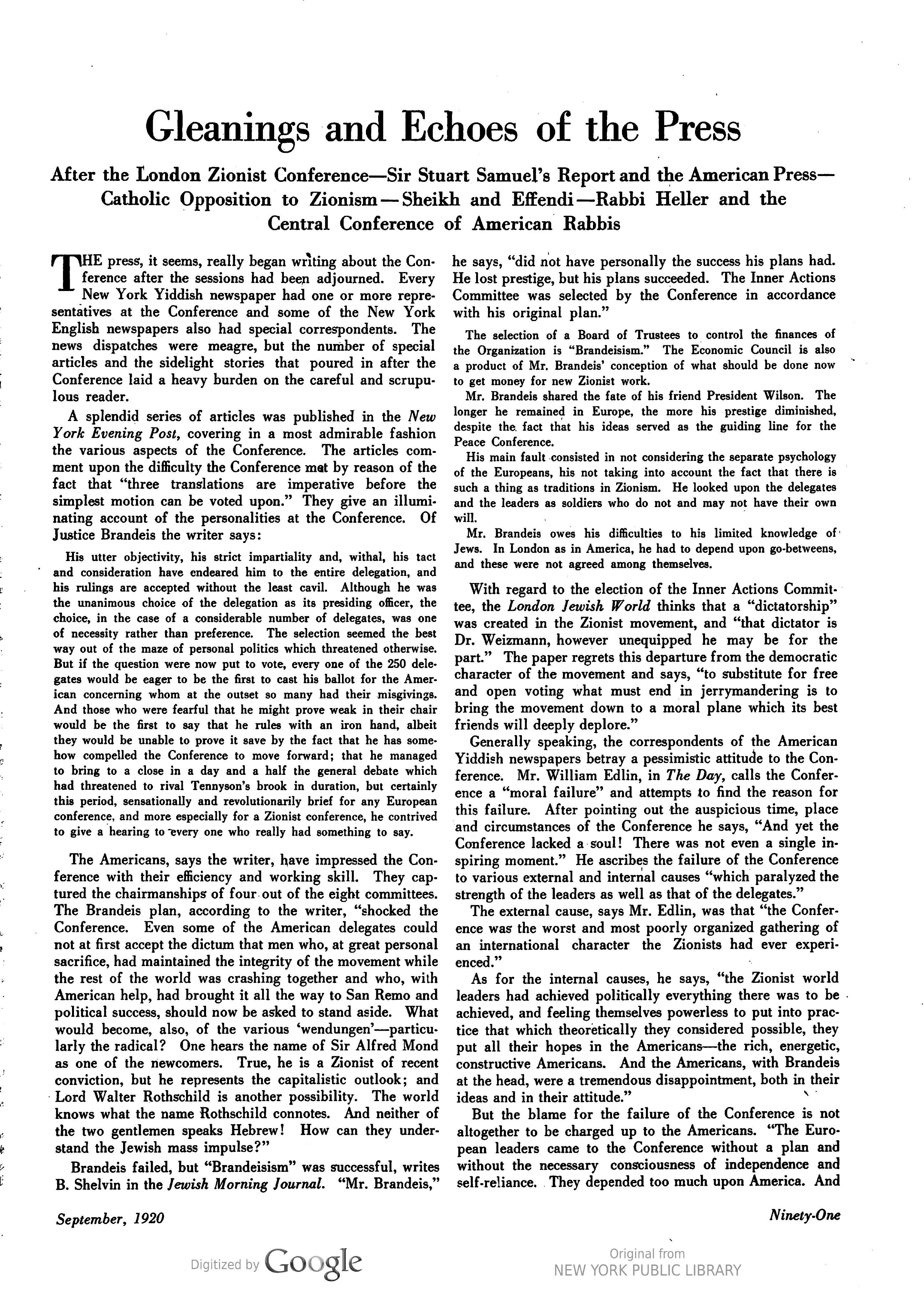
THE press, it seems, really began writing about the Conference after the sessions had been adjourned. Every New York Yiddish newspaper had one or more representatives at the Conference and some of the New York English newspapers also had special correspondents. The news dispatches were meagre, but the number of special articles and the sidelight stories that poured in after the Conference laid a heavy burden on the careful and scrupulous reader.
A splendid series of articles was published in the New York Evening Post, covering in a most admirable fashion the various aspects of the Conference. The articles comment upon the difficulty the Conference met by reason of the fact that "three translations are imperative before the simplest motion can be voted upon." They give an illuminating account of the personalities at the Conference. Of Justice Brandeis the writer says:
His utter objectivity, his strict impartiality and, withal, his tact and consideration have endeared him to the entire delegation, and his rulings are accepted without the least cavil. Although he was the unanimous choice of the delegation as its presiding officer, the choice, in the case of a considerable number of delegates, was one of necessity rather than preference. The selection seemed the best way out of the maze of personal politics which threatened otherwise. But if the question were now put to vote, every one of the 250 delegates would be eager to be the first to cast his ballot for the American concerning whom at the outset so many had their misgivings. And those who were fearful that he might prove weak in their chair would be the first to say that he rules with an iron hand, albeit they would be unable to prove it save by the fact that he has somehow compelled the Conference to move forward; that he managed to bring to a close in a day and a half the general debate which had threatened to rival Tennyson's brook in duration, but certainly this period, sensationally and revolutionarily brief for any European conference, and more especially for a Zionist conference, he contrived to give a hearing to every one who really had something to say.
The Americans, says the writer, have impressed the Conference with their efficiency and working skill. They captured the chairmanships of four out of the eight committees. The Brandeis plan, according to the writer, "shocked the Conference. Even some of the American delegates could not at first accept the dictum that men who, at great personal sacrifice, had maintained the integrity of the movement while the rest of the world was crashing together and who, with American help, had brought it all the way to San Remo and political success, should now be asked to stand aside. What would become, also, of the various 'wendungen'—particularly the radical? One hears the name of Sir Alfred Mond as one of the newcomers. True, he is a Zionist of recent conviction, but he represents the capitalistic outlook; and Lord Walter Rothschild is another possibility. The world knows what the name Rothschild connotes. And neither of the two gentlemen speaks Hebrew! How can they understand the Jewish mass impulse?"
Brandeis failed, but "Brandeisism" was successful, writes B. Shelvin in the Jewish Morning Journal. "Mr. Brandeis,"
he says, "did not have personally the success his plans had. He lost prestige, but his plans succeeded. The Inner Actions Committee was selected by the Conference in accordance with his original plan."
The selection of a Board of Trustees to control the finances of the Organization is "Brandeisism." The Economic Council is also a product of Mr. Brandeis' conception of what should be done now to get money for new Zionist work.
Mr. Brandeis shared the fate of his friend President Wilson. The longer he remained in Europe, the more his prestige diminished, despite the fact that his ideas served as the guiding line for the Peace Conference.
His main fault consisted in not considering the separate psychology of the Europeans, his not taking into account the fact that there is such a thing as traditions in Zionism. He looked upon the delegates and the leaders as soldiers who do not and may not have their own will.
Mr. Brandeis owes his difficulties to his limited knowledge of Jews. In London as in America, he had to depend upon go-betweens, and these were not agreed among themselves.
With regard to the election of the Inner Actions Committee, the London Jewish World thinks that a "dictatorship" was created in the Zionist movement, and "that dictator is Dr. Weizmann, however unequipped he may be for the part." The paper regrets this departure from the democratic character of the movement and says, "to substitute for free and open voting what must end in jerrymandering is to bring the movement down to a moral plane which its best friends will deeply deplore."
Generally speaking, the correspondents of the American Yiddish newspapers betray a pessimistic attitude to the Conference. Mr. William Edlin, in The Day, calls the Conference a "moral failure" and attempts to find the reason for this failure. After pointing out the auspicious time, place and circumstances of the Conference he says, "And yet the Conference lacked a soul! There was not even a single inspiring moment." He ascribes the failure of the Conference to various external and internal causes "which paralyzed the strength of the leaders as well as that of the delegates."
The external cause, says Mr. Edlin, was that "the Conference was the worst and most poorly organized gathering of an international character the Zionists had ever experienced."
As for the internal causes, he says, "the Zionist world leaders had achieved politically everything there was to be achieved, and feeling themselves powerless to put into practice that which theoretically they considered possible, they put all their hopes in the Americans—the rich, energetic, constructive Americans. And the Americans, with Brandeis at the head, were a tremendous disappointment, both in their ideas and in their attitude."
But the blame for the failure of the Conference is not altogether to be charged up to the Americans. "The European leaders came to the Conference without a plan and without the necessary consciousness of independence and self-reliance. They depended too much upon America. And