The Land and the People
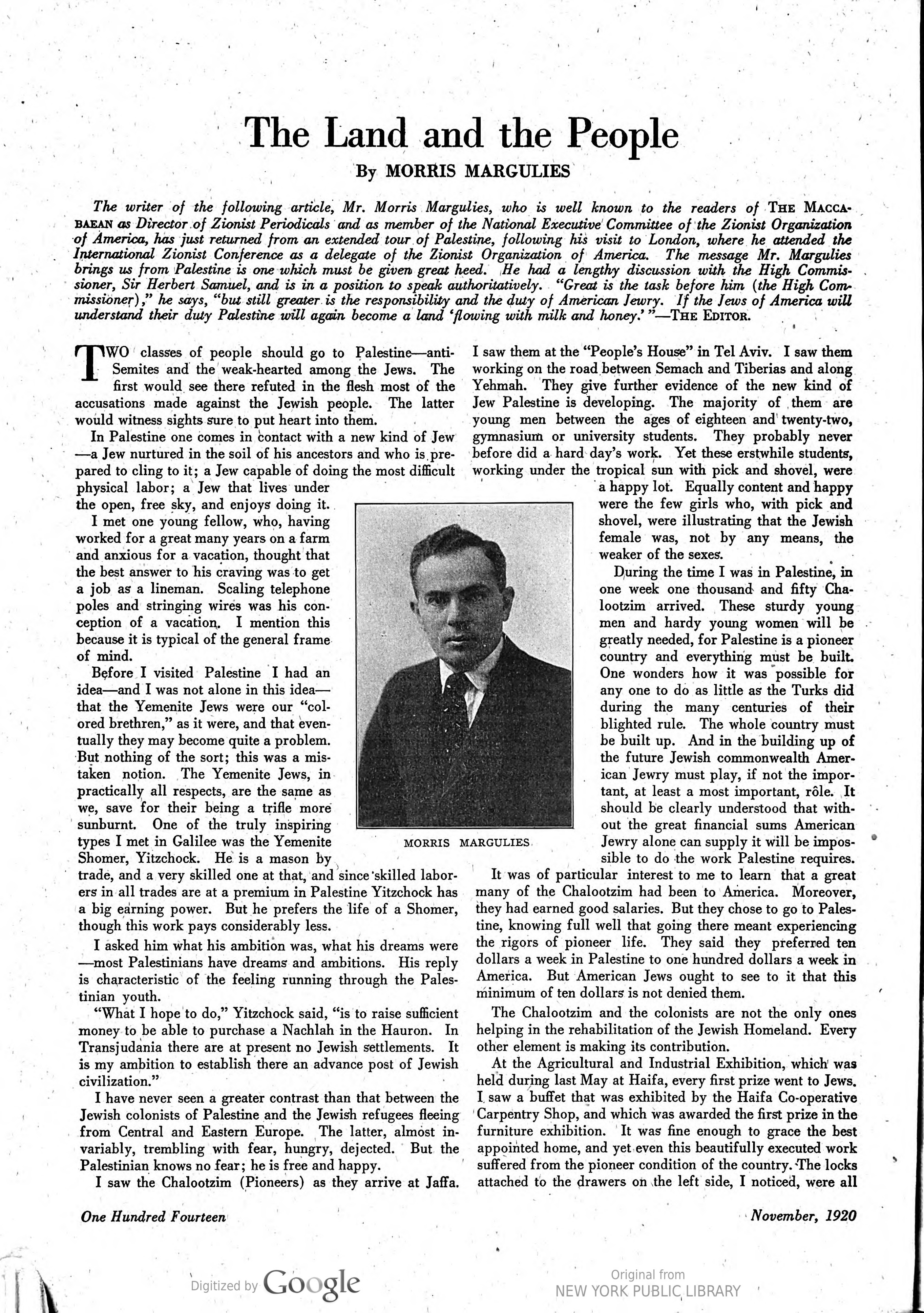
The writer of the following article, Mr. Morris Margulies, who is well known to the readers of THE MACCABAEAN as Director of Zionist Periodicals and as member of the National Executive Committee of the Zionist Organization of America, has just returned from an extended tour of Palestine, following his visit to London, where he attended the International Zionist Conference as a delegate of the Zionist Organization of America. The message Mr. Margulies brings us from Palestine is one which must be given great heed. He had a lengthy discussion with the High Commissioner, Sir Herbert Samuel, and is in a position to speak authoritatively. "Great is the task before him (the High Commissioner)," he says, "but still greater is the responsibility and the duty of American Jewry. If the Jews of America will understand their duty Palestine will again become a land 'flowing with milk and honey.'"—THE EDITOR.
TWO classes of people should go to Palestine—anti-Semites and the weak-hearted among the Jews. The first would see there refuted in the flesh most of the accusations made against the Jewish people. The latter would witness sights sure to put heart into them.
In Palestine one comes in contact with a new kind of Jew—a Jew nurtured in the soil of his ancestors and who is prepared to cling to it; a Jew capable of doing the most difficult physical labor; a Jew that lives under the open, free sky, and enjoys doing it.
I met one young fellow, who, having worked for a great many years on a farm and anxious for a vacation, thought that the best answer to his craving was to get a job as a lineman. Scaling telephone poles and stringing wires was his conception of a vacation. I mention this because it is typical of the general frame of mind.
Before I visited Palestine I had an idea—and I was not alone in this idea—that the Yemenite Jews were our "colored brethren," as it were, and that eventually they may become quite a problem. But nothing of the sort; this was a mistaken notion. The Yemenite Jews, in practically all respects, are the same as we, save for their being a trifle more sunburnt. One of the truly inspiring types I met in Galilee was the Yemenite Shomer, Yitzchock. He is a mason by trade, and a very skilled one at that, and since skilled laborers in all trades are at a premium in Palestine Yitzchock has a big earning power. But he prefers the life of a Shomer, though this work pays considerably less.
I asked him what his ambition was, what his dreams were—most Palestinians have dreams and ambitions. His reply is characteristic of the feeling running through the Palestinian youth.
"What I hope to do," Yitzchock said, "is to raise sufficient money to be able to purchase a Nachlah in the Hauron. In Transjudania there are at present no Jewish settlements. It is my ambition to establish there an advance post of Jewish civilization."
I have never seen a greater contrast than that between the Jewish colonists of Palestine and the Jewish refugees fleeing from Central and Eastern Europe. The latter, almost invariably, trembling with fear, hungry, dejected. But the Palestinian knows no fear; he is free and happy.
I saw the Chalootzim (Pioneers) as they arrive at Jaffa.
I saw them at the "People's House" in Tel Aviv. I saw them working on the road between Semach and Tiberias and along Yehmah. They give further evidence of the new kind of Jew Palestine is developing. The majority of them are young men between the ages of eighteen and twenty-two, gymnasium or university students. They probably never before did a hard day's work. Yet these erstwhile students, working under the tropical sun with pick and shovel, were a happy lot. Equally content and happy were the few girls who, with pick and shovel, were illustrating that the Jewish female was, not by any means, the weaker of the sexes.
During the time I was in Palestine, in one week one thousand and fifty Chalootzim arrived. These sturdy young men and hardy young women will be greatly needed, for Palestine is a pioneer country and everything must be built. One wonders how it was possible for any one to do as little as the Turks did during the many centuries of their blighted rule. The whole country must be built up. And in the building up of the future Jewish commonwealth American Jewry must play, if not the important, at least a most important, rôle. It should be clearly understood that without the great financial sums American Jewry alone can supply it will be impossible to do the work Palestine requires.
It was of particular interest to me to learn that a great many of the Chalootzim had been to America. Moreover, they had earned good salaries. But they chose to go to Palestine, knowing full well that going there meant experiencing the rigors of pioneer life. They said they preferred ten dollars a week in Palestine to one hundred dollars a week in America. But American Jews ought to see to it that this minimum of ten dollars is not denied them.
The Chalootzim and the colonists are not the only ones helping in the rehabilitation of the Jewish Homeland. Every other element is making its contribution.
At the Agricultural and Industrial Exhibition, which' was held during last May at Haifa, every first prize went to Jews. I saw a buffet that was exhibited by the Haifa Co-operative 'Carpentry Shop, and which was awarded the first prize in the furniture exhibition. It was fine enough to grace the best appointed home, and yet,even this beautifully executed work suffered from the pioneer condition of the country. The locks attached to the drawers on the left side, I noticed, were all