The Maccabaean
that happened in Eastern Europe during the last few years, Schiff, unlike many Jews of wealth and power, who seem to care not what happens to their broken, starving brother Jews in Eastern Europe, thought of his brothers, pitied them, cared for them and finally came to the point of view that only such solution of the Jewish question could be considered as was acceptable to them who bore the burden of the world's injustice. In his later years, Schiff came to understand that no American Jew had the right to say to East European Jew, "Here you must stay," or, "Here you must go." The spirit of democracy had so touched him that he came to understand that the Jews of Poland and other East European countries had the right to determine for themselves whether they wished to be self-respecting upbuilders of the Jewish Homeland or remain broken and crushed victims of Polish pogromism, and that this matter was to be decided by them primarily and by us in counsel with them, and not by the Central Conference of American Rabbis meeting at Rochester or by the Union of American Hebrew Congregations meeting in Boston.
Schiff was one of a very small company of American Jews who within the last ten years had come to see that a completely democratic order must be installed in the direction of American-Jewish affairs: that the time had come for American Jews to take their affairs into their own hands, and that no man or group of men were privileged to appoint them-
selves as the controllers or rulers of American Israel; that American Israel had come to be mature and erect and self-determining; that it must choose its own leaders, and that only the leaders by it chosen could truly lead and greatly serve American Israel.
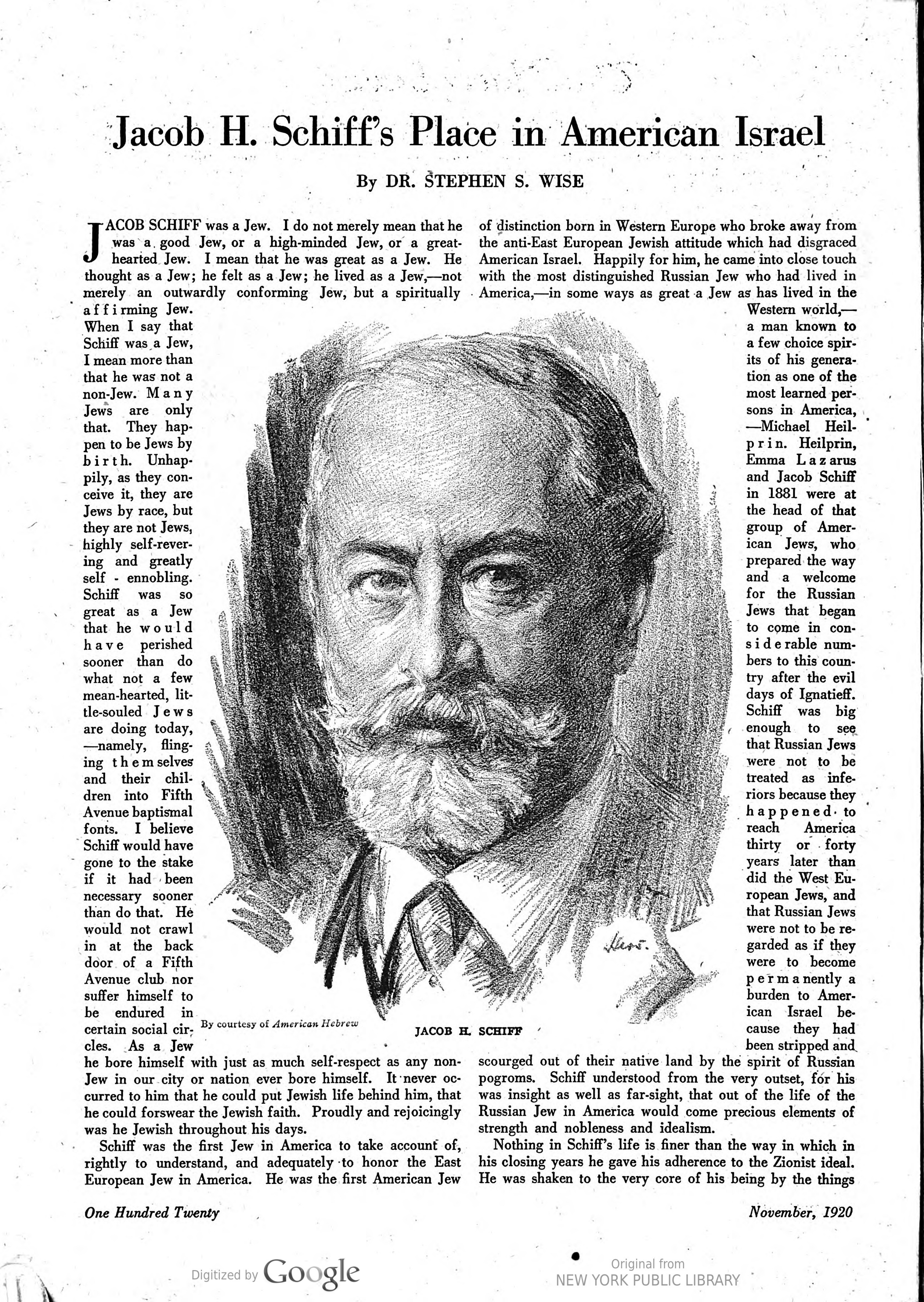
Schiff was a great Jew in that he gave not only of his possessions but of himself; that he gave more than his millions,—namely, his heart,—that Jewish heart which bled over the sorrows and tragedies of his people. A man who gives himself, his mind, his heart, his sympathy, his devotion, gives all. This Schiff did.
No man can take his place. No man ought to dream of filling his place,—that place which Schiff sought not, that place of power which was forced upon him not only by reason of his deserving and his devotion, but in very large part because the fewest American Jews of wealth and power are truly and greatly concerned, as Schiff was concerned, about the well-being of the Jewish people.
Schiff is gone, and with him passes the Schiff era. The fittest way in which to honor him is not to name his successor or successors. The fittest way in which to honor Schiff were that all American Jews solemnly resolve that no man shall be compelled nor permitted to bear the whole burden of his people, and that all Jews give of themselves, of their possessions and of their uttermost devotion for the sake of the security and the honor of their people.
Commandante Bianchini
IT is with the very deepest regret that we have to record the death of Commandante Bianchini, of the Italian navy. Commandante Bianchini was murdered by Beduin in a train near Deraa, apparently (though this is not certain) at the same time as the Syrian Ministers. His presence in the train with them was accidental. He was in command of a squadron in the Eastern Mediterranean, and doubtless, as an expert in Near Eastern affairs, was seeking to inform himself by personal investigation. Commandante Bianchini was one of the most brilliant of Italian naval officers. He had a notable part in saving Venice from an Austrian attack during the war; he had been one of the chief Intelligence officers; he was one of the most distinguished teachers in the naval school, and he was editor of the Official Naval Review. He held the highest decorations for valour, and he was about to be raised to Admiral's rank. It may be assumed that the Italian Government will demand punishment and reparation, and the murder raises the whole question of responsibility for peace and good government in the Hauran, a question which is not settled by Sir Herbert Samuel's action in Trans-Jordania. It brings
up in a tragic fashion the urgency of a proper delimitation of the Northern and Northeastern frontiers of Palestine.
Commandante Bianchini was not only a brilliant naval officer, he was a scholar and an idealist. He was the master of several languages, including English, French, and German, and by hard application he had acquired in Palestine a sound knowledge of modern Hebrew. He went to Palestine as member of the Zionist Commission, on which he represented Italian Jewry, and of which for a time he acted as Chairman. His services to the cause of a Jewish Palestine were of the highest value, and he was one of those of whom much was expected in the future—a man of exact knowledge, an organizer, one gifted with the conceiving of large ideas, the simplification of multitudinous details and the art of winning his fellows. It will be impossible to replace him. He will take his place with Sir Mark Sykes and Aaron Aaronson as among the heaviest losses which the Jewish National Cause has suffered since the armistice. We tender to Commandante Bianchini's widow and mother our respectful sympathy in their terrible bereavement, which follows close upon the accidental death during the war of a beloved daughter and grandchild.