The Maccabaean
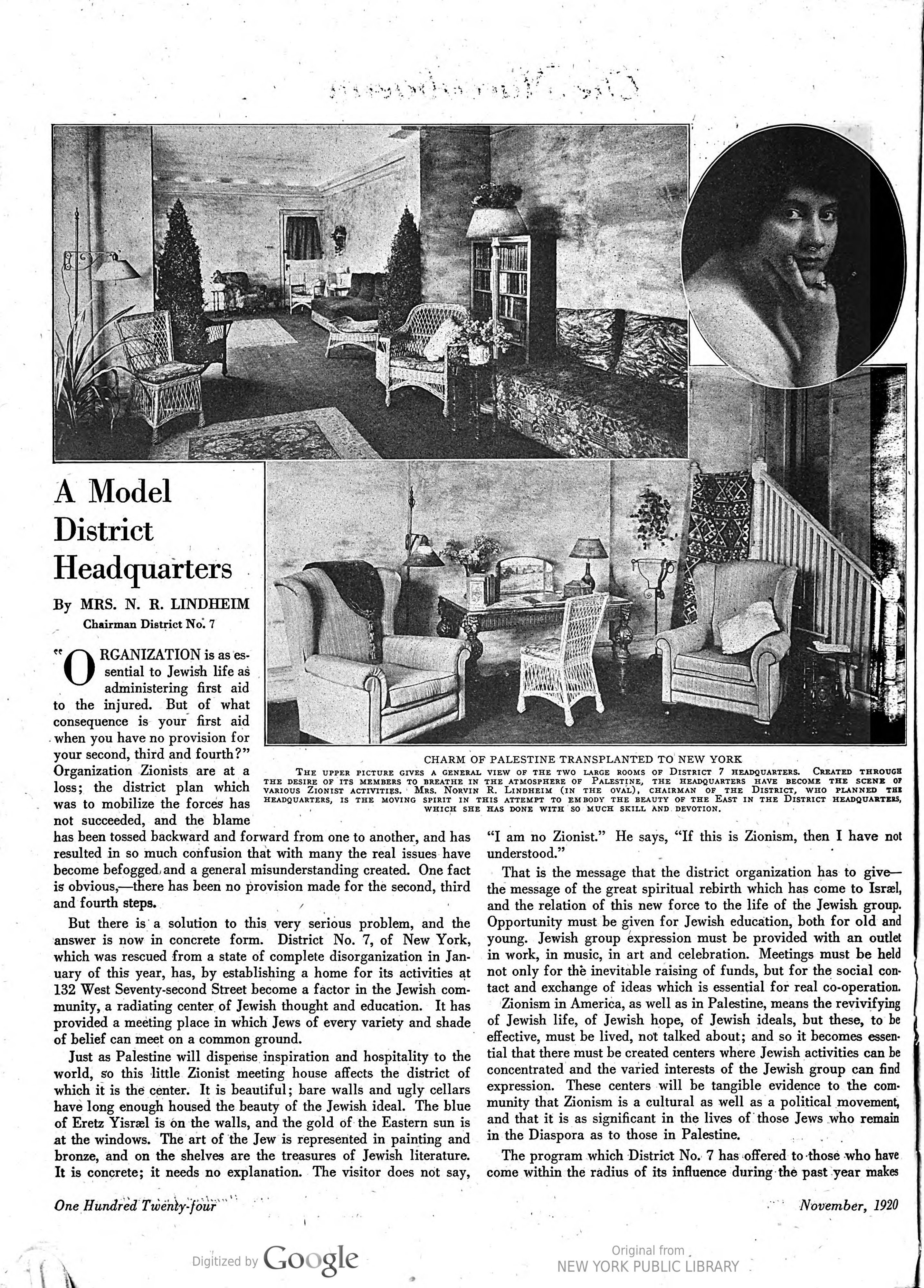
it quite unnecessary to argue this point—the fact is self-evident. Every Sunday afternoon a group of young college men and women gathered at the District Headquarters to hear some speakers of note deliver an address upon a subject which directly or indirectly had bearing upon the Jewish problem. This made the topics chosen all inclusive, which does not affect the problem of the Jew. The address, which was preceded by tea and a social hour, was followed by general discussion, which proved by its aliveness that the Jewish youth has not kept away from the Jewish subjects because of a lack of interest, but because of the lack of opportunity to become an integral part of the work which was to effect a new order of things. Some of the speakers who addressed the Sunday forums were Norman Hapgood, Prof. Horace Kallen, M. E. Ravage, Dr. Joseph Krimsky, Capt. Robert Rosenbluth, Dr. Turoff, Dr. A. A. Berle and many others, each coming with his special message and opening new vistas of thought to those who heard him.
On Sunday evenings, at the District Headquarters, Dr. Mordecai M. Kaplan conducted a Seminar for a group of forty or fifty, on "The Relation of Judaism to Modern Thought." Those who attended these talks saw the dawn of a new day dispelling the darkness of indifference which has hidden the horizon for so long a period.
On Saturday mornings a group of young children have been meeting to learn the history of the Jews. For the first time, they were made to feel the spirit of the Sabbath, because the little ones who attended were chiefly from homes whose affiliation with the Jewish group has not been strong. The enthusiasm displayed by the children and their interest in their work was so real that in the coming year there will be many groups instead of one. The value of the knowledge which the children have received has so influenced their parents that they have become members of the Organization.
During the week, groups meet almost daily, sometimes just for a social hour, sometimes for debate, and then again, to listen to those who have recently returned from
Palestine and who are able to give new inspiration and understanding.
Once the group is awakened to the realization of the future in the light of the knowledge of the past, the listeners will become the workers and when that day comes and they ask "How may we help?" the District Organization must have the answer ready. To make it possible for each and every one to have the opportunity to contribute the benefits of his special training, there should be organized within the district social and vocational unit groups, these groups to combine with the groups of other districts to consider the problems for which their training has fitted them; doctors to work on plans for the sanitation and health of Palestine so that through their experience costly and unnecessary mistakes may be avoided, and ideal conditions created from the outset; Rabbis and educators to work out programs which may be developed for use in America as well as in Eretz Yisrael; social workers who have tried to relieve some of the suffering caused by a maladjusted social order, to work with the economist and sociologist to lay a foundation which will insure justice and happiness in the new commonwealth, and business men to consider the raising of the large sums which are needed for the actual realization of the dream.
The realization of the extension of this plan to all districts, as it has been worked out in District No. 7, would mean that the Zionist Organization would become a great working force. Representatives of the district groups would also be represented in the National Organization, and so a unity of purpose would be created which would make possible the great results which all desire.
The district should be autonomous and self-supporting, a center or club financed by membership dues, each member paying in proportion to his means so that the member who pays $1 or $1,000 should have the same privileges.
"May we prove ourselves worthy of this great opportunity." The first stage of Zionism is past; the second is here. The political framework is finished; the walls must be built and made beautiful. May the structure prove worthy of the soul it will house!
Kosl Maarovi
It guards no palaced city,It has no steel-clad gate;More than a thousand treasures,It guards a people's fate.
Who dreams of it at twilightSees not the stones and sod;He sees a burnished Temple,An altar lit for God.
He sees the white priests walkingBefore a praying throng.
While conquering soldiers lift their swordsWith rich and pausing song.
He sees—no more the Temple,But old men stooped and gray,In whose worn eyes the years of tearsWashed all but dreams away.
Like moss upon a tombstone,About the Wall they cling . . .. . . Is it Shekinah on them?And do they weep, or sing?