Justice Brandeis' Proposed Palestine Policy
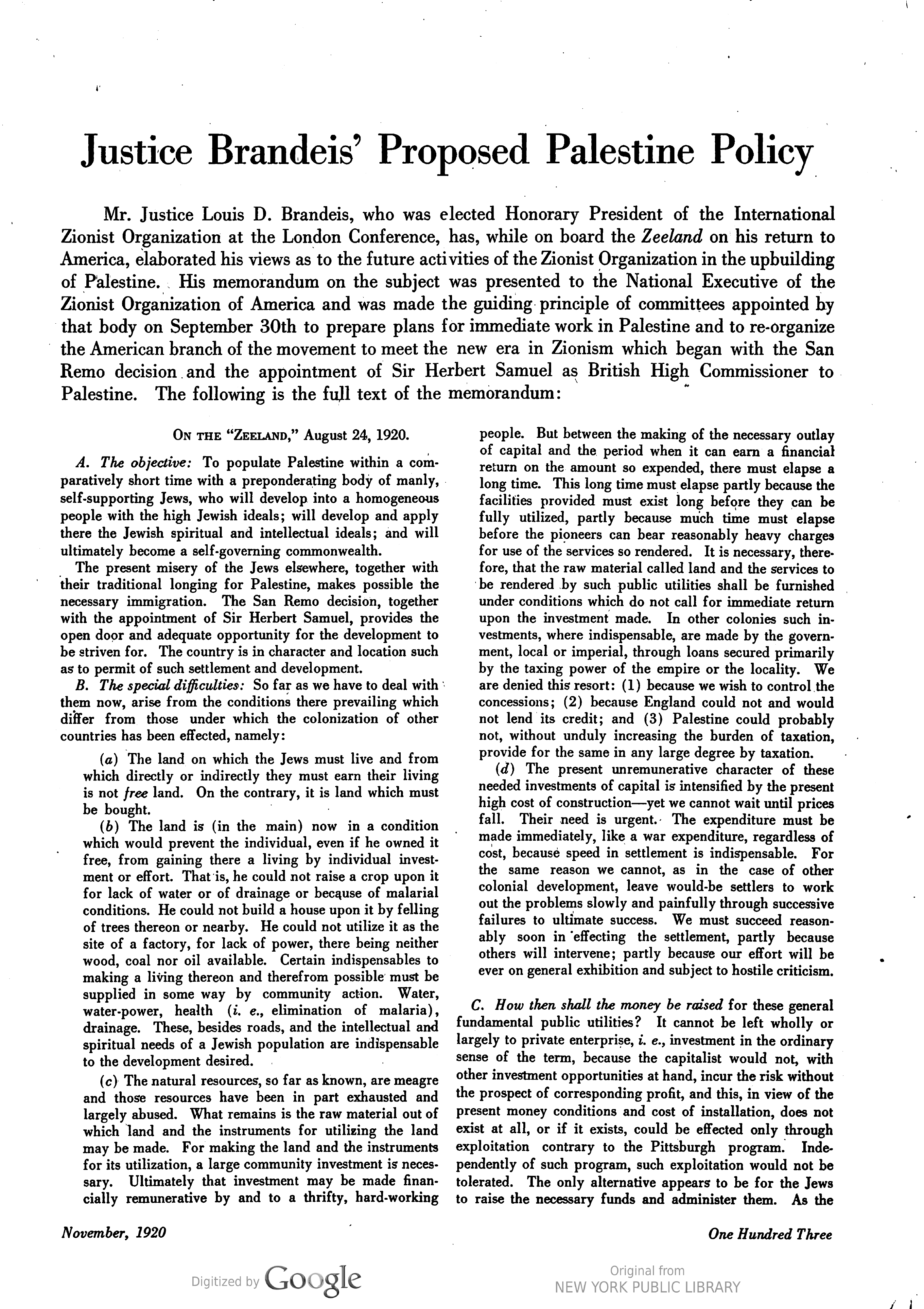
Mr. Justice Louis D. Brandeis, who was elected Honorary President of the International Zionist Organization at the London Conference, has, while on board the Zeeland on his return to America, elaborated his views as to the future activities of the Zionist Organization in the upbuilding of Palestine. His memorandum on the subject was presented to the National Executive of the Zionist Organization of America and was made the guiding principle of committees appointed by that body on September 30th to prepare plans for immediate work in Palestine and to reorganize the American branch of the movement to meet the new era in Zionism which began with the San Remo decision and the appointment of Sir Herbert Samuel as British High Commissioner to Palestine. The following is the full text of the memorandum:
A. The objective: To populate Palestine within a comparatively short time with a preponderating body of manly, self-supporting Jews, who will develop into a homogeneous people with the high Jewish ideals; will develop and apply there the Jewish spiritual and intellectual ideals; and will ultimately become a self-governing commonwealth.
The present misery of the Jews elsewhere, together with their traditional longing for Palestine, makes possible the necessary immigration. The San Remo decision, together with the appointment of Sir Herbert Samuel, provides the open door and adequate opportunity for the development to be striven for. The country is in character and location such as to permit of such settlement and development.
B. The special difficulties: So far as we have to deal with them now, arise from the conditions there prevailing which differ from those under which the colonization of other countries has been effected, namely:
(a) The land on which the Jews must live and from which directly or indirectly they must earn their living is not free land. On the contrary, it is land which must be bought.
(b) The land is (in the main) now in a condition which would prevent the individual, even if he owned it free, from gaining there a living by individual investment or effort. That is, he could not raise a crop upon it for lack of water or of drainage or because of malarial conditions. He could not build a house upon it by felling of trees thereon or nearby. He could not utilize it as the site of a factory, for lack of power, there being neither wood, coal nor oil available. Certain indispensables to making a living thereon and therefrom possible must be supplied in some way by community action. Water, water-power, health (i. e., elimination of malaria), drainage. These, besides roads, and the intellectual and spiritual needs of a Jewish population are indispensable to the development desired.
(c) The natural resources, so far as known, are meagre and those resources have been in part exhausted and largely abused. What remains is the raw material out of which land and the instruments for utilizing the land may be made. For making the land and the instruments for its utilization, a large community investment is necessary. Ultimately that investment may be made financially remunerative by and to a thrifty, hard-working
people. But between the making of the necessary outlay of capital and the period when it can earn a financial return on the amount so expended, there must elapse a long time. This long time must elapse partly because the facilities provided must exist long before they can be fully utilized, partly because much time must elapse before the pioneers can bear reasonably heavy charges for use of the services so rendered. It is necessary, therefore, that the raw material called land and the services to be rendered by such public utilities shall be furnished under conditions which do not call for immediate return upon the investment made. In other colonies such investments, where indispensable, are made by the government, local or imperial, through loans secured primarily by the taxing power of the empire or the locality. We are denied this resort: (1) because we wish to control the concessions; (2) because England could not and would not lend its credit; and (3) Palestine could probably not, without unduly increasing the burden of taxation, provide for the same in any large degree by taxation.
(d) The present unremunerative character of these needed investments of capital is intensified by the present high cost of construction—yet we cannot wait until prices fall. Their need is urgent. The expenditure must be made immediately, like a war expenditure, regardless of cost, because speed in settlement is indispensable. For the same reason we cannot, as in the case of other colonial development, leave would-be settlers to work out the problems slowly and painfully through successive failures to ultimate success. We must succeed reasonably soon in effecting the settlement, partly because others will intervene; partly because our effort will be ever on general exhibition and subject to hostile criticism.
C. How then shall the money be raised for these general fundamental public utilities? It cannot be left wholly or largely to private enterprise, i. e., investment in the ordinary sense of the term, because the capitalist would not, with other investment opportunities at hand, incur the risk without the prospect of corresponding profit, and this, in view of the present money conditions and cost of installation, does not exist at all, or if it exists, could be effected only through exploitation contrary to the Pittsburgh program. Independently of such program, such exploitation would not be tolerated. The only alternative appears to be for the Jews to raise the necessary funds and administer them. As the